
Axios Markets

March 09, 2026

👋 Welcome back. We lost an hour, but we gained more uncertainty.
📈 Oil prices surged overnight, and stock futures are down this morning. Today, we dig into the psychology behind these moves and look at Dubai, which faces its first big test in its role as a safe haven for the global elite.
Let's get into it. All in 1,260 words, a 5 minute read.
1 big thing: Fear sets in


The Iran war intensified over the weekend, and markets took notice.
Why it matters: A surge in crude oil prices now risks the entire global economy, and investor psychology is adjusting accordingly.
The latest: Markets in the U.S. are waking up to what looks like a prolonged conflict, long the dreaded outcome.
- The price of benchmark Brent crude oil soared overnight, hitting $119.50 a barrel before falling to around $104 after the Financial Times reported the G7 nations are considering releasing crude oil from their strategic reserves.
- That news, and a move from Saudi Arabia to offer a rare spot sale off a supertanker near Taiwan, stemmed the spike.
Friction point: Sentiment has clearly shifted. Investors, notably in the U.S., were optimistic and looking "for the war to end in a matter of days," Jefferies chief European economist Mohit Kumar wrote in a note this morning.
- "There was a sense of complacency around the geopolitical impact." With the war in its second week, investors are reassessing positions, he said.
- "We have to admit that events of the weekend suggest that the war could last longer than our initial assessment."
Reality check: Even as markets face a massive oil shock, U.S. stocks are just slightly off their record highs.
What they're saying: President Trump tried to play down the spike in oil. "Short term oil prices, which will drop rapidly when the destruction of Iran nuclear threat is over, is a very small price to pay for U.S.A. and World, Safety and Peace," he posted on Truth Social.
- Over the weekend White House officials argued the market is moving on fear versus reduced supply. Is there a difference at this point?
Zoom out: Yes, markets are reacting to real-world disruptions: a strangled Strait of Hormuz, halted production and strikes on fuel storage.
- But the Strait has been effectively closed now for a week, Robin Brooks, senior fellow at the Brookings Institution, noted this morning.
- The moves last night were "entirely psychological," he wrote. "Markets are weighing the closure against how quickly oil tanker traffic can restart and on what scale. That's the kind of thing that can change on a dime."
2. A big test for Dubai
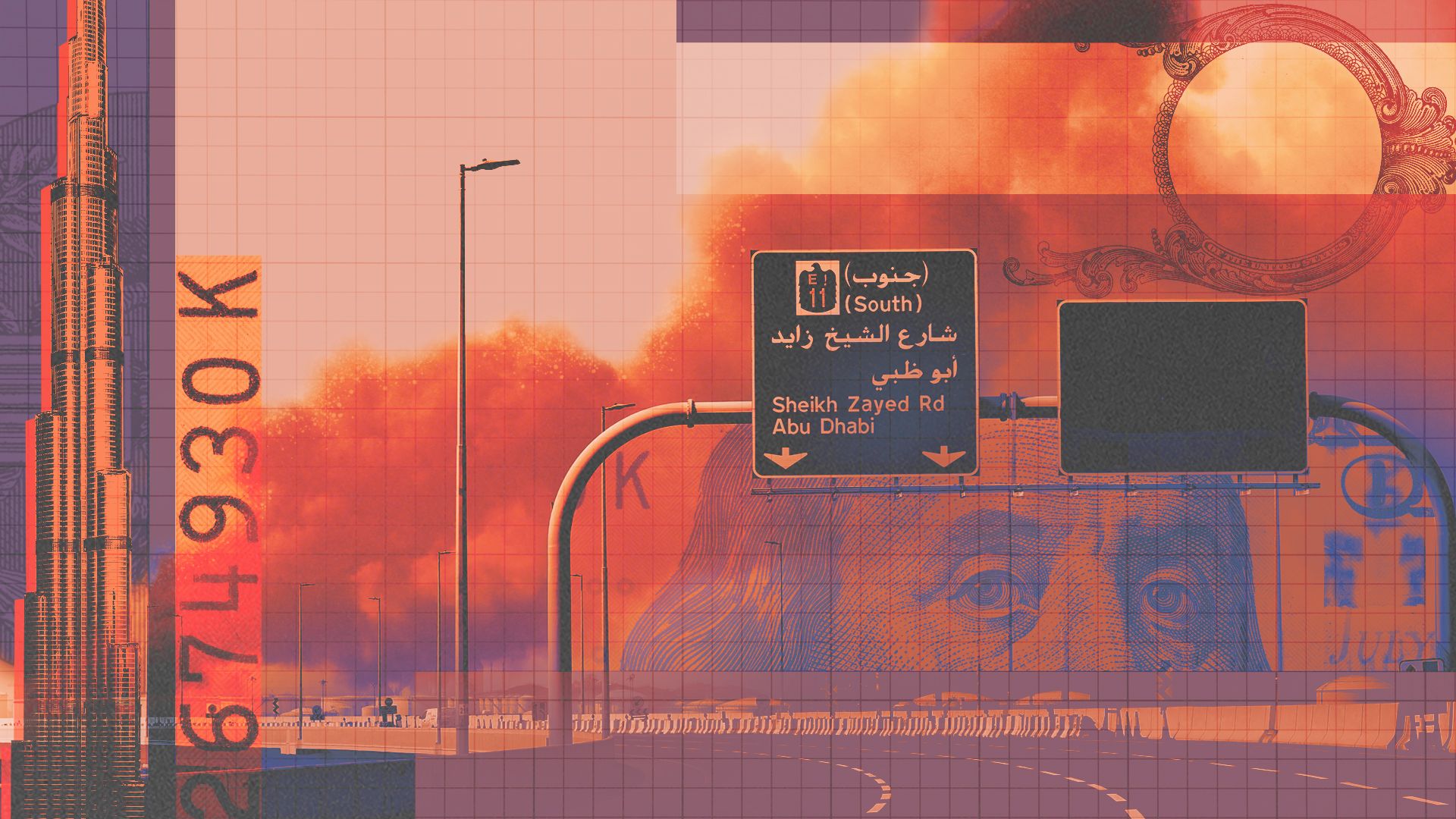
The role of Dubai as a global finance hub and favored landing spot for the global elite faces its first big test in the Iran war.
The big picture: Dubai is the flagship city of oil power United Arab Emirates, but the war is fueling economic repercussions well beyond energy.
- Along with its neighbors Qatar and Saudi Arabia, the Emirates spent years diversifying away from oil, using trillion of dollars in sovereign wealth to grease the wheels of global finance.
The latest: Asia's richest families are reconsidering their exposure, Bloomberg reported this morning, with some rethinking their relocation plans or ways to scale back investments.
Zoom in: Dubai was probably most successful in its rebrand, not only in terms of investing from abroad, but in drawing the super rich to settle there with the promise of no taxes — not on income or capital gains or inheritances — and exceptional safety. (The city is so well known it has virality via chocolate.)
- Until now, the city was seen as a great place for the wealthy to set up family offices to manage their money.
Between the lines: "Dubai has not itself been a target before," says Karen Young, a senior fellow at the Middle East Institute. "That's what's new and different."
- The city is known for ultra-low crime rates. People leave cars and homes unlocked. But now there's danger overhead.
By the numbers: Nearly 10,000 millionaires moved to Dubai last year, along with $63 billion in wealth, per data from Henley & Partners, an advisory firm for ultra-high-net-worth individuals.
- The Dubai International Financial Centre has 120 family offices collectively managing assets valued at roughly $1.2 trillion.
Zoom out: Dubai has become the place where a lot of deals and investments involving Persian Gulf sovereign wealth get done, and the number of hedge funds with offices in the city doubled last year.
- Even while M&A dealmaking fell globally last year, it rose in these Middle Eastern countries, which invested billions of dollars in AI, data centers and other technology.
Where it stands: The rich are trying to leave town, scared of Iranian attacks.
The other side: There are some rich folks clamoring to get back into Dubai to avoid big tax bills for violating residency rules, the Financial Times reported.
Reality check: Living in a financially powerful city comes with the danger of being a potential target.
- Think New York in September 2001 or London on July 7, 2005. Every time a city faces a crisis like this, residents are forced to readjust their risk calculus.
The bottom line: In the past, a spike in oil prices would be an upside for the regional petro-states.
- Now, the calculus is more complicated. Not only are these economies more complex, it's also not clear if they'll even benefit from rising energy prices.
- "There is no benefit…if you have shut-ins and no way to export to customers because the Strait of Hormuz is blocked," Young notes.
3. Fearless February
Even as worries around a software SaaS-pocalypse and private credit "cockroaches" shook markets last month, retail investors dove into stocks, apparently looking for opportunities in beaten-down sectors, according to Charles Schwab data shared exclusively with Axios.
The big picture: The report points to a force in the market that is still willing to take some risk and put money to work amid jarring headlines.
By the numbers: One of the biggest brokerages in the U.S., Charles Schwab examines stock positions and trading activity from millions of its customer accounts. Its Schwab Trading Index, or STAX, rose to 57.32 in February from 49.96 in January.
- The index is at the highest level since February 2022, when war — the Russian invasion of Ukraine — last jolted markets and sent energy prices surging. (History rhymes…)
- It was its biggest month-over-month percentage rise in over five years.
What they're saying: The trading behavior among Schwab clients showed many investors thought the selling in a number of stocks was overdone, Joe Mazzola, head of trading and derivatives strategist at Charles Schwab, tells Axios.
- "The idea that the sectors that were purchased were technology, discretionary and financials, that really kind of flew in the face of conventional wisdom," he says.
Follow the money: The five stocks that were the biggest net buys by Schwab clients in February were Amazon, Microsoft, Nvidia, Palantir and Netflix.
- Clients were net sellers of Meta, Apple, Verizon, Costco and AT&T.
- The pattern shows that investors are taking money out of stocks with low beta, or low price volatility, that have done well this year, like Verizon and Costco, and buying high beta names, Mazzola says.
What to watch: The resiliency of retail investors may get tested this month by volatility as the Iran war escalates.
- And the sluggish start to the year for stocks could start to sap their confidence. The S&P 500 is down 1.5% so far this year.
Send comments to [email protected] or simply reply to this email.
Thanks to Jeffrey Cane for editing and Anjelica Tan for copy editing. Tell your friends to sign up.
Sign up for Axios Markets