
Axios Markets

August 26, 2025

🚨 We've got markets to talk about, but first the latest news. President Trump fired Federal Reserve governor Lisa Cook last night. The move is considered to be legally dubious and it marks the latest threat to central bank independence from the current administration.
- Yet stocks don't look like a Fed official was fired, with equities under just a touch of pressure while the yield curve continues to steepen this morning.
- For clues on the how the market may respond, investors can see how emerging markets responded to leaders who threatened central bank independence over the years, as Axios Markets has recently reported.
- Our colleagues at Axios Macro will have more coverage later this morning, and keep an eye out for more updates from Axios Markets on the reaction.
Let's get into it. All in 1,220 words in 4 minutes.
1 big thing: The stocks joining the market rally


Hopes for lower interest rates are an invitation for small-cap stocks, typically those with valuations under $2 billion, to join the market rally.
Why it matters: As the market becomes increasingly concentrated in Big Tech names, investors are looking for places to diversify. Now small caps are finally breaking out relative to large caps, in a trend that could be primed to continue.
By the numbers: Small caps tracked by the S&P 600 underperformed large caps by 12% over the last year, which marks the most extreme dislocation in performance since 2000 on a three-year rolling basis, according to Truist data.
Catch up quick: The underperformance of late was driven by several factors.
- Companies are staying private for longer, and when they finally go public, they're bigger, skipping the small-cap phase. Higher interest rates are also a drag on small companies that are typically more leveraged.
Zoom in: Interest rate cuts, stimulus from the passage of the "one big beautiful bill," decreased macro uncertainty, and a reacceleration of the economy could all be catalysts for smaller company earnings growth.
- During rate-cutting cycles, small-cap value stocks — which show lower price-to-earnings ratios — tend to outperform growth stocks, which can have higher prices.
- Quality small caps, or companies with strong balance sheets and solid fundamentals, also outperform riskier names when rates fall.
Be smart: Small caps "are a diversifying asset," writes Gregg Fisher, founder and portfolio manager with Quent Capital. "But diversifying assets need to perform well sometimes or it doesn't help to hold them."
- He sees small caps breaking out because of valuations.
- Small caps are 40% cheaper than large caps, a discount not seen since the dot-com bubble. When that bubble burst, "subsequent small-cap returns were among the highest in history," he notes.
Yes, but: Smaller companies are also more susceptible to downturns, since they don't have the same liquidity that larger firms have to weather storms.
- That's in part why Citi notes concerns about labor market weakness or higher for longer inflation as headwinds for small caps.
- RBC is "more open to the idea of near-term (but short-lived)" rotation of leadership into small caps, while Bank of America sees the Russell 200 leading "for now."
- Truist upgraded the basket from less attractive to neutral, also cautioning the rally may revolve around more short-term momentum than long-term fundamentals.
- None of these calls are ringing endorsements.
The bottom line: Wall Street banks like Citi and Bank of America note the importance of stock picking versus buying the entire index of small caps.
- This could be a more effective tool as there are systemic risks along with idiosyncratic opportunities for investors within the Russell 2000.
What we're watching: The next jobs report could make or break an interest rate cut next month, which could also make or break the rally in small caps.
2. Time to bring back the 60/40 portfolio!
It's time to revisit the 60/40 investment strategy — allocating 60% of your portfolio to stocks and 40% to bonds — before the Federal Reserve potentially cuts rates, says George Catrambone, head of fixed income at DWS Americas.
Why it matters: As stocks and bonds become increasingly correlated amid several economic head fakes, Catrambone argues that the bond market is on track to become a great portfolio diversifier again.
State of play: Investors have "short memories" and they forgot "what that April move felt like" when stocks nearly slipped into a bear market, Catrambone tells Axios.
- Fixed income can start "finding its way back into a normal investment allocation" for investors who wished they owned bonds in that market volatility.
Be smart: If the Federal Reserve cuts rates in September because the economy is weakening, now is the time to buy longer duration bonds, Catrambone says.
- As rates come down, historically, yields will go down as well.
- Investors want to lock in higher yields now before they drop.
- The 10-year Treasury yield, for example, sits at about 4.28%, but Morgan Stanley sees it dropping to below 4% as the Fed is expected to cut rates.
Catch up quick: Longer-duration notes and bonds, like the 10-year Treasury, have fallen out of favor with the fixed-income crowd on Wall Street.
- The consensus has been to own the belly of the curve — bonds that aren't too short-term and not too long-dated — as it remains unclear where the economy is heading and what the Fed's response will be.
- A rate cut could reignite interest in longer-dated bonds.
Yes, but: If the Fed cuts short-term rates amid rising inflation, that could drive yields higher on the longer end of the curve, making duration a less attractive option for investors right now.
- That's what played out in the bond market the last time the Fed cut rates, only to pause its cutting cycle at the very next meeting, thanks to sticky inflation.
The bottom line: The top 10 stocks in the S&P 500 today make up about 40% of the index market cap. Diversifying amid an equity market that top-heavy is a "great setup for bonds," Catrambone says.
3. Japanese 30-year bond yield hits record
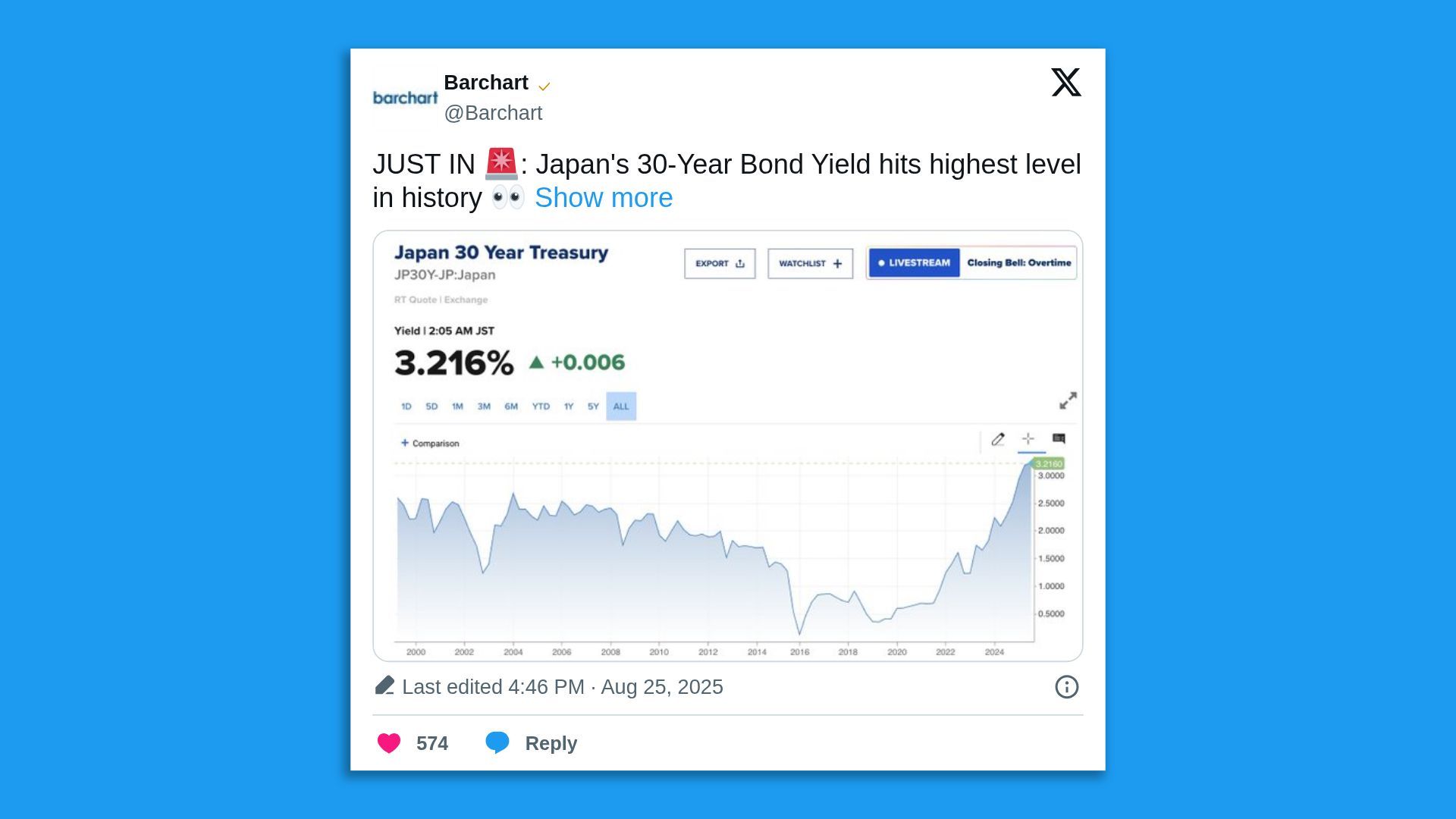
The yield on the Japanese 30-year government bond reached a record high, as investors demand higher return for the risk of owning Japanese debt, thanks to sticky inflation and deficit concerns.
Why it matters: Yields from Japan to the U.S. may be rising for the same reason: concerns about inflation and the government's ability to pay off its debts.
Driving the news: Super-long bonds are underperforming in Japan even as yields become increasingly attractive.
- That's in part since investors see signs of prolonged inflation ahead, which signals potential room for yields to rise further before investors jump in.
- If yields keep going up, that could lure in investors from across the globe.
Catch up quick: Treasury Secretary Scott Bessent has called on the Bank of Japan to cut interest rates in what could be an effort to tamp down Japanese bond yields.
- If bond yields continue to rise in Japan, that could attract foreign investors, luring them away from American assets. Economists also predict the Bank of Japan is on track for one more rate hike this year.
Be smart: Foreign demand for U.S. treasuries looked strong for the month of July, according to Treasury data. But persistent rising global yields could be a potential headwind for U.S. government debt.
👀 Got tips? Email me at [email protected]. I would love to hear from you about anything that may be of interest for our investor audience.
Thanks to Jeffrey Cane for editing and Anjelica Tan for copy editing. See you tomorrow!
Sign up for Axios Markets