Axios Markets

June 10, 2024




2. Women's employment hits an all-time high (again!)


A record share of working-aged women are employed, according to new data from the Bureau of Labor Statistics.
Why it matters: It's a remarkable comeback story. Women have not only regained their pandemic losses in the job market, they've been exceeding those numbers month after month.
Zoom in: In May, 75.7% of all women 25-54 were working — a record high.
- There was also another increase in employment in the child care sector, which has enabled more women to work, says Julia Pollak, chief economist at ZipRecruiter.
- "People are actually able to drop their kids off," she says, adding that for a while some centers would turn away parents on days when they were understaffed.
The big picture: Working-aged men's employment rate is hovering around pre-pandemic levels — it was 86.4% in February 2020 and 86% in May 2024.
Reality check: It seems like women have come a long way. But the employment number in May 2024 is only a smidge higher than nearly a quarter-century ago when 74.9% of working-aged women were employed.
3. Orange crush

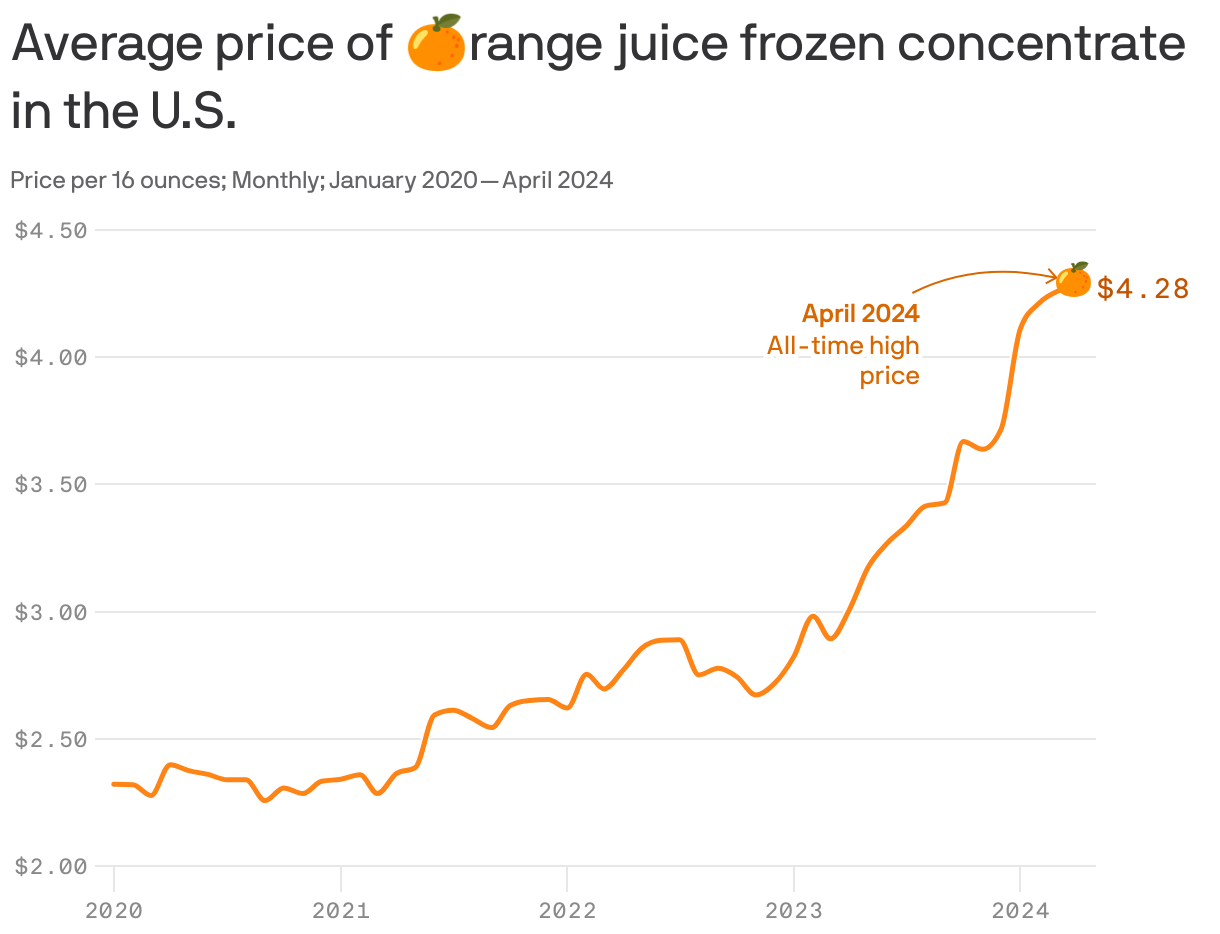
Fruit-borne disease and extreme weather, plus a warming climate, are throttling orange-producing regions in Brazil and Florida — curbing harvests and driving up citrus prices.
Why it matters: The fruit is one of the most popular in America — a longtime breakfast staple; and another higher priced item squeezing consumers.
- Add it to the list of commodities battered by weather-related issues this year, including sugar, cocoa and coffee.
The big picture: Florida orange production plummeted 92% over the past 20 years due to natural disasters and disease, according to a report last month by Citrus Industry Magazine.
- A USDA forecast last year said the Florida orange crop would be the lowest since 1935.
The average retail price of orange juice frozen concentrate in the U.S. spiked to an all-time high in April — $4.28 per 16 ounces, up from $3.01 a year ago.
- The global price of oranges is $3.68 per pound for April this year, up from $2.76 per pound a year ago.
The bottom line: "Food prices are a very tangible way to talk about climate change," Uriyoán Colón-Ramos, director of the Diet Disparities Lab at George Washington University, tells Axios.
Axios Markets
