Axios Markets

April 09, 2025

⚠️ The stock market tried to rally yesterday, but it didn't hold, and now President Trump's sweeping new tariffs are in effect.
We've got a look at what happens between the port and the corner store, and how much consumers might pay.
- Plus: Everyone's shopping to get ahead of the tariffs, and reading the numbers behind the ultra-rare stock market volatility.
📉 Situational awareness: China retaliated with an 84% tariff on U.S. goods, reports say, weighing on stocks. The levy will particularly impact U.S. farmers.
- This follows another rough night. Asian shares were mixed, with Chinese markets higher but Japan's Nikkei down 4%. Early this morning, European shares are lower 3% to 4%, while U.S. futures are down 2%.
- Oil fell further below $60, the dollar weakened again, and U.S. 10-year Treasury yields rose to 4.38%, up 50 basis points in five days.
All in 1,510 words, a 5-minute read.
1 big thing: Who ends up paying for tariffs
When Trump imposed tariffs on China during his first term, U.S. importers paid the price, that we know (now). Exactly how those costs were passed on to U.S. consumers, though, is surprisingly less clear.
Why it matters: The key question for anyone in the U.S. who buys stuff — i.e., all of us — is who pays for Trump's latest tariff increases.
- The answer is probably everyone.
The big picture: Americans and the entire global economy will effectively be living through a real-time economics experiment, because the sheer size and scale of the tariffs going into effect today has never been seen before.
- It's possible that some products simply won't be available at all. In the U.S. we can't preorder the new Nintendo Switch, for instance. Some automakers are pausing exports.
Catch up fast: During Trump 1.0., when tariffs on China were put in place, economists had a natural experiment in pricing to chew on.
- There had been theories that perhaps exporters would lower prices on goods going to the U.S. to accommodate the increases.
That didn't happen, according to the research done at the time, says Chad Bown, a senior fellow at the Peterson Institute who specializes in trade.
- Basically everyone studying this found that the importer pays, he says.
Where it stands: Probably the best of that work was from a paper written by researchers at Harvard, University of Chicago, the Federal Reserve Bank of Boston and the International Monetary Fund, he says.
- They looked at government data on import prices and found that importers paid nearly 95% of the tariff, while exporters paid the rest.
- U.S. exporters also ponied up, cutting prices on goods hit by retaliatory tariffs — mainly commodity agricultural products — bought by China.
But that's hardly the end-game. The harder part of the question: "How much can importers then pass along to their different points in the supply chain?" Bown says.
- Someone who imports widgets for car parts may raise prices levied on the parts manufacturer, who may then raise prices levied on the auto assembly company, which would pass that along to dealers, who would jack up up sticker prices.
- Along the way, some of these companies could shrink margins and absorb some costs, while others might exert pressure to keep prices down.
The other side: The paper Bown points to looked at two big-box retailers and found that they didn't raise prices very much after tariffs were imposed during the first Trump administration.
- Retailers were able to source from different countries and stockpile inventory. It's possible they even ate some costs.
- The White House cited that paper when unveiling tariffs last week.
Yes, but: One of the authors wrote this week that the current administration "got it wrong."
- The research also stops early in 2020. At the time, the authors wrote that they expected eventually retailers would be pressured to raise prices. But they never got a chance to look into it.
- The pandemic happened. Inflation ended up skyrocketing in the U.S., and there hasn't been much research to unpack whether tariffs played a role.
The bottom line: "This is my challenge to all the economists out there who stopped writing about this. Could you rerun your model please?" Bown says.
2. Americans shop in the face of crisis
When the going gets tough, Americans go shopping. With high tariffs about to engulf the country, they're doing it again.
Why it matters: Consumer spending is the engine that drives the U.S. economy.
How it works: We don't yet have hard data to show that spending is ticking up, but anecdotally folks appear to be stocking up on imported goods — TVs! Cars! Wine! Yoga pants! — that will likely see price hikes with high tariffs.
- And some very early data from last week seem to confirm that something's going on.
Where it stands: Retailers are offering sales ahead of the tariffs. Media outlets are doing their thing and publishing listicles of what to buy.
- Bloomberg reported Apple stores were "slammed" with panic buyers.
By the numbers: Sales volume in "shelf stable" groceries also rose after tariffs were announced last week, according to new data from Consumer Edge, which tracks spending through credit and debit card data from major retailers.
- Instant coffee sales rose 21%, ketchup 18% and beer 3%, compared to the previous week. Plus, the data showed transaction size increased across several retailers, including BJs, Costco and Target.
- "It really does seem like consumers are responding to (the tariffs) and trying to buy some stuff early," says Michael Gunther, vice president and head of insights at Consumer Edge.
Zoom in: Trump's tariff announcement last Wednesday was the trigger, the Wall Street Journal noted. "Just like Tom Hanks getting Covid was the tipping point five years ago," Peter Atwater, an adjunct economics lecturer at William & Mary, told the paper.
- "It was just a simple rational decision," one man in Arlington, Virginia, who rushed to lock down a lease on a new car, told the Associated Press. "If this is what the government's going to do, I need to get my act together."
- After Trump's speech, Mark Cuban encouraged people to get out and buy everything, warning that retailers would take advantage of the moment to jack up prices on stuff not even subject to tariffs: "From toothpaste to soap, anything you can find storage space for, buy before they have to replenish inventory."
Flashback: Following the 9/11 terrorist attacks, President George W. Bush encouraged spending, giving consumerism the sheen of patriotism, to show the terrorists Americans had resumed normal life.
- When the pandemic struck, Americans who were sent home from work did so much shopping they helped drive a demand shock, which was so strong it eventually turbocharged the recovery.
Between the lines: Robust spending can keep a recession at bay, as seen in 2022 when inflation was high but the job market was strong, and folks were able shop through it.
The other side: Recession and unemployment fears can reduce spending, as people hunker down with savings, hang on to their money in anticipation of riding out a storm, or lose their jobs and reduce their spending.
The bottom line: When Trump announced massive tariff increases last week, he was effectively waving a "buy now" sign to U.S. consumers, and they seem to be on the case.
3. Two days of historic market volatility
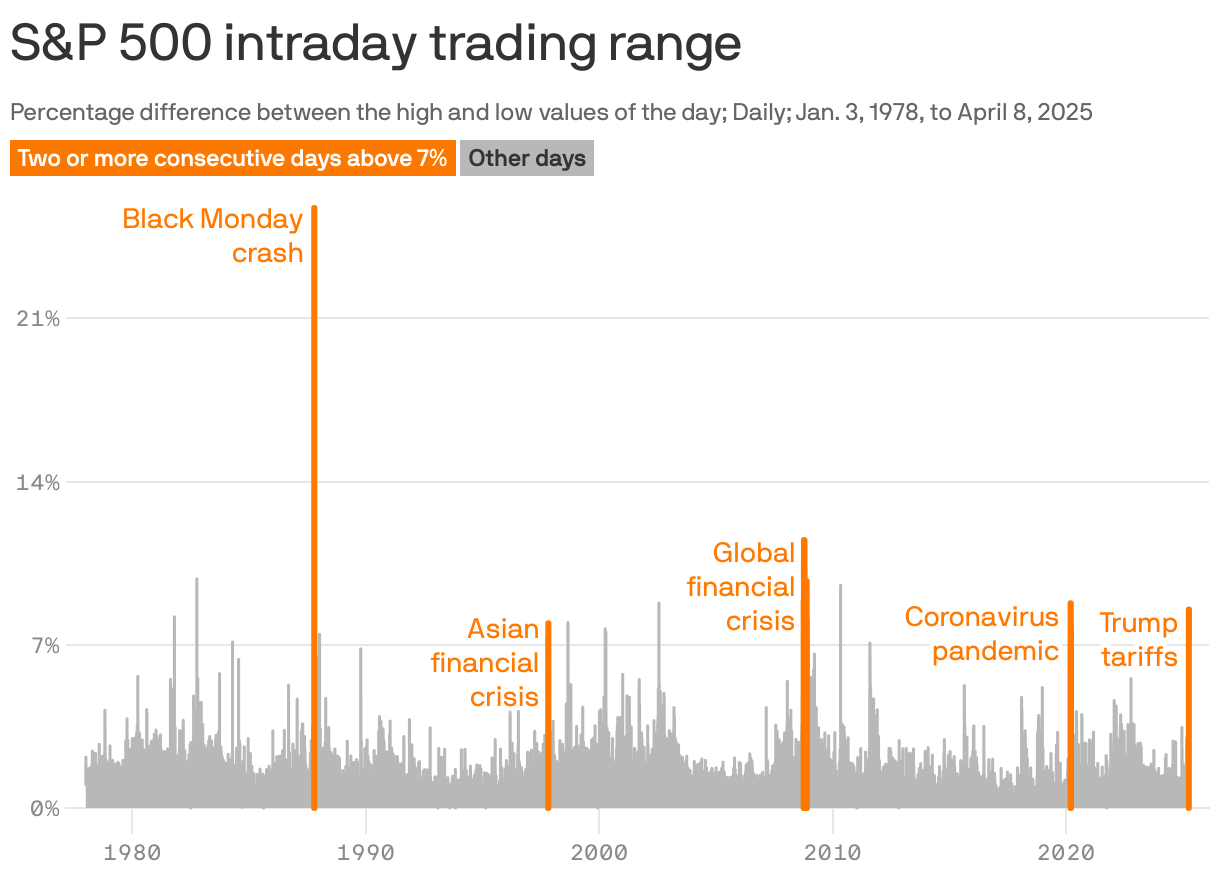
The volatility we've seen in the markets this week is not unprecedented, but it's extremely rare, and has happened only four previous times since 1978.
Why it matters: This kind of noise is a sign that we've now entered a world of radical uncertainty, and that the markets are finding it impossible to do their main job, which is price discovery.
Flashback: Last Thursday, as the markets reacted to the tariffs announced the previous evening, the S&P 500's intraday trading range — the gap between the high and low points of the trading day — was a relatively modest 2%.
- Stocks opened down 3.1% and ground lower to close down 4.8%, in what looked like a large but orderly decline.
Where it stands: This week's trading has been very different, marked by wild intraday swings. The S&P 500% rose 8.3% in a mere 34 minutes on Monday; on Tuesday it opened up 4% and closed down 3%.
Between the lines: Stock market trading is increasingly dominated by multi-strategy "pod shops," and at the heart of most of them is "some sort of quant strategy," as hedge fund manager Krishna Kumar recently told the Odd Lots podcast.
- What that means in practice is a lot of short-term trades and a lot of leverage, both of which work to magnify both returns and volatility.
- Meanwhile, fundamentals-based long-term investors have essentially zero visibility into how the current tariff drama is going to play out.
- Without any strong conviction one way or the other, they're now hesitant to take losses or buy the dip, so therefore they've effectively ceded the role of price discovery to the algorithms.
What's next: What we haven't yet seen, says David Rolley, co-head of fixed income at Loomis Sayles, is "capitulation" by those real-money investors.
- While Rolley does see international investors in particular rotating out of U.S. assets, he says that process is likely to take years rather than days.
The bottom line: Previous bouts of massive volatility were associated with huge financial dislocations, or, in the case of the coronavirus pandemic, the entire planet pretty much coming to a stop.
- This time around, though, the chaos is intentional.
Thanks to Ben Berkowitz for editing and Anjelica Tan for copy editing. See you tomorrow!
Sign up for Axios Markets


/2025/04/06/1743966441085.gif?w=3840)