Axios Markets

January 23, 2025


🖊️ Welcome back! With one signature, President Trump fundamentally changed six decades of how America does business. We take a look at what happens next.
- Plus: Elon Musk escapes Salutegate unscathed, and automakers have a China problem.
All in 1,280 words, a 5-minute read.
1 big thing: Rolling back bedrocks


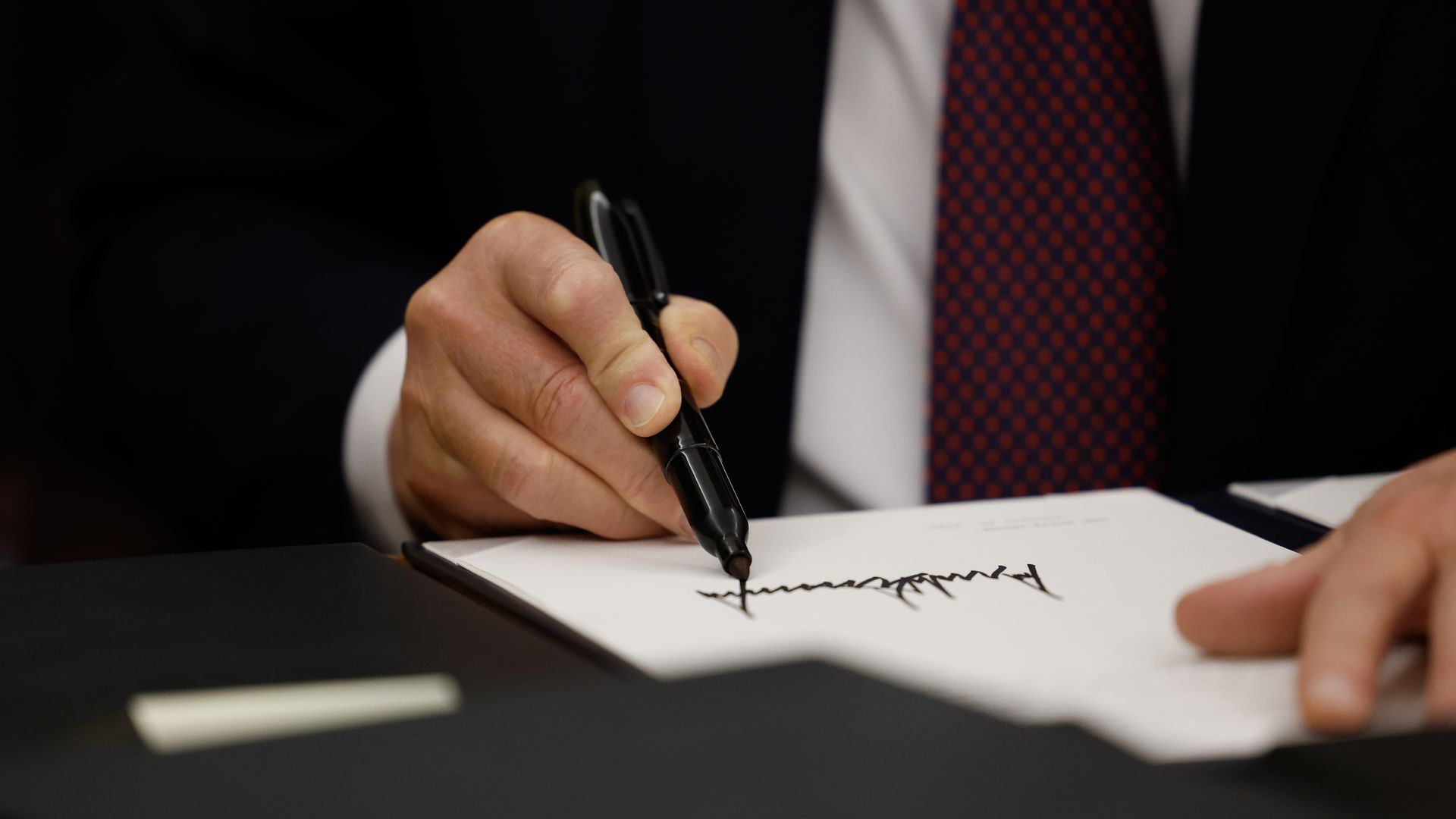
President Trump's sweeping executive order revoking decades of federal diversity and affirmative action practices — and potentially making private sector DEI programs illegal — augurs a fundamental change in the way American government and companies do business.
Why it matters: It builds on the anti-DEI activist pressure of recent years, and could pave the way for a world where the government prosecutes, not protects, corporate diversity efforts.
The big picture: Though Trump's executive order emphasizes a commitment to equality, it guts the mechanisms the federal government has historically used to root out discrimination and guarantee equal opportunity, particularly among the federal contractors that employ about 3.7 million people.
- But even more than gutting standards, the order mandates that federal agencies identify companies, foundations and schools that have diversity programs, and target them for civil enforcement actions, effectively telling corporate America that its DEI efforts now stand on shaky legal ground.
- "You can't have a commitment to ending discrimination and then get rid of the tools that help you end discrimination," Jocelyn Frye, president of the advocacy group National Partnership for Women & Families, told Axios.
- You're "empowering agencies to engage in some sort of strange anti-diversity witch hunt," she said.
Zoom out: Trump's order, issued Tuesday, revokes one that President Johnson signed on Sept. 24, 1965, more than two years after the Rev. Martin Luther King Jr. gave his "I Have A Dream" speech at the Lincoln Memorial.
- The reversal comes after six Republican presidents — including Trump during his first term — kept the Johnson executive order in place, while others expanded it through amendments.
- The new order is sure to face legal challenges, and it's not clear how long any of these changes will ultimately take to implement.
- In the meantime, the administration is asking federal employees to snitch on any colleagues who are still doing DEI work.
What they're saying: Civil rights advocates were anticipating this move.
- Marc Morial, president of the National Urban League, framed Trump's actions as "an assault on the civil rights movement and everything we've achieved in the last 60 years."
- Brenda Victoria Castillo, president of the National Hispanic Media Coalition, emphasized the economic power of the Latino community, with a $3.6 trillion buying power in 2024.
- "Anti-diversity is anti-business," she said. "Representation in leadership and media isn't just morally right. It's essential for success in a diverse America."
Some CEOs are still defending their DEI initiatives amid the backlash.
- JPMorgan Chase CEO Jamie Dimon, long a defender of the bank's diversity initiatives, was asked on CNBC yesterday if he was aware of anti-DEI activists going after his firm.
- He said he wasn't, but in his typical pugnacious way said, "Well, bring them on. I'm not aware of it." He added, "Wherever I go, red states, blue states, green states, mayors, governors...they said they like what we do."
Between the lines: Recent polling makes clear that while rolling back diversity programs may be a priority for the Trump administration, it's not for most Americans.
- The recent Axios Vibes/Harris Poll survey indicated that a majority of Americans oppose, or are unsure about, rolling back diversity programs.
- Almost three-fourths of the 3,200 global CEOs polled for the AlixPartners Disruption Index said their corporate diversity efforts had actually helped their bottom lines.
- Shirley Wilcher, who ran the office in charge of administering the LBJ executive order during the Clinton administration, said businesses will still wind up facing discrimination complaints: "If any of these companies think they're off the hook, they're not."
The bottom line: Corporations were already rolling back diversity programs and policies, partially in response to attacks from conservative groups.
- While some may push back, expect many to run even harder from those programs now.
2. Teflon Musk
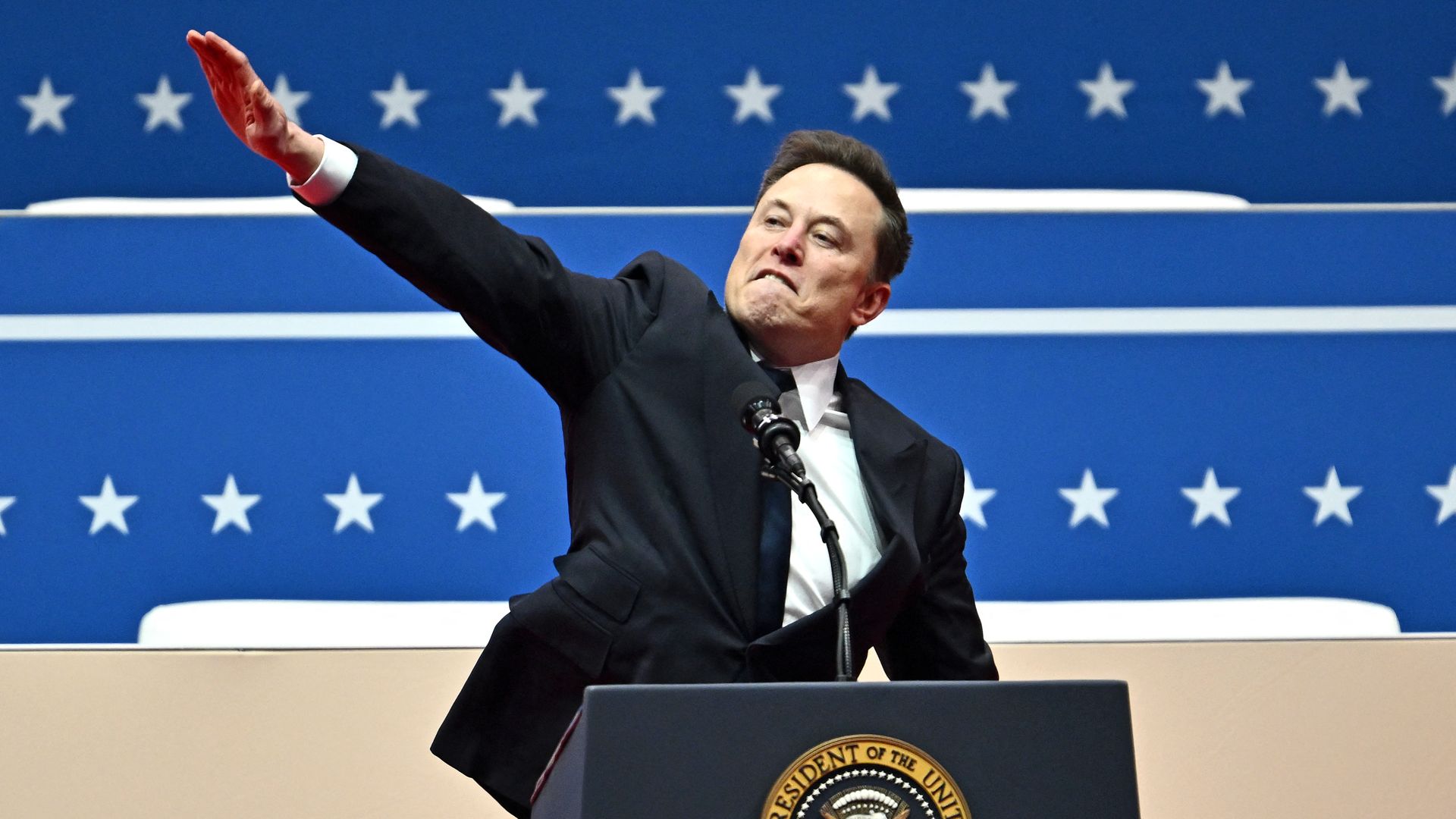
Elon Musk, the world's richest man, standing behind a podium bearing the Seal of the President of the United States, on Monday twice gave what scholars, journalists and rights groups said was a Hitlergruß, or Nazi salute.
- It doesn't seem to have done him (or his company Tesla) any visible harm.
Why it matters: Musk shrugged off accusations of Nazi symbolism as "dirty tricks," laughingly thanking the Anti Defamation League after they said it was merely "an awkward gesture."
- His reaction only served to further inflame much of the glee with which the sign was received within the far right.
Context: Musk has been making inroads into the far right for some time, endorsing the hard-right AfD party in Germany, failing to stop the posting or amplification of pro-Nazi content on his social media site X, and responding to an antisemitic post on X as "the actual truth."
- Musk apologized, saying "it might be literally the worst and dumbest post I've ever done," and went on an apology tour to Auschwitz.
Follow the money: Financial markets have been bidding up Tesla stock as Musk has cemented his bonds to Trump.
- On Tuesday, Tesla shares closed largely unchanged from their previous levels, indicating that in the eyes of the market, Musk did no harm to his position.
- The stock is up 65% since Trump's election, far outpacing peers and the market.
Between the lines: Steve Bannon, a self-appointed avatar of alt-right America, has called Musk "evil" and wants him removed from the White House.
- Musk's body language (regardless of his intent), insofar as it gains him the support of Bannon's base, will help neutralize that threat.
The bottom line: Musk seems to have roughly the same degree of control over his right arm as Dr. Strangelove.
- He also seems be just as central to the inner workings of the U.S. government.
3. Carmakers face China issue as "EV mandate" ends

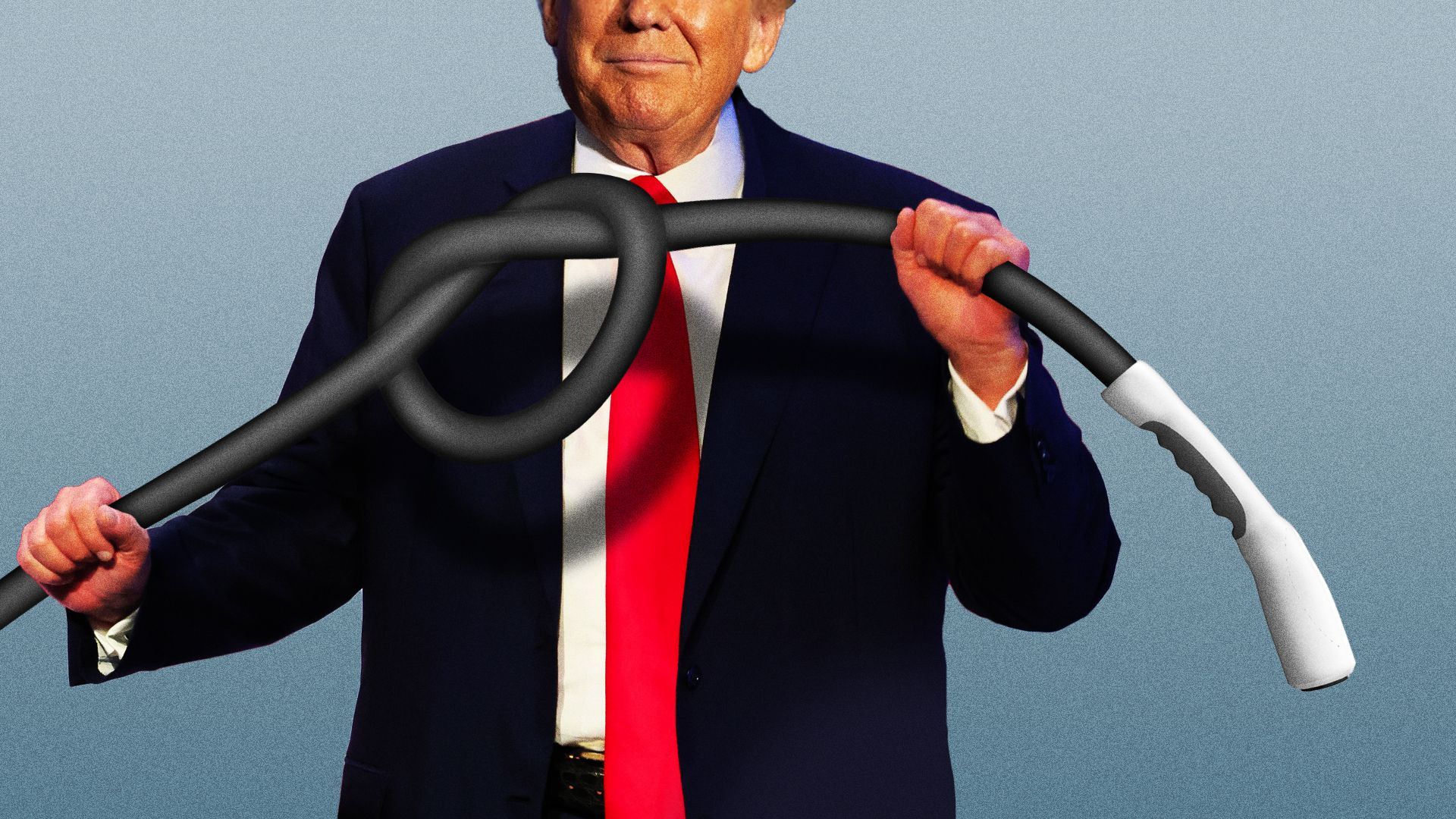
Trump's executive order to revoke what he calls the "EV mandate" gives automakers a welcome reprieve from regulatory hurdles, but could make it harder for them to compete on a global scale with Chinese rivals.
Why it matters: The rise of lower-cost Chinese manufacturers marks an existential threat to U.S. car companies already in the midst of a once-in-a-century transformation.
- Trump's policies, while meant to help the domestic auto industry, could leave it fighting China globally with one hand behind its back.
Driving the news: Just hours after taking office on Monday, Trump signed a broad energy-focused directive that includes a plan to "eliminate the electric vehicle (EV) mandate," ostensibly to give consumers more choices.
Between the lines: Automakers aren't thrilled if EV tax breaks go away, but the impact is small since only about 15 models qualify.
- They're more worried about defending the far richer production tax credits for EV and battery manufacturing in the U.S., which are worth billions of dollars and critical to making EVs profitably.
- "Many of our plants in the Midwest that have converted to EVs depend on the production credit," Ford CEO Jim Farley told reporters at the recent Detroit Auto Show. "We would have built those factories in other places, but we didn't...It changed the math for a lot of investments."
Zoom out: Regardless of what happens with U.S. policy, however, the auto industry is a global one.
- EVs are coming, and much sooner in other parts of the world.
- If the U.S. wants to be a global leader, automakers must somehow match their lower-cost Chinese competitors, whose head-snapping growth is already upending the industry.
The big picture: About half of cars sold in China are electric or plug-in hybrids.
- Carmakers in China are heavily supported by government subsidies and most of the EV battery supply chain is based there.
State of play: For the rest of the industry, that's going to require further belt-tightening, more innovation and increased collaboration to help shoulder the investment burden of new technologies.
The bottom line: Taking regulatory pressure off carmakers isn't going to help that effort.
Thanks to Ben Berkowitz for editing and Anjelica Tan for copy editing.
👋 We'd love to hear from you! What changes in the Trump era are you trying to understand? What other big issues are on your mind? What's the best thing you've read so far this year?
- Just reply to this email or click here.
Sign up for Axios Markets
