Axios Markets

June 09, 2025


2. The rising jobless rate for Black women
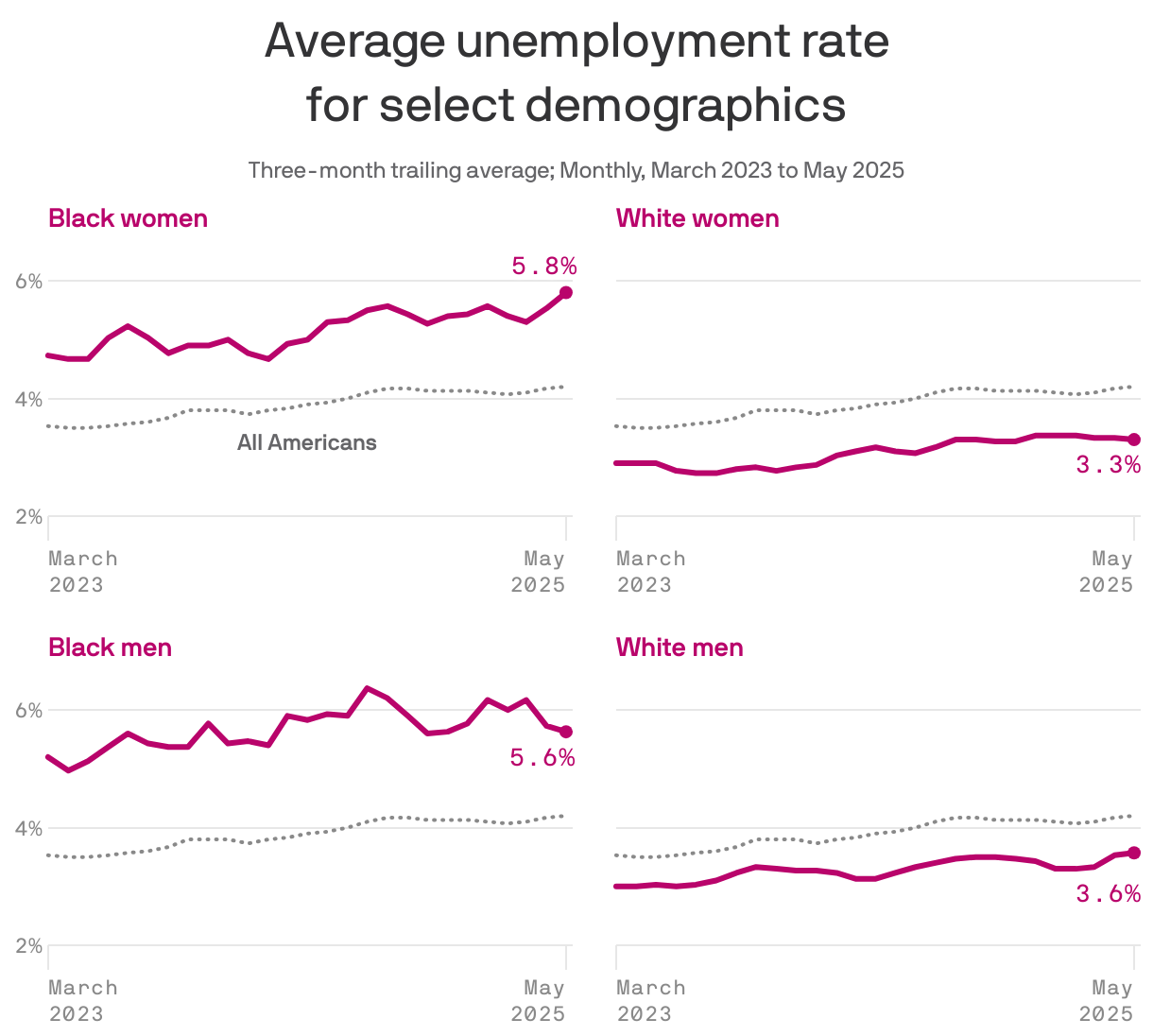
The jobless rate for Black women has been creeping higher all year.
Why it matters: This could be a sign of weakness in the overall job market, economists say, though others point to the Trump administration's purge of the federal workforce and its push to eliminate DEI efforts.
By the numbers: The demographic-level data on unemployment from the Labor Department can be volatile month-to-month, so Axios looked at the three-month trailing average, based on the jobs numbers released Friday.
- By this measure, Black women's unemployment rose to 5.8% in May, up from 5.3% a year ago, surpassing the jobless rate for Black men, which declined to 5.6%.
- For white women, the jobless rate has stayed relatively flat. While it rose for white men, their unemployment rate is still below the overall number.
Between the lines: Women in general make up a slight minority of the federal workforce, but they represent the majority of employees among the agencies targeted by the White House, including the Department of Education, where Black women comprise 28% of workers.
- Black women are overrepresented in the federal employment compared with the private sector, accounting for nearly 12% of the federal workforce in 2020, compared with about 7% in the civilian labor force, according to a federal report.
- "The layoffs at the federal level where Black people are more represented, the impacts of the tariffs, particularly on small businesses that hire Black women, and just the overall use of DEI as a slur, which may be contributing to a lack of hiring of Black women, all of these factors are probably at play," Andre Perry, senior fellow at the Brookings Institution told Bloomberg.
Reality check: The federal job loss doesn't fully explain the decline in overall employment for Black women.
- Federal employment has fallen by 69,000 this year, per the Bureau of Labor Statistics, though the number is expected to move higher because those on paid leave or receiving ongoing severance are still counted as employed.
- From January to March, Black women's employment fell by a whopping 306,000. It has recovered a bit since then and now is down by 233,000 for the year to date.
- "It's a really large drop and it can't just be the federal layoffs," says Jessica Fulton, senior fellow at the Joint Center for Political and Economic Studies.
What to watch: Black unemployment in the U.S. always trends higher than the overall number. Historically it has been double the rate of white workers, though that gap narrowed a bit in the post-pandemic job market.
- A higher Black unemployment rate can be an early recession warning sign, Fulton says. "Black unemployment rates rise more sharply and sometimes more quickly than for other workers" heading into downturns, she notes.
The bottom line: Uh oh.
3. Charted: It pays off to invest in women


Investing in firms that invest in women has paid off this year.
By the numbers: The SPDR MSCI USA Gender Diversity ETF was built to track companies with high gender diversity scores, which indicates they're successfully promoting female leadership throughout the ranks.
- Year to date, that ETF is up 5.4%, beating the 2.2% gain in the S&P 500.
- Another fund in a similar vein, the BNY Mellon Women's Opportunities ETF, is also beating the broader market with its 3.3% gain this year.
The intrigue: ETFs that track companies promoting gender diversity broadly, like those above, are doing much better this year than ETFs that specifically focus on companies with female CEOs.
The bottom line: It pays to invest in women.
Axios Markets