
Axios Markets

June 03, 2023
I hope you had a fabulous Memorial Day. Welcome to June!
- In this week's newsletter: The tension between politicians and CEOs when it comes to China; cognitive decline in retirement; a "Succession" postmortem; and a new building for Sotheby's. All in 1,325 words, a 5-minute read.
1 big thing: Corporate America still loves China
Illustration: Annelise Capossela/Axios
Corporate America can usually count on one if not both of the two main U.S. parties to espouse the policies it favors. Not when it comes to China.
Why it matters: Economic imperatives are sending a steady stream of CEOs to China. The real obstacle to growth, however, is found in Washington.
Driving the news: Tesla CEO Elon Musk visited Beijing this week and was quoted as saying that the U.S. and China are “intertwined like conjoined twins.”
- JPMorgan CEO Jamie Dimon was in Shanghai after doubling the bank's China head count over the past four years. He now controls a mutual fund company, a futures business and a securities firm in the country.
- “We’re here, we’re going to support the Chinese people,” he told Bloomberg.
Between the lines: China has been courting international CEOs, including French luxury-goods magnates François-Henri Pinault (who visited earlier this year) and Bernard Arnault, who's planning a trip later this month.
- Apple's Tim Cook told a Beijing audience in March that being in China "means the world to me" given the "symbiotic relationship" his company has with the country.
The other side: "The new cold war is getting colder," writes economist Nouriel Roubini in the wake of a G7 summit that explicitly condemned China on both human rights and its militarized expansionism. "It is now clearer than ever that the U.S. and the broader West are committed to containing China’s rise."
- U.S. secretary of state Antony Blinken is refusing to make the same journey as his country's CEOs, using a Chinese balloon as a pretext for postponing a trip that had been designed to turn down the heat on tensions between the two countries.
- U.S. lawmakers on both sides of the aisle are talking up concerns that imports of foreign technology could pose national security risks. Such language only further inflames relations between the two countries.
- Tensions over Taiwan, similarly, continue to worsen.
The big picture: China is the largest or second-largest market for a slew of U.S. multinationals — not only Apple and Tesla but also the likes of GM, Starbucks, McDonald's and Nike. It also represents much greater potential growth than the U.S. can offer.
- When Wall Street types urge Dimon to run for president, it's easy to see a desire for better relations with China.
- Hedge fund billionaire Bill Ackman cited Dimon's respect among "the global political and business leaders that matter," for instance, as a reason for him to be president. When it comes to future global growth and prosperity, of course, no one matters more than China's leaders.
The bottom line: Even Dimon has resigned himself to the fact that "over time there’ll be less trade.” The CEOs will try to rescue what they can, but the politicians are setting the rules.
2. When retirees can't even trust themselves
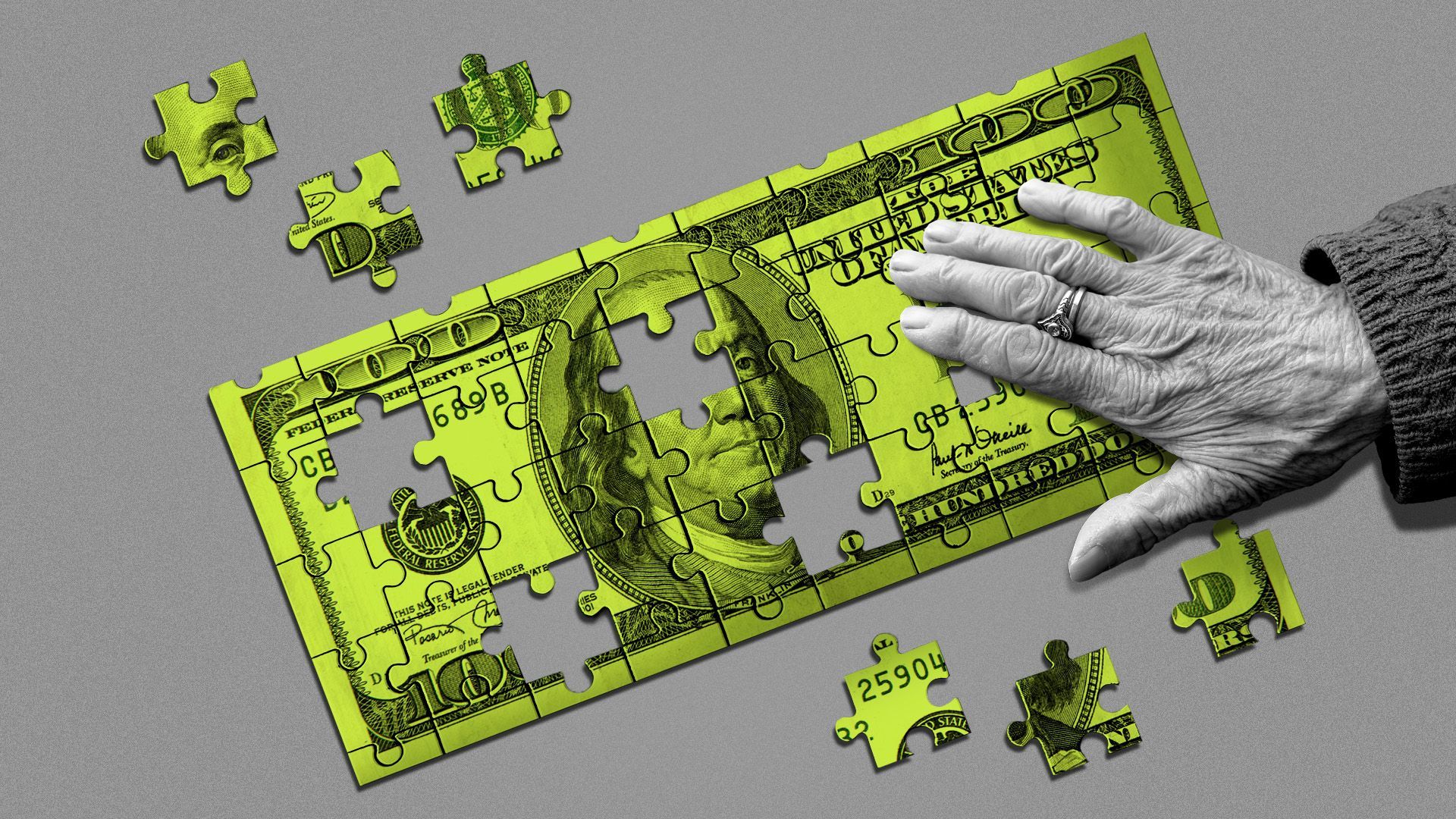
Illustration: Sarah Grillo/Axios
Old age is the trickiest part of life to navigate financially, with its unpredictable care expenses and unknowable longevity. It's also the point at which cognitive decline can scupper even the savviest financial plan.
Why it matters: A recent American Economic Association paper surveyed Americans in or nearing retirement and asked them about the risks of handing over control of their money too early — or too late.
- By the numbers: On average, the respondents said that waiting too long to hand over control would cost them 18% of their wealth. On the other hand, they didn't want to cede control too early, they said, because that would cost 10% of their wealth.
The big picture: In a world of individual retirement plans rather than defined-benefit pensions, an enormous onus is placed on retirees to manage their wealth and income — what to invest in, how much to withdraw, when to retire and more. These calculations are fearsome even for the most financially savvy; for most Americans, they're almost unfathomable.
- In a recent Allianz poll, for instance, 61% of Americans said they were more afraid of running out of money than they were of death itself.
- 59% said they had no idea how they were going to pay for their health care costs in retirement.
Between the lines: Money is more important than happiness, at least according to the Allianz poll.
- The biggest regret in all generations is not saving enough for retirement, while fewer than one in three said they wished they had spent more money on activities or experiences, or even that they wished they had spent more time with their family.
The bottom line: It behooves all retirees to be on the lookout for signs of cognitive decline and to have a plan for what they intend to do if and when those signs appear.
- That kind of plan, however, barely begins to ameliorate the myriad financial worries and concerns of modern retirement.
3. What money can't buy
The rich and powerful Logan Roy (Brian Cox). Photo: Courtesy of HBO
At the heart of the final season of "Succession," which ended its four-season run on Sunday, was an examination of the interrelationship of money and power.
Why it matters: Logan Roy, the fearsome media magnate at the center of the show, amassed power — owning a massively popular right-wing cable news channel will do that — and turned it into money.
- His billionaire children, on the other hand, spend four seasons trying to turn money into power, and fail at every turn. At the end (spoiler alert!) they're richer than ever — and miserably powerless.
Between the lines: As befits a show about money, the subject itself is rarely tackled head-on. In Season 4, however, we get to see the Roy kids' relationship to money more clearly than before.
- While they are happy to spend lavishly on huge houses and private jets, it turns out that nine-figure sums are big enough to give them pause. In the season premiere, for instance, eldest son Connor Roy concedes that spending an extra $100 million on TV ads in the final days of his quixotic presidential campaign would be "kind of a lot."
- Youngest son Roman Roy is briefly worried about upping his bid for the rival Pierce media empire by a mere $0.5 billion: "You do know what half a billion dollars is, right? Five hundred million dollars? A million is a thousand thousand. You do know that. So five hundred times a thousand thousand dollars of actual money."
The big picture view is given to middle son Kendall, talking about his father's money: "The lifeblood, the oxygen of this wonderful civilization we have built from the mud. The money. The corpuscules of life gushing around this nation, this world, filling men and women all around with desire."
- The irony is that Kendall himself — along with his siblings — evinces no such desire for money. "We're already rich," he tells Swedish tech billionaire Lukas Matsson.
- When faced with a choice between money and power, the siblings choose power — and then, tragically, fail to maintain their unity for long enough to actually get what they think they want.
The bottom line: In the end, the character who is most open about his desire for money ends up with more power than any of the Roy siblings. Money can be inherited, but successful ambition often skips a generation or two.
4. Building of the week: The former Whitney Museum
Marcel Breuer designed one of the most iconic art museums in the world for the Whitney in 1966.
- An inverted ziggurat, most of the building is covered with 1,500 slabs of granite, each weighing more than 500 pounds. The existence of such exterior cladding makes it hard to class the building as brutalist — a style characterized by the humble use of raw concrete.
Driving the news: Now that the Whitney Museum has moved downtown, the building has been sold to auction house Sotheby's for $100 million.
- Glenn Ligon, the artist whose 2011 retrospective in the building ranks as one of the museum's greatest-ever shows, marked the sale with a post on Instagram. The caption: "Matthew 21:12-13. KJV."
- That verse reads: "My house shall be called the house of prayer; but ye have made it a den of thieves."
Thanks to Kate Marino for editing this newsletter, and to Jay Bennett for copy-editing it.
Sign up for Axios Markets

Stay on top of the latest market trends and economic insights