Axios Markets

November 25, 2024

π Happy Monday! It's a short week ahead, following a long weekend β for news at least. Highlights:
- After the nominee jockeying for Treasury secretary, President-elect Trump chose hedge-fund billionaire Scott Bessent. He's viewed as less of a hard-liner on trade (read more), and U.S. stock futures are up, while Treasury bond yields are down, this morning following the pick.
- Meanwhile, Trump gave Rep. Lori Chavez-DeRemer (R-Ore.) the nod for Labor secretary. She's seen as pro-labor and is already getting some flack from the right. Teamsters president Sean O'Brien, who publicly urged Trump to select her, thanked him for doing so.
But enough about the nominee derby βΒ today we're talking about rules and regulations and how they could fare under the new president.
- And for a delightful surprise, Felix Salmon is back to explain why the $6.2 million banana isn't so bananas after all. In 1,148 words, 4 minutes. Let's go!
1 big thing: Breaking the rules


Donald Trump will nullify "thousands" of regulations, Elon Musk and Vivek Ramaswamy wrote in a Wall Street Journal editorial last week about their "DOGE" plan to cut the size of the federal government.
Why it matters: There's a lot to slash and burn. President Biden's administration put through more rules than any other White House over the same time period.
By the numbers: Through October 2024, the Biden administration published 292 "economically significant" rules, meaning they're forecast to have a large impact on the economy, according to George Washington University's Regulatory Studies Center.
- That's partly because the Biden White House rushed through a flurry of regulations in the spring.
- They were trying to leverage a provision of a 1996 law, the Congressional Review Act, which lets an incoming administration βΒ with simple majorities in Congress β overturn rules made toward the end of the previous president's term.
Between the lines: Trump was the first president to take advantage of the look-back provision β overturning a record number of Obama regulations early on. It's expected he'll do it again.
The big picture: Some of these policies βΒ implemented by agencies to carry out laws passed by Congress βΒ cover critical things like clean air and water, protections for workers and financial regulations meant to prevent crisis.
- Some argue that a banking deregulation push in Trump's first term helped create the conditions for the banking mini-crisis of 2023.
- With Congress so gridlocked in recent years, regulations have become the way for an administration to put through their agenda.
Yes, but: Republicans say this process has gone way too far, and that regulations are costly and hold back economic growth.
Zoom out: It's unclear how much real impact DOGE will have βΒ it can only make recommendations and doesn't have cutting power.
- Regardless, there's little doubt the incoming administration will take a whack at the rules.
- Trump 1.0 rolled back more than 100 environmental rules, per a 2021 New York Times analysis, weakening emission standards, removing protections for wetlands, and limiting wildlife protections.
What to watch: Incoming Senate Majority Leader John Thune (R-S.D.) pledged to "take a hatchet to the regulatory apparatus choking our economy, " in an op-ed earlier this month.
Follow the courts: Deregulation is easier now than it was in 2017, following several Supreme Court decisions βΒ signed on to by the three Trump-nominated judges βΒ that curbed rule-making power.
2. Exclusive: Biden takes economic victory lap

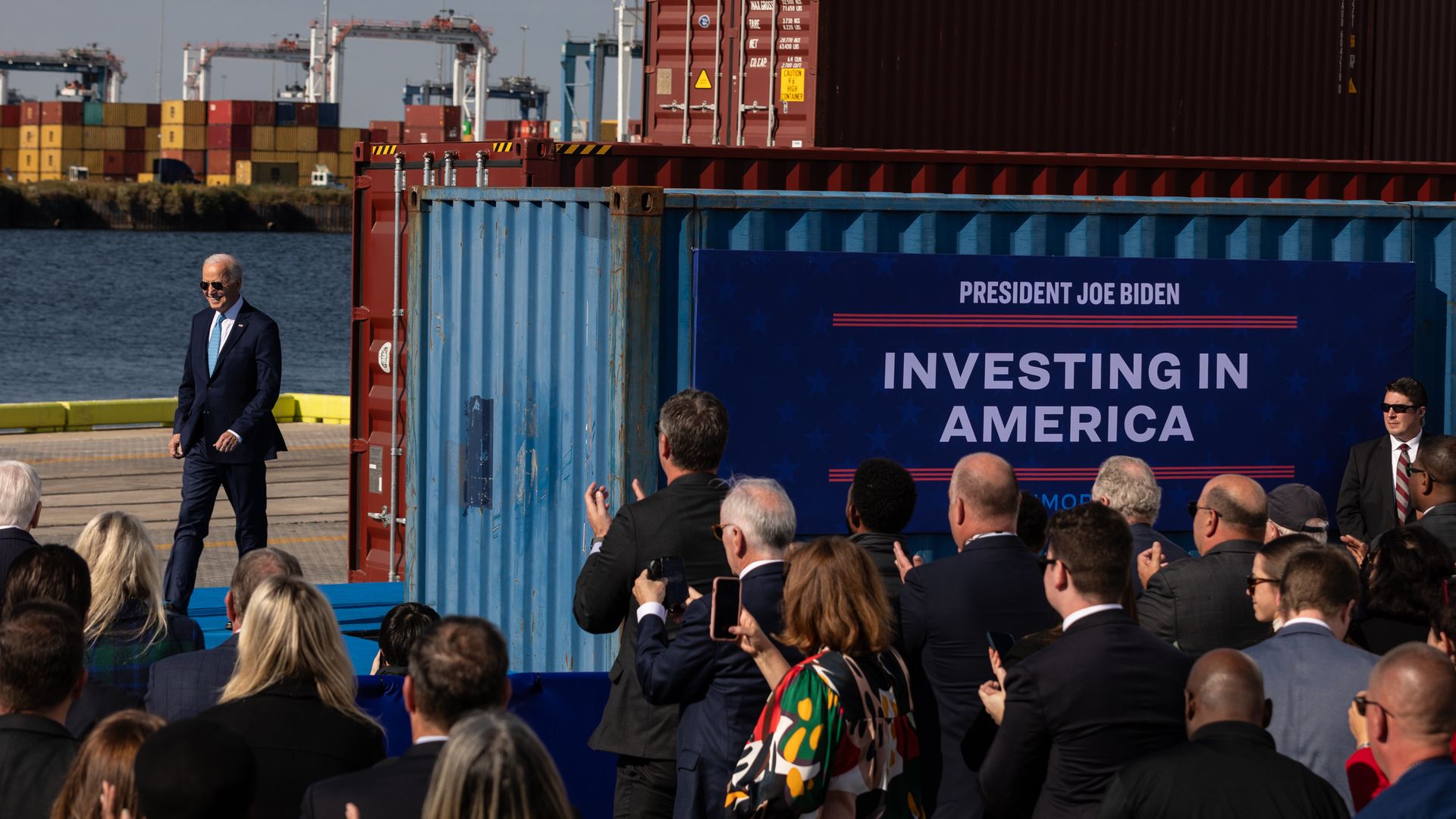
Expect the White House to tout a new milestone today: $1 trillion of private sector money put toward clean technology and manufacturing β investments officials say are a result of Biden-era legislation.
Why it matters: Trump is set to preside over an economy where parts of Biden's agenda live on β in the form of unfinished semiconductor factories or clean-tech projects.
- Trump might like the economic activity spurred by such projects, but he has threatened to roll back the laws passed under Biden that incentivized and funded them. (See above for the looming rules and regulations purge.)
What they're saying: A White House memo announcing the $1 trillion milestone β first seen by Axios β does not name Trump. But it hints at the uncertain fate of unspent funds allocated by Biden-era legislation, including the Inflation Reduction Act.
- "The progress we've made ... represents only a fraction of the full impact of this agenda," White House deputy chief of staff Natalie Quillian writes in the memo.
- "If future Administrations continue to implement at the pace we have, people across the country will enjoy the benefits of safer water, cleaner air, faster internet, and smoother commutes."
"These investments in industries of the future are ensuring the future is made in America, by American workers," according to a statement set to be released from President Biden.
The intrigue: The huge sums of private-sector money pouring into the economy β and the popularity of the legislation's tax credits and more β might make it less appealing to roll back at least one key aspect of Biden's agenda.
Go deeper: What might keep Trump from killing green spending
3. This isn't just a banana
"Comedian" is the most famous artwork by Maurizio Cattelan, an Italian artist who had a retrospective at the Guggenheim in 2011, and whose auction record, set in 2016, stands at $17.2 million.
- In most news reports, however, including this one, it's generally referred to as "a banana," or "the banana."
Why it matters: "Comedian" sold for $6.2 million at auction last week β a ludicrous price for a banana, but a perfectly normal price for a major piece of contemporary art.
How it works: Cattelan is a conceptual artist, which means that the artwork being bought is a concept β a set of instructions for duct-taping a banana to the wall β rather than an object.
- The idea of an artwork that is executed by the owner according to the artist's instructions is more than half a century old, dating back at least to a Sol LeWitt show at Paula Cooper gallery in 1968.
- Most of the time, when it doesn't make the front page of the New York Post, conceptual art is uncontroversial, an important and mainstream component of the contemporary art world.
The big picture: Comedy has always struggled with being taken seriously, and Cattelan, often referred to as a "prankster," is one of very few major artists who work mostly in a comedic vein.
- If a serious work by Cattelan's peers Anselm Kiefer or Bill Viola sold for this much, no eyebrows would be raised.
- Partly because of its comic nature, however, "Comedian" seems to invite ridicule.
Where it stands: "Comedian" can be placed in a long line of conceptual artworks where everyday objects are transformed into art.
- Marcel Duchamp started producing his "readymades" 110 years ago, in 1914, when he presented a bottle rack as art.
- The Tate Gallery in London caused a minor scandal when it acquired "Equivalent VIII," a 1966 Carl Andre work comprising everyday house bricks, in 1972.
Between the lines: Cattelan is one of the few artists whose artworks have become memes.
- Other such works include Andy Warhol's portraits of Marilyn Monroe, one of which sold in 2022 for $195 million, or Shepard Fairey's "OBEY" portrait of Andre the Giant, available in an unlimited edition for just $30.
Zoom in: A lot of attention has been paid to the materials used in "Comedian" β a banana and some duct tape, both of which can be replaced (or even eaten) an unlimited number of times according to the will of the owner.
- Justin Sun, the winning bidder, promised to eat the banana that was on show at Sotheby's. After all, he does own it β and will continue to own it, and be able to exhibit it, whatever happens to this particular fruit.
The bottom line: "Comedian" is a legitimate artwork, by a legitimate artist. Its value, while amusing to many, is not particularly difficult to understand.
Thanks to Ben Berkowitz for editing and Anjelica Tan for copy editing. Let the countdown to turkey eating commence.
Sign up for Axios Markets