Axios Markets

January 28, 2025

Good morning! After yesterday's DeepSeek market rout, today we take the other side of the argument: why cheap AI is good for everyone's bottom line.
- Plus: CFOs are planning to be tight with pay raises in 2025.
👋 We want your take. Help us make Markets even sharper by sharing your feedback! It's quick, and your insights will shape the future of our coverage.
All in 820 words, a 3-minute read.
1 big thing: DeepSeek's great news

The markets have started pricing in an AI future that's going to be cheaper and more accessible than they had previously assumed.
Why it matters: The less money that companies need to spend on the AI equivalent of picks and shovels — Nvidia chips and the electricity needed to power them — the more profitable they will be.
Follow the money: What looked like a broad-based rout early yesterday turned out to be much more selective by market close.
- While Nvidia lost $600 billion of market value in a single day, for instance, Apple gained more than $100 billion.
What they're saying: "If you still believe that AI is going to be big, this news out of China should only make you feel better," Siebert chief investment officer Mark Malek wrote yesterday.
- His argument is that DeepSeek's technological breakthrough will only serve to multiply the amount of performance that companies can get per dollar invested in AI.
The big picture: The market's theory of AI — at least up until the end of last week — was that, broadly, bigger is always better.
- Companies would see their share prices rise simply on an announcement that they had bought a large number of Nvidia chips, even if they were extremely vague as to what they intended to do with them.
- Similarly, energy companies have been soaring on the grounds that there's no such thing as too much electricity when it comes to powering the AI revolution.
Reality check: DeepSeek has now shown it's possible to produce a state-of-the-art AI that needs fewer and less-powerful chips, less energy, and much less up-front investment.
- That seems bad for Nvidia, which has an effective monopoly on AI chips right now, and it's also bad for power companies who were counting on surging demand from data centers.
Where it stands: Last week, the markets believed that without billions of dollars in funding, it was impossible for rivals to compete with OpenAI. This week, they're not so sure.
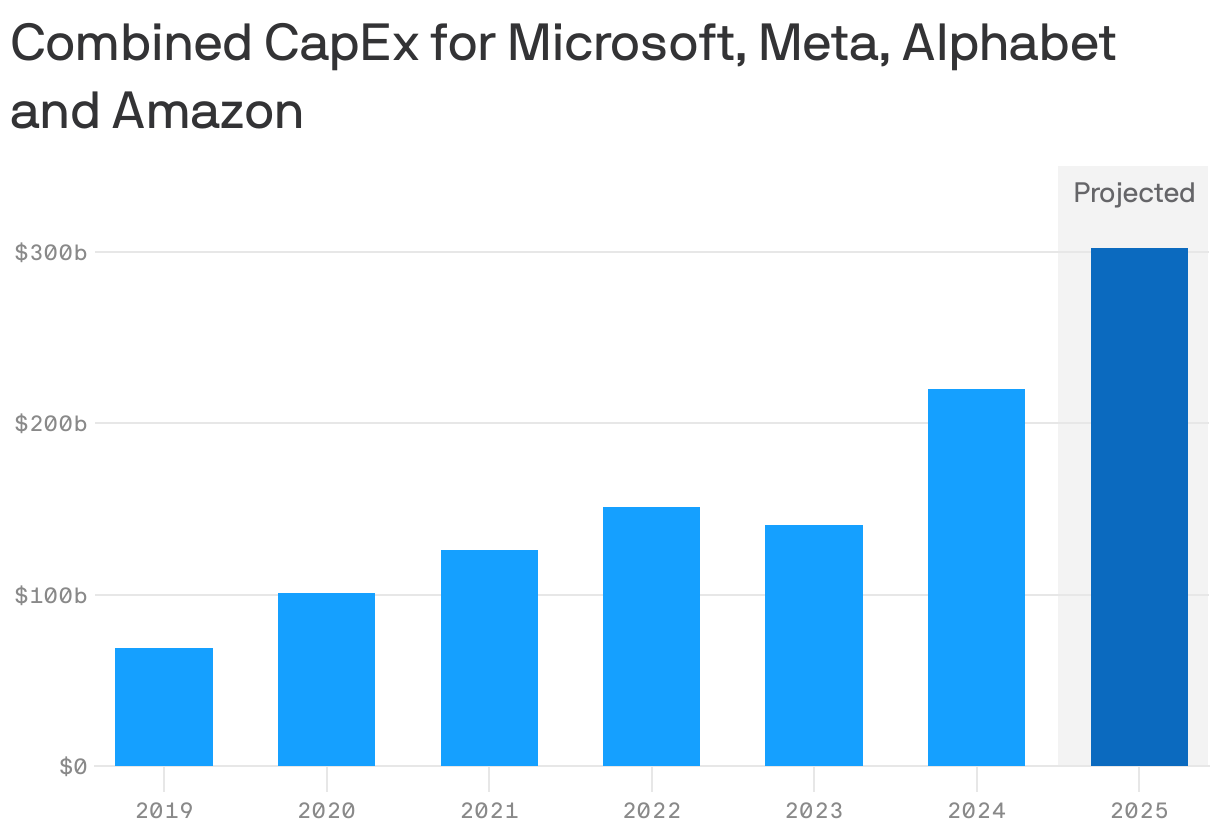
- The markets were also pricing in massive compute costs for the biggest consumers of AI. Google, Meta, Amazon and Microsoft are expected to spend over $300 billion between them on capital expenditures this year. (More on this below.)
- You can be sure that all four of them are revisiting those assumptions this week, asking if they can get the same bang for many fewer bucks.
- If some of the $500 billion earmarked for Stargate, for instance, can be redirected to other purposes that could fund a lot of very profitable opportunities.
Between the lines: The biggest market trend of recent years has been linked to the concept of "positive returns to scale." This is the idea that the bigger you get, the harder it becomes for anybody to compete with you, and the more your margins grow.
- That helps explain the enormous sums that investors have poured into AI companies in recent years.
- But if AI is the future of business, and if powerful AI tools are available at low cost to any company on the planet, then, as Axios' Dan Primack wrote yesterday, Silicon Valley's enormous investment in foundational AI models may never see any returns at all.
The bottom line: What's bad for the companies looking to sell AI products is likely to be good for the companies looking to buy them.
- And there are many more of the latter than there are of the former.
2. Charted: Surging spending on AI

Some of the biggest U.S. technology companies are expected to collectively spend $300 billion or more this year on the capital expenditures to fuel their AI build-out.
Why it matters: It's not just chips. It's power and construction workers and materials and a host of other ancillary expenses that fuel local economies.
- If DeepSeek can do AI faster and cheaper than these companies, their spending plans may come into question.
3. Pay raises are shrinking this year
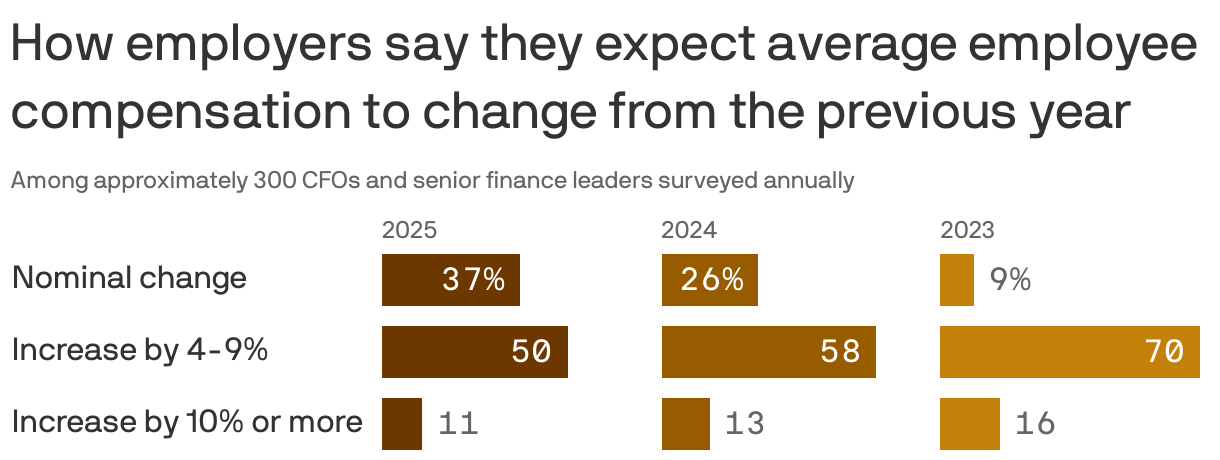
Companies are planning smaller raises this year, according to a new survey of chief financial officers from Gartner.
Why it matters: Outside of those skyrocketing egg prices, inflation has moderated and, at the same time, the job market has cooled way down.
The big picture: It's become harder to find a job, particularly in the white-collar world. So employers are far less worried about people quitting and don't need to do as much to get workers to stick around.
- "Nobody is talking about the Great Resignation anymore," says Randeep Rathindran, a vice president in the finance practice at Gartner.
By the numbers: The vast majority of employers, 94%, are still planning raises this year, per Gartner, which surveyed 300 CFOs and finance executives. The amounts are just smaller now.
- The share of CFOs planning to raise average employee compensation by 4% or more in 2025 fell to 61% from 86% in 2023.
- 37% of respondents said they are planning to offer "nominal" raises this year, which is up from 9% in 2023.
The bottom line: Something is better than nothing.
Thanks to Ben Berkowitz for editing and Anjelica Tan for copy editing. We'll see you here tomorrow. Please take the survey if you have a minute!
Sign up for Axios Markets