Axios Markets

July 02, 2024


1 big thing: The global stock market recovery

The S&P 500 has been the clear winner among major stock markets in recent years, thanks to enormous technology companies. But the whole world has managed to recover pretty well from the 2020 crash.
Why it matters: The S&P 500's outperformance isn't really a function of American exceptionalism. U.S. small caps, for instance, as measured by the Russell 2000, are significantly underperforming France and Germany, and are barely outperforming Brexit-wracked Britain.
Between the lines: While Japan's Nikkei tops major markets in terms of its five-year returns, it looks much less impressive in dollar terms.
- It's also worth noting that the Nikkei's 35-year return, in local currency terms, is +20%, compared to +1,740% for the S&P 500.
The big picture: Deglobalization is visible everywhere except the stock market, where technology megacaps are reaping the benefit of global domination.
- That said, it's great news that almost all the world's major stock markets are sitting on reasonably healthy five-year returns, given that in early 2020, they all plunged in the face of the deepest and sharpest recession since the 1930s.
The bottom line: Sharp falls generate headlines and panics — but are often short-lived.
2. The new remote work normal
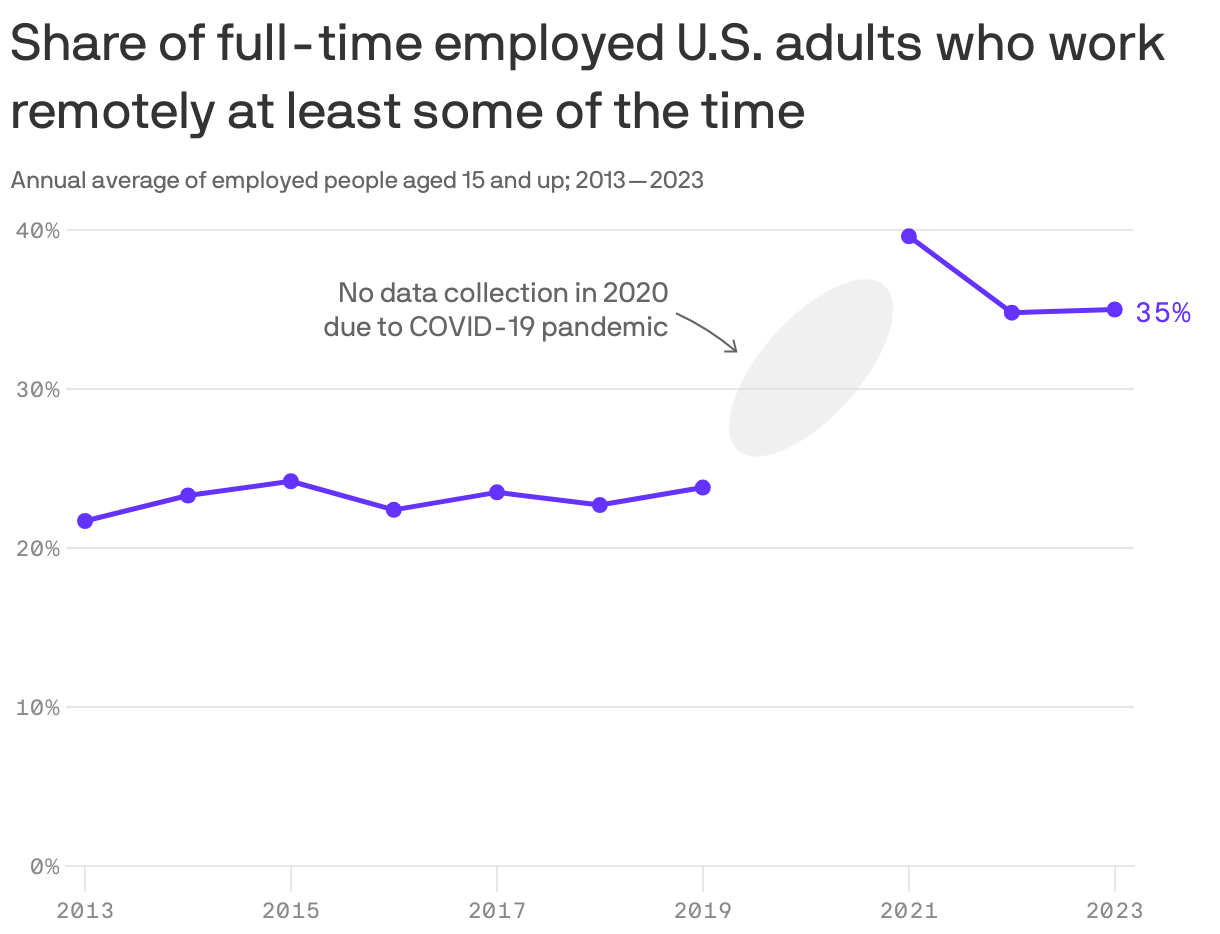
In 2023, 35% of workers aged 15 and over worked from home some of the time, per fresh data from the American Time Use Survey from the Bureau of Labor Statistics.
Why it matters: That's unchanged from 2022 — a sign that a post-pandemic normal has emerged.
What's next: We're heading into the thick of summertime, a particular flashpoint when it comes to remote work.
- Tis the season when flexible work arrangements collide with employees' summer vacation plans.
- Some bosses resolve the tension with strict crackdowns on any intrusion of leisure into the workday, while others are more inclined to trust employees and offer more flexibility.
Zoom in: It's an especially tricky moment for middle managers, who are struggling to trust workers at a time when they're not always right in front of the boss's face.
- In the worst-case scenario, you wind up with monitoring software and strict return-to-office ultimatums that push some people out of the workforce.
The bottom line: The hybrid work world is here to stay. Managers need to adapt.
Axios Markets