Axios Markets

February 09, 2026

🏈 Good morning! It's Emily Peck, your former Markets newsletter writer, back for another run. It's the day after the Super Bowl, which still isn't a national holiday. But we fight on.
Today: Amid all the doomsday worries about AI crushing tech, there are bright spots.
Plus: Retail investors' bullish January
Let's kick this thing off. All in 920 words in 3 minutes.
1 big thing: Di-SaaS-ter, or not
The so-called SaaS-pocalypse has come for all kinds of software companies, as AI upends the "software as a service " industry, or SaaS.
Why it matters: There are signs of rising financial stress for software makers, public and private, but as we head into the week, there are some reasons to believe a di-SaaS-ter could be averted.
The big picture: Everything is SaaS these days — nearly every piece of software people use, particularly at work, from Slack to Microsoft Word.
- Instead of, say, just buying a piece of software, companies shell out tons of money on a monthly or annual basis for SaaS.
- Until very recently, investors in the private markets, like private equity firms, liked that safe, recurring revenue stream. Growth prospects looked good.
- Then AI entered the chat. Now, the question is: Will businesses just DIY their own software, leaving these companies behind?
Catch up quick: Last week, the stock market appeared to wake up to the notion that AI will change how these companies work, and they didn't like the vibes — most tech stocks are hurting.
Between the lines: Those fears could be a tad over-the-top. Companies move slowly, they already trust their SaaS providers and it would be costly to start over.
- "Replacing a core SaaS platform is effectively open-heart surgery for an enterprise," per a note from PitchBook. More likely, established software providers will incorporate AI into their products.
- "There's a whole bunch of software companies whose stock prices are under a lot of pressure because somehow AI is going to replace them," Nvidia CEO Jensen Huang said last week. "It is the most illogical thing in the world."
- "Would you use a hammer or invent a new hammer?"
Flashback: This definitely isn't the first major disruption to the software business to roil markets and create uncertainty over the sector's future.
- The advent of the Internet made way for new huge players in software, like Google. Plenty of software companies went under or were absorbed or shrank. Lotus 1-2-3 ring a bell? Probably not if you're under 50 years old.
- Back in 2007, investor Paul Graham even wrote an obituary for Microsoft.
The bottom line: AI is disrupting the investment picture for the software business, and amid all this uncertainty, you'll likely see a lot of volatility and doomsday predictions.
2. Bonus chart: Distress signal


Signs of SaaS trouble in the private markets had been building well ahead of the stock market's ah-ha moment.
- An increasing share of loans backing software firms are trading at "distressed" levels, or below 80 cents on the dollar, according to data from PitchBook.
By the numbers: $25 billion in software loan volume was marked at distressed levels by the end of January — more than double what it was in December.
- 30% of all the distressed debt in this loan market is coming from the software sector, which makes up an outsized share of the overall market.
Between the lines: These are companies heading toward trouble, says Rachelle Kakouris, director of LCD Research at PitchBook. Think bankruptcies, restructuring, etc.
- During the pre-inflation days of 2020 and 2021, many of these companies were borrowing money at very low rates.
- "Now, the halcyon days are behind us," she says.

3. Retail investors were bullish in January
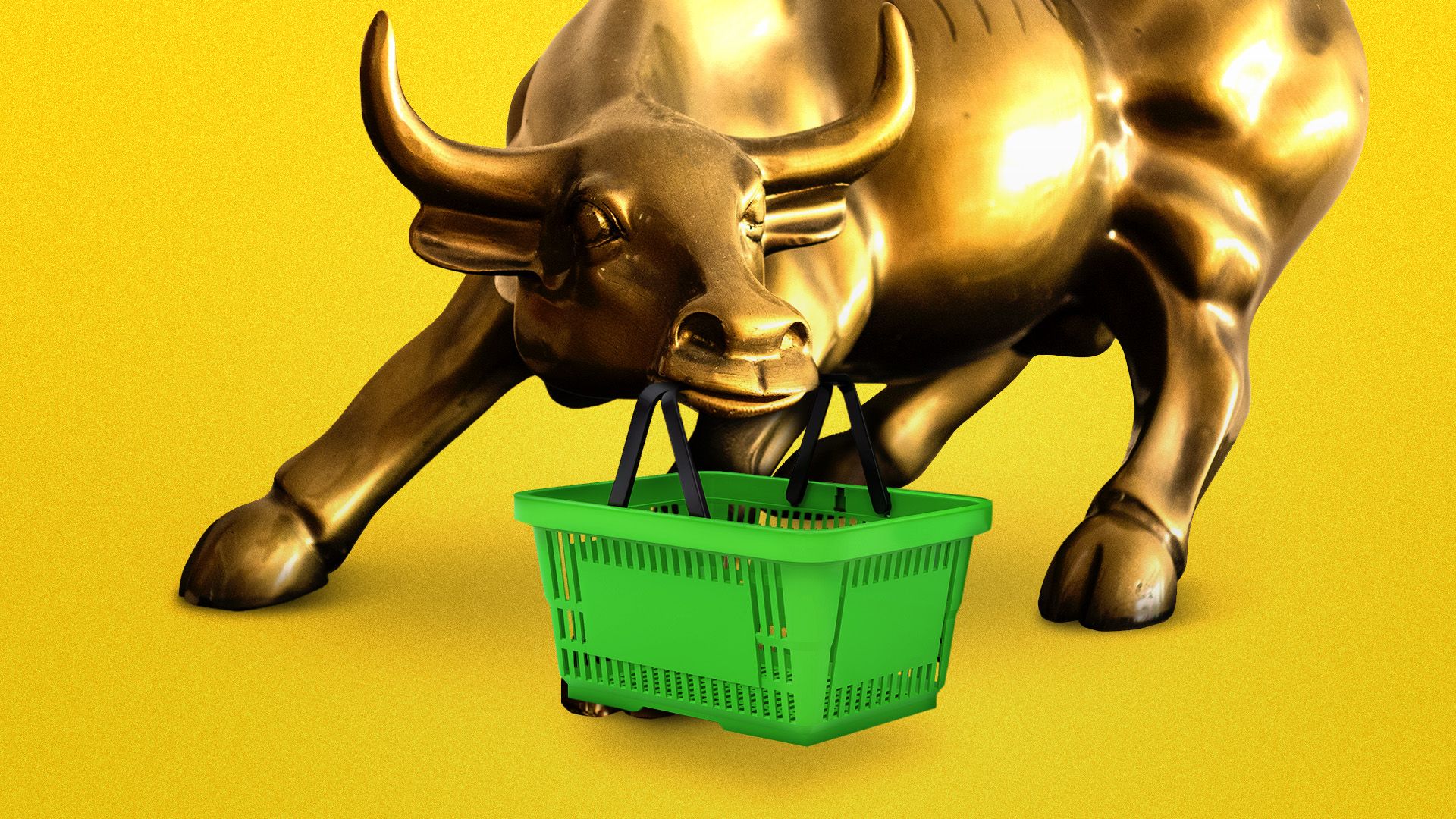
Retail investors were net buyers of stocks in January after being net sellers the previous month, and Big Tech firms were the most popular investments, data from Charles Schwab shared exclusively with Axios shows.
Why it matters: The report analyzes retail investor stock positions and trading activity from millions of accounts, and shows that despite a number of clouds over the market, there is a large cohort of investors still looking for opportunities in stocks.
By the numbers: The Charles Schwab Trading Activity Index, known as the STAX, rose to 49.96 in January from 48.48 in December, showing investors became more bullish about stocks last month.
- It was the biggest percentage gain in the STAX since October 2025.
- Activity was strongest toward the end of the month, when quarterly earnings reports picked up steam.
- Schwab said that it noticed significant dip buying after earnings.
Zoom in: While investors overall rotated out of tech and into materials, industrial and financial stocks, Schwab clients' biggest net buys were still in the Big Tech faves: Microsoft, Netflix, Tesla, Amazon and Nvidia.
- In January, Schwab clients were net sellers of AMD, Costco, Boeing, CoreWeave and Alibaba.
- Generation X investors were the most aggressive buyers in the month, Schwab said, while the Gen Z cohort was the most reluctant.
- "It could be that they're saving for new homes or worrying about the impact of AI on their jobs, but they're not as confident buying," Joe Mazzola, head trading and derivatives strategist at Charles Schwab, said in a statement.
Zoom out: Even as the rotation into non-tech sectors drove the market in January, retail investors remain keen on tech, Mazzola tells Axios.
- "They're still looking for opportunities that have oversold properties," he says.
Thanks for starting your week with us! You can reach us by replying to this email, or send tips and ideas directly to me at [email protected].
Thanks to Jeffrey Cane for editing and to Carolyn DiPaolo for copy editing.
Sign up for Axios Markets