Axios Markets

August 06, 2025

👋 We're back! The question is, are we back to stay? After a tough end of July, markets are up and down this week.
- Today: We unpack fears that the party will end eventually, especially if all this AI spending runs out.
- Plus: Tariffs are causing some gloom, and companies are pulling back on what they share about diversity.
All in 1,050 words, a 4-minute read.
1 big thing: The party has to stop sometime
If you follow markets and the economy, the only thing you've heard over the last few days is that AI spending is propping everything up, from GDP to the S&P, and that can't last forever.
Why it matters: When bubbles burst, they don't do it gently.
The big picture: Like every land rush in history, from railroads to websites with sock puppet mascots, investor faith in AI is strong enough to ignore all the warning signs around them.
- Barring the data center boom, underlying economic growth isn't that strong.
- Valuations in the stock market are stretched beyond all historic norms, and the best earnings growth comes from just a few megacap companies.
- Tariff policy is starting to show up in inflation data, which threatens to weigh on consumers, the real engine of the economy.
What they're saying: "While you can quibble with this or that estimate or figure, the order of magnitudes make it pretty clear that AI itself is not enough to buoy the economy, sales, or earnings ahead," Bob Elliott, chief investment officer at Unlimited Funds, wrote in a Substack post yesterday.
- "Instead it is going to require an overall economic productivity rise to meet the bulls hopes (and then some)."
The intrigue: AI has so far been very good at getting companies to spend on things like chips, buildings and electricity. The spend on all that stuff runs into the hundreds of billions of dollars a year.
- But it's not translating to spending on people. As Callie Cox, chief market strategist at Ritholtz Wealth Management, put it this week, "The human economy is stumbling, but the robot economy is flourishing."
- In fact, some employers are touting how many humans they've been able to fire with AI. Less so how many they've been able to keep paying and retrain into more productive work.
Reality check: There is no sign yet that any of the biggest players in the market are at all inclined to pull back on spending.
- If anything, the demand looks to be strengthening, inspiring the most magnificently performed of the Mag 7 — Meta, Microsoft, Nvidia — to continue a voracious pace of talent hiring and infrastructure building.
What to watch: How the back and forth plays out between the optimists and the pessimists.
- A stew of bad headlines caused a sharp market selloff last Friday. There was an equally enthusiastic rebound on Monday before a dip yesterday.
- "This week will be a telling one: a tug-of-war is unfolding between traditional institutional seasonality, which suggests weakness, and retail investors who may see a dip as a buying opportunity. It's a good test for who's really in control," wrote Mark Hackett, chief market strategist at Nationwide, on Monday.
2. Tariffs are killing the buzz in the market
If the market party is over, the effects of tariffs certainly didn't help any.
The big picture: Imports are plunging, President Trump is threatening heavy new levies on key allies and sectors, and businesses are feeling the squeeze to the tune of billions of dollars.
Catch up quick: The ISM Services report out yesterday pointed to both employment weakness and rising prices, which the chair of the survey committee called "worrisome developments."
- Caterpillar warned of up to $1.5 billion in tariff costs this year, while census data showed imports were plunging even before the new levies took effect.
- Meanwhile Trump threatened up to 250% tariffs on the pharmaceutical industry, as well as substantial increases in the 25% tariffs being paid by India (in an ongoing spat over Russian oil).
What they're saying: "Tariffs are now starting to show up in pricing, and we are seeing increases across the board," one respondent to the ISM survey in the transportation sector said.
- In fact, 60% of the comments published by ISM reflected some kind of negative trade effect.
By the numbers: Stocks fell yesterday, as the investors who bought the dip on Monday were confronted with two realities: The economy isn't as strong as it looks, and the trade war isn't over.
3. Fewer firms share data on women directors

The number of firms publicly disclosing data on women in top management roles or other demographic information plunged this year, a new report finds.
Why it matters: It's harder to identify gender and racial discrimination inside companies without this data.
The big picture: In the wake of the White House crackdown on diversity, equity and inclusion, firms are racing away from anything related to DEI, including simply releasing demographic data on employees and leaders.
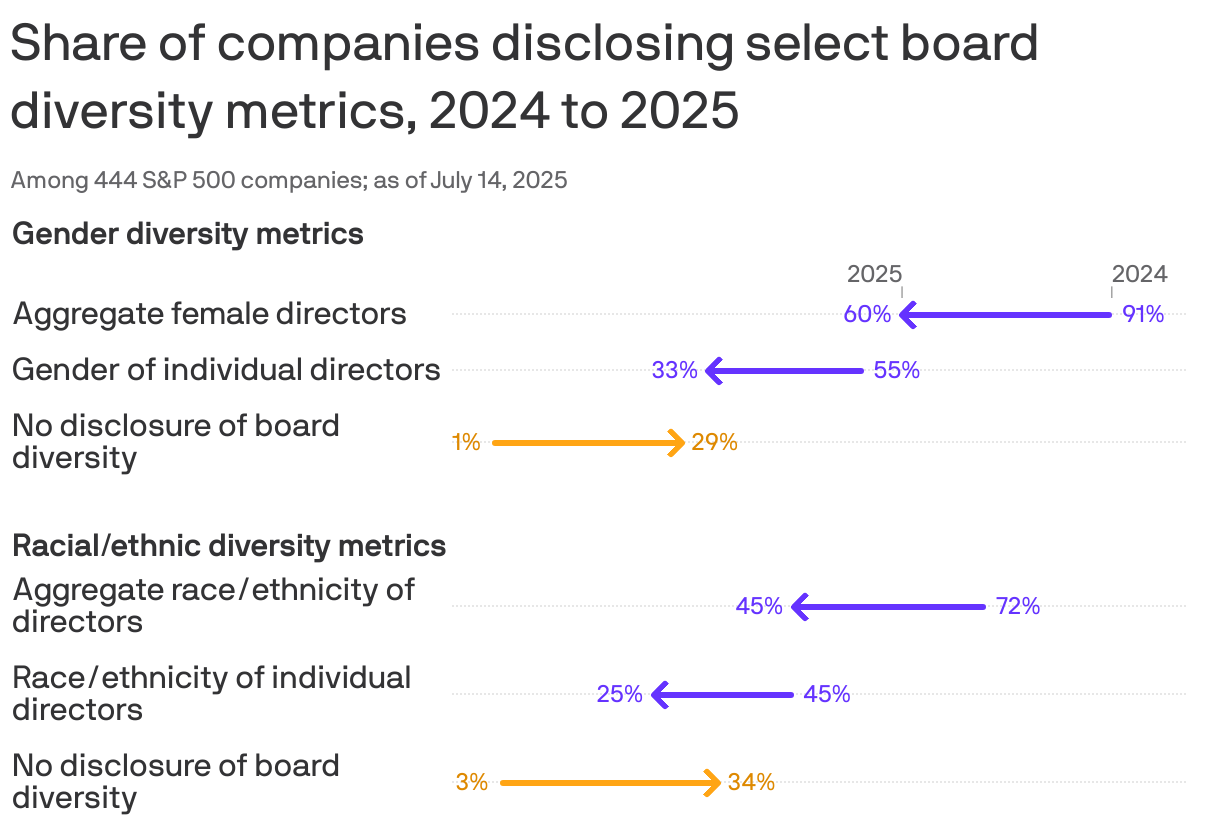
By the numbers: The share of S&P 500 companies that disclose how many women are sitting on their board of directors fell to 60% in 2025 from 91% in 2024, per a report Monday that looked at public filings and disclosures from the Conference Board, a think tank, and analytics firm ESGAUGE.
- That's still a majority, but 30 points is a steep drop.
- The disclosure of racial and ethnic diversity also fell sharply, as the share of firms disclosing racial or ethnic diversity metrics declined to 45% from 72%.
Zoom out: The trend toward transparency started to reverse in 2023, when the Supreme Court struck down affirmative action in universities.
- The ruling "prompted broader corporate reassessment of race- and identity-conscious programs," and was "a key inflection point," per the Conference Board.
- Last year, a different court struck down a rule approved by the Securities and Exchange Commission requiring firms to have at least one woman director and one from an underrepresented group, or to publicly explain why they didn't.
The real earthquake came in 2025, when Trump took office and embarked on a steady drumbeat of anti-DEI moves through executive orders and new rules demanding changes inside companies and universities.
Friction point: The recalibration inside corporate America conflicts with international disclosure standards.
- Companies are still internally considering DEI, and an increasing share are disclosing which board committees oversee the practice, assessing for legal and political risk.
Thanks to Jeffrey Cane for editing and Anjelica Tan for copy editing. Until tomorrow!
Sign up for Axios Markets