Axios Markets

February 20, 2025

🌩️ Good morning. Today we have a sober assessment of the U.S. turn away from Europe and toward Russia, which comes with huge implications for American businesses and the economy.
- Plus: The CEO vibes are pretty strong, and how corporate America is changing its DEI views after 30 days of the Trump administration.
All in 1,060 words, a 4-minute read.
1 big thing: The peril of pivoting to Russia
As Donald Trump pivots away from Europe and toward Russia, he's putting at risk the deepest and most important economic relationship in the world: that between the U.S. and Europe.
Why it matters: The U.S. economy has reaped enormous dividends from the way in which the U.S. government has provided a security guarantee to Europe. If that guarantee goes away, the dividends might, too.
The big picture: "No two other regions in the world are as deeply integrated as the U.S. and Europe," per AmCham EU, which collates such figures.
- More than 60% of foreign investment into the U.S. comes from Europe, and in the other direction, more than 60% of foreign investment by the U.S. goes into Europe.
- Similarly, U.S. companies employ about 5 million Europeans, while European companies employ some 5 million Americans.
- European companies are major employers in several Trump-supporting states, including BMW in South Carolina, Volkswagen in Tennessee, Airbus in Alabama, and Siemens in Texas and the Carolinas.
Zoom out: "Security goes hand in hand with interdependence," Abraham Newman, a Georgetown University political scientist, tells Axios.
- "From the Marshall Plan to the creation of the EU, the U.S. made the bet that if you solved security issues it would generate huge new wealth for U.S. companies. And it did," he says.
- Former U.S. Treasury secretary Hank Paulson tells a story of a Chinese official saying to him that "you have all the good allies." Effectively, China has always been stymied, in terms of competition with the U.S., by the fact that America is strongly allied with Europe.
Between the lines: The depth of the U.S.-EU relationship dwarfs anything that Russia can offer. Even before Russia first invaded Ukraine in 2014, for instance, U.S. goods exports to Russia were a mere $11 billion, roughly one-third of U.S. exports to Belgium alone.
- Russia, per the New York Times, claims American losses due to pulling out of Russia have totaled more than $300 billion. But that doesn't mean there's anything close to $300 billion of opportunity in reopening Russia to U.S. business.
- Edward Fishman, a former Russia sanctions lead at the State Department, tells Axios: "The U.S. is much better at turning off economic activity than we are at turning it on."
- Even if all U.S. sanctions on Russia were lifted tomorrow, most American companies would still be extremely wary of reentering a country led by Vladimir Putin, and would likely stay away.
What's next: If Europe no longer benefits from U.S. geostrategic protection, that in turn will affect the way American companies are viewed on the continent, per Georgetown's Newman.
- As U.S. companies become increasingly viewed as a mask for U.S. power, he says, the rhetoric surrounding them will move from complaints about fair competition to worries that they represent a security threat.
The bottom line: If Europe starts seeing the U.S. as an enemy superpower, the negative consequences for the U.S. domestic economy would likely be enormous.
2. CEO confidence is surging again
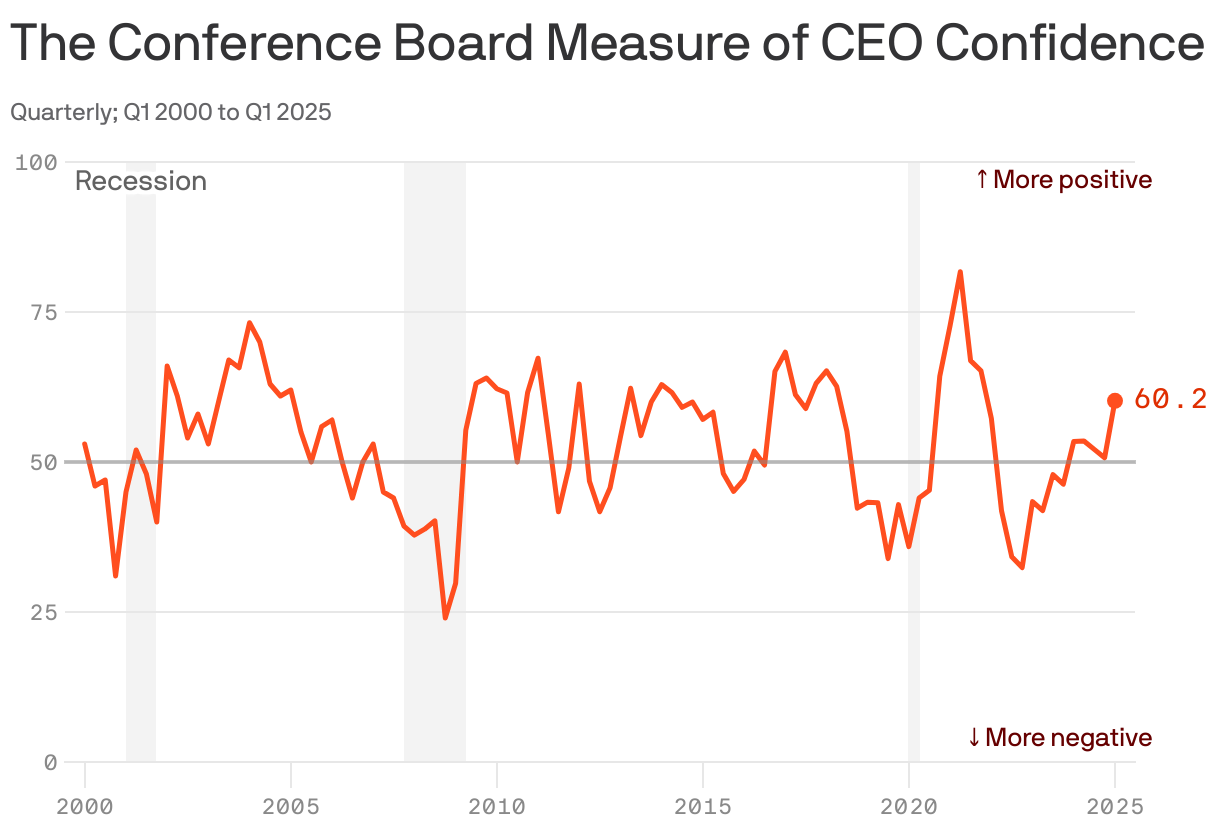
Corporate leaders are feeling good: A measure of CEO confidence rose to its highest level in three years, per a post-inauguration survey out this morning.
Why it matters: The surge happened even as President Trump announced new tariffs on the country's largest trading partners, sparking fears of economic fallout for both companies and consumers.
How they did it: 134 CEOs from the Fortune Global 500 were surveyed from January 27 to February 10 by the Conference Board, in conjunction with the Business Council, a CEO membership group.
- Leaders were asked how they view current economic conditions, and for expectations of conditions over the next six months in their own industry and the economy writ large.
What they found: Confidence surged 9 points to 60, the highest level since 2022 and the first significant jump into clear positive territory in years. (Any number over 50 is considered positive.)
Reality check: There are headwinds here. The share of executives who said geopolitical instability is a high-impact risk rose to 55%, up from 52% in the previous quarter.
- Only 32% said they were expecting to increase the size of their workforce, compared with 40% in the previous survey.
- Other surveys out recently are painting a less rosy vibe, as well. Small business optimism fell in January, and optimism also declined among manufacturers in a survey from the Federal Reserve Bank of New York.
3. Changing DEI in the Trump era
Companies are scrambling to rejigger, recast or kill their diversity, equity and inclusion policies to avoid the wrath of the White House.
Why it matters: Firms are on a tightrope with legal risks on either side: Stick with DEI and face a Trump DOJ investigation or lawsuit, or abandon it and face the potential for lawsuits from employees and job applicants.
- Either way companies run the risk of angering customers and staff.
Where it stands: Corporate America's DEI anxiety intensified after February 5, when newly sworn-in Attorney General Pam Bondi issued a memo directing the Civil Rights division "to investigate, eliminate, and penalize illegal DEI and DEIA preferences, mandates, policies, programs, and activities in the private sector."
- By March 1, the Civil Rights division should report "the most egregious and discriminatory DEI" practitioners, per the memo.
- That followed an executive order Trump signed the day after taking office that directed agencies to make lists of companies to target.
What they're saying: Since the Bondi memo came out, "I have been on the phone with companies almost nonstop," says Jonathan Segal, an employment attorney at Duane Morris.
- There's been a flurry of news about several firms, including Accenture, Booz Allen, Goldman Sachs and Disney, pulling back or scrapping DEI altogether.
Zoom in: The disappearing policies mostly involve explicitly targeting certain underrepresented groups in hiring. Lawyers say some of these practices were always dicey under federal anti-discrimination laws.
Between the lines: DEI policies viewed as less risky, like employee resource groups, or ERGs, where people from the same background can connect, are also changing.
- Many companies have groups for women, parents, LGBTQ+ people, Black workers, etc. Firms are now making it clear these groups are open to all.
The big picture: Anti-DEI sentiment was building, and companies were rolling back polices, before Trump took office.
- 45 companies have been attacked for their DEI policies in the past three years by opposition groups led by White House deputy chief of staff Stephen Miller and activist Edward Blum, according to a tally from Bloomberg.
Thanks to Ben Berkowitz for editing and Anjelica Tan for copy editing. See you tomorrow!
Sign up for Axios Markets