
Axios Markets

April 25, 2024
🌅 Welcome back. It's April 25, aka the perfect date. Grab your light jackets and seize the day! Today's newsletter is 967 words, 4 minutes.
1 big thing: Worker rules
Illustration: Annelise Capossela/Axios
It's been a big week for U.S. workers, courtesy of regulators at the Federal Trade Commission and Department of Labor, Emily writes.
What happened: The FTC banned noncompete agreements and the Labor Department expanded its rule on when employees are owed overtime.
Why it matters: Their actions, along with the recent flurry of union activity and a still-tight labor market, are helping swing the balance of power between capital and labor in the U.S. closer to workers
- Yes, but: Big legal hurdles could keep these new rules from taking effect.
The big picture: There's an inherent imbalance of power between employers and the individual workers who serve at their discretion — and regulation is one way to adjust for that.
- Along with its big support for unions, regulations like these are part of the White House's attempt to pull power to labor's side.
State of play: On Tuesday, the FTC banned noncompete agreements — which prevent employees from taking jobs with their employer's competitors for a certain period. It was the first time in a half-century the agency mandated an "economy-wide" change, as the WSJ pointed out.
- The rule is meant to take effect in August — and if that happens, it would make it easier for workers to job-hop and, the agency says, could lead to higher wages.
Reality check: On Wednesday, as expected, business groups filed a lawsuit in Texas federal court to stop the noncompete rule from taking effect.
- Observers think the suit is likely to succeed — the judge who will hear the case, J. Campbell Barker, has overturned other actions from Biden federal agencies, including the COVID-era eviction moratorium and banking regulations around race discrimination.
- The Trump nominee is the "go-to judge for litigation against the power and reach of the administrative state," Bloomberg Law recently noted.
- And any appeals will land at a conservative Supreme Court that's been fairly hostile to regulations.
Meanwhile: The Department of Labor's rule change about overtime pay could mean raises for millions of workers.
How it works: Right now employers must pay employees time-and-a-half if they work more than 40 hours a week.
- But if a worker is paid a salary over a certain minimum threshold and primarily performs executive or professional duties, they don't qualify for overtime pay.
- Currently, that minimum salary is $35,568 a year. The new rule would bump it up to $43,888 on July 1, and then to $58,656 in 2025.
- The final rule would benefit 4.3 million workers, more than half of them women, per an estimate from the progressive Economic Policy Institute. It could result in a transfer of $1.5 billion in pay annually from employers to workers.
Between the lines: It's likely the overtime rule will also be challenged, but the chances that the first increase overcomes that challenge are pretty good, says Brett Coburn, an employment attorney at Alston & Bird.
- Businesses have a few options for dealing with the new rule: Give managers raises to get them over the threshold, start paying overtime, or curb worker hours.
- It's a win-win for employees, whatever they choose, says Heidi Shierholz, president of the Economic Policy Institute, who worked on the Obama administration's ultimately failed efforts to raise the overtime threshold. "Workers will either get higher pay or they'll get their time back."
2. Where states land on noncompete bans
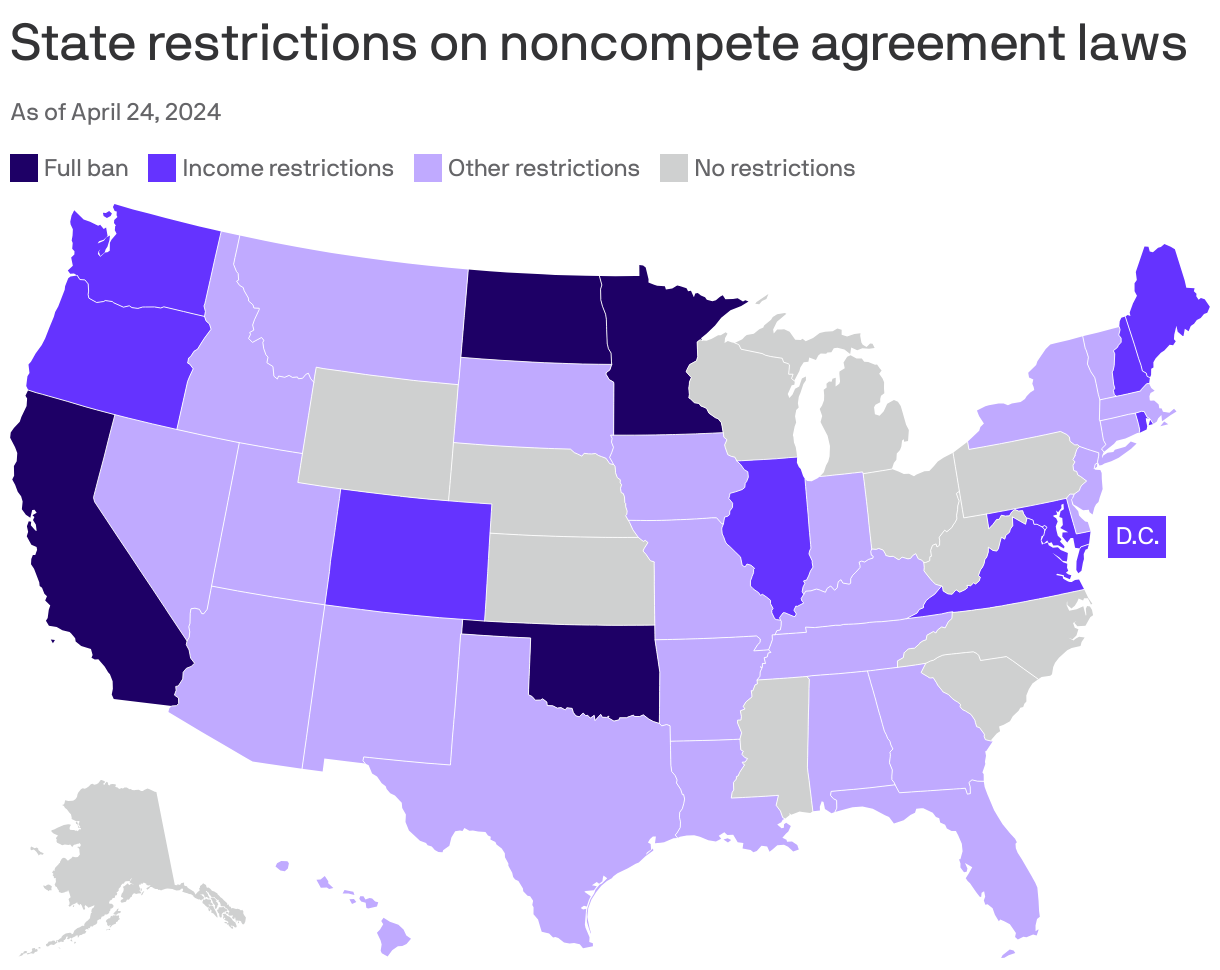
Even if the FTC's ban is rejected by the courts, employers will still face restrictions on noncompetes, Emily writes.
- Plenty of states already limit the use of noncompete agreements — Minnesota became the fourth state to pass a ban last year.
- And more states are considering passing restrictions — many aimed at the health care sector, where these contracts are particularly popular, as Axios' Tina Reed reports.
Between the lines: The lawsuit centers on the FTC's ability to establish a nationwide ban. It doesn't challenge states' regulating noncompetes.
3. 🔌 Electronics price surge drove inflation

Illustration: Annelise Capossela/Axios
Consumer electronics and software prices increased at a 22% annualized rate in the first quarter, according to an analysis from Jessica Rindels, U.S. economics analyst at Goldman Sachs, Emily writes.
Why it matters: It's the largest quarterly increase in this category going back to 1959, when the Personal Consumption Expenditures Price index first started, she says.
- And it's likely due to the reversal of some big end-of-year promotions that drove prices down at the end of 2023.
- "Consumer electronics" is a shorthand for the category of "audio, video, photographic, and information processing equipment" in the PCE.
The big picture: The increase in electronics and software prices, along with higher prices for financial services, health care and foreign travel, helped drive a hotter-than-expected increase in core PCE inflation — the Fed's preferred inflation gauge.
- Core PCE rose at a 4% annualized pace in the first quarter, up from 1.9% in the second half of 2023. That helped change the economic outlook for the rest of the year — instead of expecting rate cuts, markets are pricing in a higher for longer scenario.
- It's why mortgage rates are climbing, with the average on the 30-year hitting 7.24%, per the Mortgage Bankers Association — the highest level since November 2023.
What to watch: A new PCE print is due out Friday morning. Goldman expects annualized quarterly inflation to slow and return to 2.2% over the next three quarters.
4. Meta falls


Meta shares plunged by more than 16% after the close yesterday, on news that the social media company's AI spending was going to be billions of dollars higher than the market had anticipated, Felix writes.
- The drop is reminiscent of the last time Meta's stock entered freefall — back when it was spending billions on its huge bet on the metaverse.
Our thought bubble, via Axios tech editor Scott Rosenberg: AI definitely has a lot more reality going for it than the metaverse, but Meta has not been in the lead with AI.
Thanks for starting your day with us! If this email was forwarded to you, subscribe here.
Axios Markets is edited by Kate Marino and copy edited by Mickey Meece.
Sign up for Axios Markets

Stay on top of the latest market trends and economic insights