Axios Markets

April 16, 2025

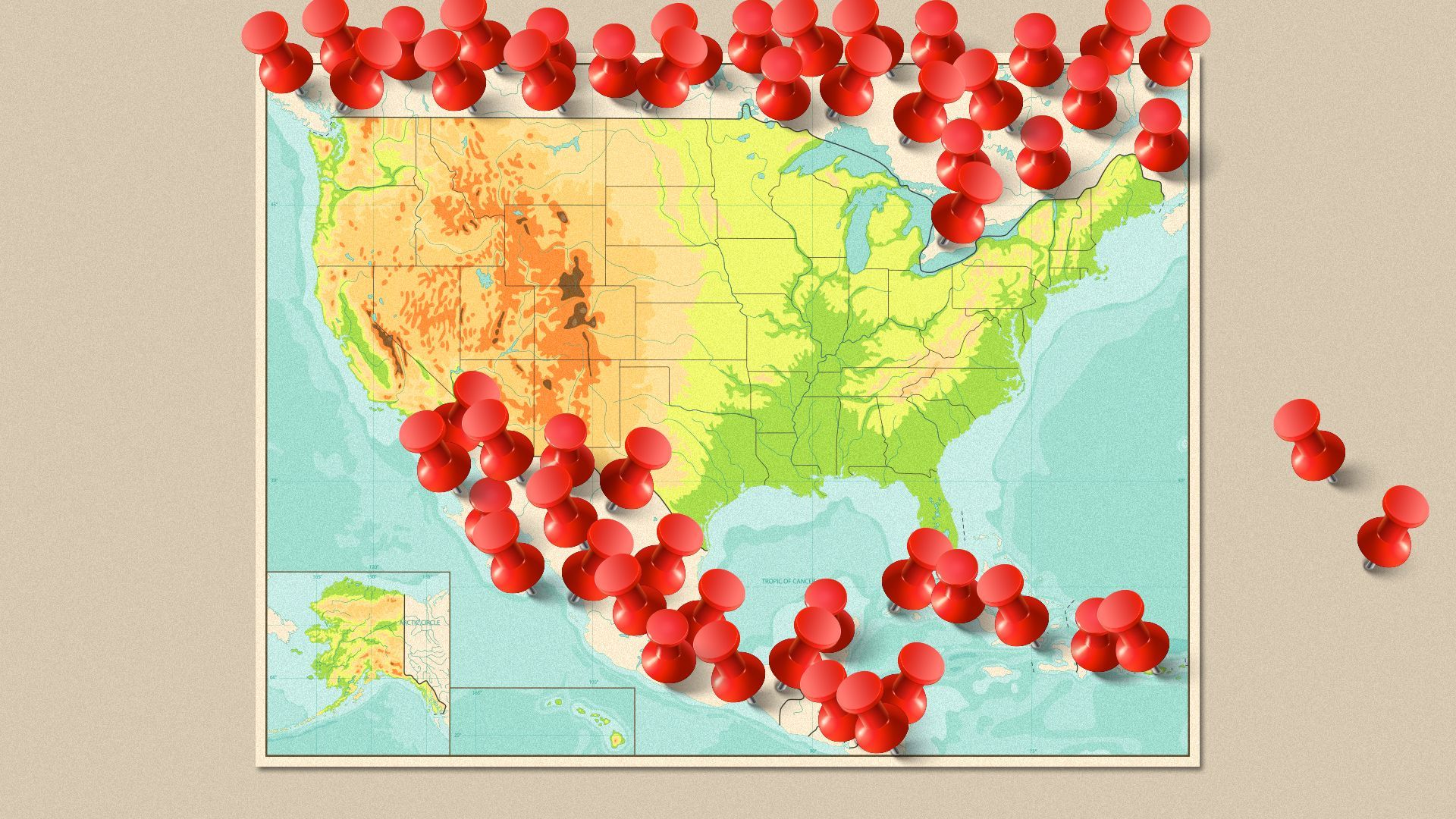
πͺ We're halfway there. Today, you may sense an icy theme.Β There's a cooling in international tourism to the U.S., over fears of the Trump administration's crackdown on foreign visitors.
π₯Ά Plus, Felix unpacks the recent jam in the junk bond market with numbers provided by ICE Data Indices.
- Before we get to that, Axios Macro author Courtenay Brown shares the latest on the small businesses pushing back on President Trump's tariffs.
It's all in a very chill 1,140 words, 4 minutes. Let's do this.
1 big thing: Trump tariffs are on trial
U.S. courts have the potential to be the biggest threat yet to the central tenet of President Trump's economic agenda.
Why it matters: Legal groups representing Main Street businesses want judges to block some tariffs as lawsuits against the levies make their way through the judicial system.
State of play: Bigger names in corporate America have been reluctant to take Trump on in court. A trade group representing major retailers has pulled back on a potential tariff lawsuit, Bloomberg reported this month. Its members were hesitant to proceed.
- Small businesses, however, are involved in multiple lawsuits seeking to block Trump's tariffs. The legal groups that represent them admit it is impossible to know how β and how quickly β courts might respond.
- The latest lawsuit, filed by Liberty Justice Center on Monday on behalf of five small businesses, alleges Trump does not have the power to impose across-the-board worldwide tariffs without congressional approval.
Between the lines: The White House relied on untested emergency powers to impose tariffs, a move at least three lawsuits now argue is executive overreach.
- Trump invoked authorities under the International Emergency Economic Powers Act (IEEPA), which gives the president wide-ranging powers in an emergency.
- Trump signed executive orders saying that illegal drugs, undocumented immigration and "large and persistent" trade deficits constituted national emergencies.
Yes, but: IEEPA has never been used to implement tariffs since its creation in 1977.
- "Even if you declare an emergency, it doesn't let you tax the American people. It doesn't let you impose a tariff," says Andrew Morris of New Civil Liberties Alliance, which filed a lawsuit against the China tariffs on April 3 in a Florida district court on behalf of a local retailer.
The other side: White House spokesman Harrison Fields told Reuters, "Never Trumpers will always oppose him, but President Trump is standing up for Main Street by putting an end to our trading partners β especially China β exploiting the U.S."
- While use of the emergency law to impose tariffs is unprecedented, courts have previously granted presidents other wide authorities under IEEPA.
What to watch: Liberty Justice Center tells Axios it is preparing to file for a preliminary tariff relief that, if granted, could result in suspended across-the-board tariffs
- The risk is if a small business goes under before a judge rules on the tariffs that threaten the business.
- "In six months or a year from now, these businesses could look really different and monetary damages aren't going to be able to make that up," says Jeffrey Schwab, lead attorney on the case.
The bottom line: Tariffs are the latest policy under legal scrutiny, posing a test for how the administration handles potential fallout from the judicial branch.
2. Tourism to America under threat
International tourism to the U.S. is falling fast, and the actions of the Trump administration are only likely to make things worse, industry experts say.
Why it matters: The travel industry was worth $1.3 trillion in 2024, and supported 15 million U.S. jobs, per the U.S. Travel Association. Now, that revenue β and those jobs β are being threatened.
The big picture: Non-U.S. citizens were already wary about visiting the U.S. in March, according to Aran Ryan at Tourism Economics.
- Visits from Germany alone plunged 28% year-on-year in March, he wrote in a recent report, showing the "early ramifications of a potent mix of negative sentiment, which has developed abroad in response to polarizing rhetoric and policy actions by the Trump administration, as well as concerns around tighter border and immigration policies."
What's next: "March may be just the beginning," he added, noting that the "Liberation Day" tariffs will only damage sentiment further.
Driving the news: Secretary of State Marco Rubio sent an extremely harsh message on Saturday to anybody thinking of visiting the country.
- "Visiting America is not an entitlement," he wrote in a Fox News opinion piece.Β "It is a privilege extended to those who respect our laws and values."
- "We expect β and the law requires β all visa holders to demonstrate their eligibility every day their visa is valid."
Between the lines: "When you're traveling to another country, whether it's for a business trip or a personal trip, you you want to have the assurance that you're going to be able to enter the country and be welcomed," said Henry Harteveldt, president of Atmosphere Research Group.
- "The actions and words of the U.S. right now are not very welcoming to international visitors."
For the record: The State Department did not respond to repeated requests for comment.
3. What the bond market is saying


The bond market, just like the stock market, is sending signs that maybe you can start breathing again. Not breathing normally, perhaps, but still, breathing.
Why it matters: The junk bond market seized up entirely after the "Liberation Day" tariff announcements on April 2, but now it's showing signs of life.
The big picture: The bond market is more important for the economy than the stock market, since it's the main way for real money to find its way into companies and deals. (The stock market, by contrast, is overwhelmingly dominated by investors just selling shares to other investors.)
Where it stands: After April 2, no companies rated below investment grade β the high yield, or junk, issuers β were able to issue debt at all, until yesterday, when a single natural gas company came to market.
- A closely watched index of high-yield spreads, from ICE BofA, spiked alarmingly from 3.42 percentage points on April 2, before Trump's reciprocal tariffs were announced, to 4.61 points on April 7.
- That is on top of the rise in rates over the same period. The underlying interest rate, plus the spread, is the total yield on the bond.
- Since then, spreads have come back in, to about 4.14 points yesterday, in a sign that outflows from the bond market have ceased and opportunistic funds have started buying.
- "It's not a disaster for high yield," says Bill Zox, a high-yield bond portfolio manager at Brandywine. "We had a very bad week of outflows. But things do seem to have settled down."
Zoom out: When the market expects a recession, it tends to trade at a spread of about 6 points, Zox says, compared to about 2.5 points when it doesn't. So the pullback in recent days means that we've moved from being about halfway to recession levels to being about a third of the way to recession levels.
The other side: Liquidity remains scarce, Zox says, with bid/offer spreads at historically wide levels. That means a lot of investors are happy to wait for attractive opportunities in the future instead of putting money to use today.
The bottom line: Private-equity companies are still going to find it hard to issue a lot of new debt to finance leveraged buyouts. But we're not at crisis levels yet, or even at levels that presage a recession.
Thanks to Pete Gannon for editing and Anjelica Tan for copy editing. See you tomorrow!
Sign up for Axios Markets


/2025/04/15/1744753500449.gif?w=3840)