
Axios Markets

January 20, 2024
Greetings from New York, where I've had no altitude sickness and no FOMO and no jet lag all week.
- In this week's newsletter, I check in on Argentina; look at what happens when people find out how sustainable the brands they're buying are; speculate about how the government got its hands on phone transcripts of a Morgan Stanley trader; and — as ever — enhance collective consciousness ecosystems while doing so. All in 1,270 words, a 5-minute read.
1 big thing: Economic restructuring, from A to Z

Illustration: Shoshana Gordon/Axios
If your economy is broken, you can try to fix it — or you can essentially just throw it in the trash and try to build something new from scratch.
Why it matters: The latter is, broadly, the plan of anarcho-capitalist Argentine president Javier Milei, while the former is the plan of Zambian president Hakainde Hichilema.
Where it stands: Milei came in like a wrecking ball after he took office in December. He slashed the official value of the currency in half, introduced a "mega-decree" scrapping 366 separate rules, and laid off 5,000 government employees.
- Alejandro Werner, the former head of the International Monetary Fund's Western Hemisphere department, explains that this course of "shock therapy" carries enormous risks, both to the upside and the downside.
- The devaluation, at least for the next few months, increases the Argentine inflation rate, which was over 200% in 2023. Milei's budget cuts will also cause a plunge in household income, as well as a deep recession.
- The economic pain will embolden Milei's opposition — including in the courts, which have already suspended many of his early decrees. A general strike is planned for Wednesday.
What we're watching: Werner is hopeful that Congress will be at least minimally cooperative, that a good agricultural harvest will help replenish foreign reserves, and that inflation will fall to an annualized rate of 50% by the end of the year.
- Argentina being Argentina, however, Werner notes, it's entirely possible that Milei's opponents in Congress will block most of his policies and devastating hyperinflation will result.
Reality check: Argentina's action stands in stark contrast to the zugzwang in Zambia, which is trying to restructure the old-fashioned way. There, creditors find themselves in a standoff without any obvious resolution — and where even the IMF seems powerless to move things forward.
Between the lines: Milei was quite the toast of the Davos elite this week, notwithstanding the fact that he's on the record calling climate change "a socialist lie."
- "The Argentine economy is in such bad shape that it has to be shaken up. President Milei and his team are doing exactly that," said IMF chief Kristalina Georgieva in a CNN interview.
- Milei returned the favor, saying that the CEOs assembled for his speech were "social benefactors" and "heroes."
- "Let no one tell you that your ambition is immoral," he added.
The bottom line: For the time being, Milei seems to be able to draw on a wellspring of support and goodwill from the international community.
- The IMF has restarted its program in the country, which means $4.7 billion in international funds have been unlocked and default isn't imminent.
- All the same, Argentina's bonds are still trading at roughly the same level as those of Spirit Airlines. Some kind of default remains more likely than not — just pitched as part of a bold recovery plan, rather than being draped in anti-creditor rhetoric.
Bonus: The ever-shrinking peso


2. The sustainability boost
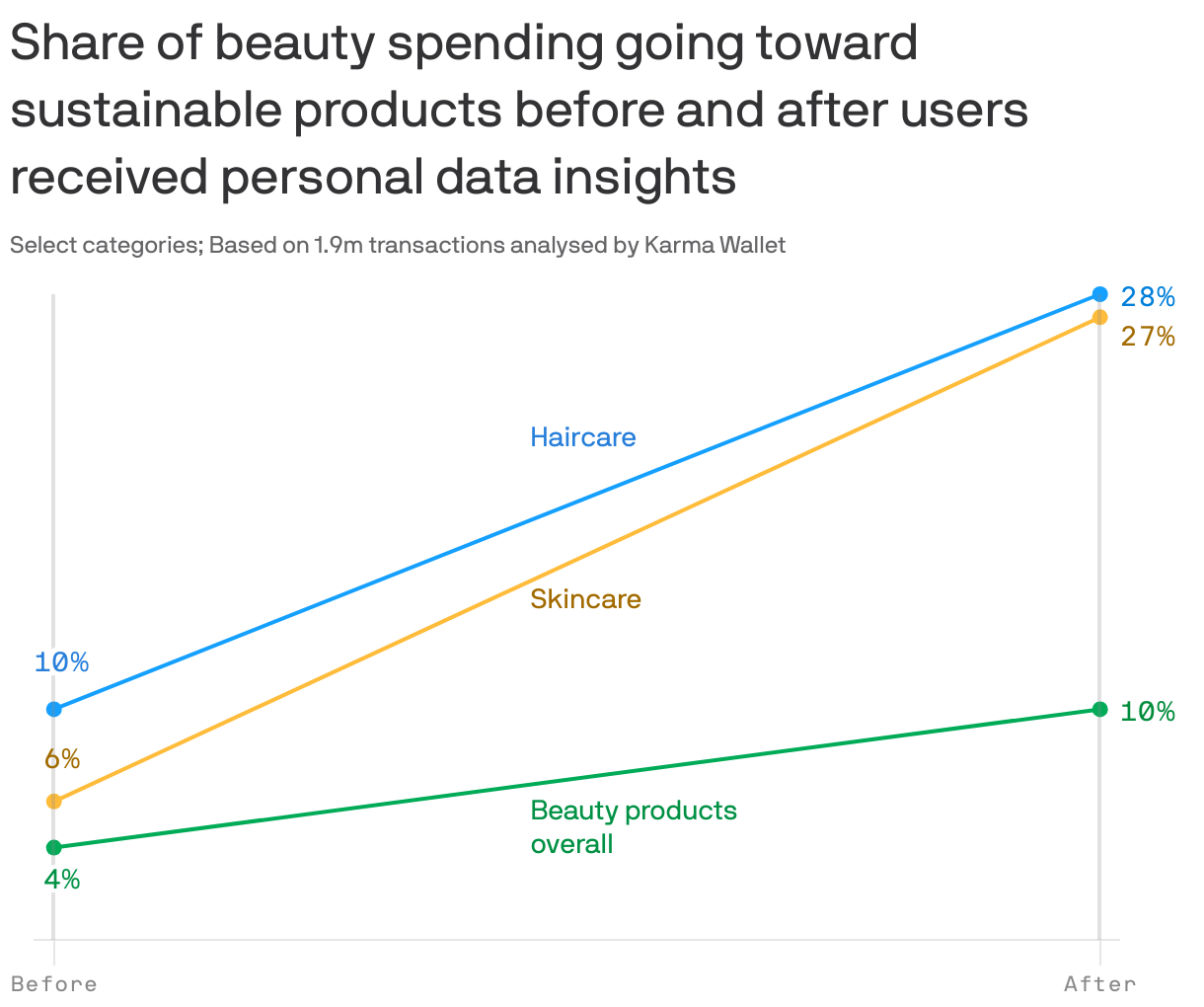
Sephora might be the hot tween hangout, as I wrote this morning, but that doesn't mean it isn't also popular with socially conscious adults.
Why it matters: Once those grown-ups get information on which brands are the most sustainable, they change their purchasing habits dramatically.
How it works: Karma Wallet is a company that allows you to link your credit card to its brand database and see how much of your spending takes place at companies that are aligned with the United Nations' Sustainable Development Goals.
By the numbers: Out of 17,749 brands in the database, 3,250, or 18%, have a ranking high enough that they're considered to be sustainable.
- Three beauty brands in particular boast very high scores — Prose, Beautycounter, and Aveda, which is owned by Estée Lauder but is also a B Corporation, a designation that certifies a company's positive social and environmental impact.
- When consumers get data on the sustainability of the brands they're spending money on, they tend to massively increase their spending on those three brands.
The bottom line: It's easy for brands to boast about how sustainable they are. But when the data comes from a trusted third party, it can move consumer spending — especially on largely discretionary purchases like beauty — by a surprisingly large amount.
3. The Morgan Stanley phone-transcript mystery

Illustration: Annelise Capossela/Axios
Morgan Stanley has agreed to pay $250 million after it emerged that the head of its block trading desk, Pawan Passi, had tipped off hedge funds to large upcoming sales — after explicitly promising his clients that he wouldn't do so.
Why it matters: The case sheds a tiny bit of light on how far the government will go when it's investigating a bank.
For the record: The statement of facts in the case includes multiple transcribed phone calls between Passi and hedge funds. But they weren't obtained easily. The wording is intriguing:
"These calls were not recorded by Morgan Stanley, nor did they take place on a regularly-recorded line, unless otherwise noted. Rather, the Government obtained the calls described below, as well as other calls in which Morgan Stanley employees discussed block trades, in the course of its investigation."
Between the lines: The behavior in question took place — by Passi's own admission — between 2018 and 2021. But Passi's damning transcribed phone calls took place at the very end of that date range, in May 2021 or later.
Be smart: The government doesn't say exactly how it obtained the calls. But there are a few possibilities.
- It's possible that the government persuaded the hedge fund traders to record their calls with Passi — although it would be weird that they would then have been allowed to trade on the material non-public information they received.
- If the hedge fund traders were on their desk phones, then it's also possible the government recorded those lines without the traders' knowledge — but with the knowledge and consent of the hedge fund's general counsel.
My thought bubble: The most likely explanation, however, is just that the government started by investigating suspicious trades by hedge funds. After the hedge funds came clean and told the investigators what Morgan Stanley was doing, that in turn was enough for the government to get a warrant to tap Passi's personal phone.
The intrigue: The statement of facts looks as though it describes pretty cut-and-dried insider trading at multiple hedge funds. But there's no sign of any settlements or charges. Even Passi avoids any criminal conviction — although he did forfeit $7.4 million in compensation.
The bottom line: Passi was smart enough not to put the confidential information in writing, or to talk about it on a regularly recorded line.
- In a world where he was in New York and at least one of the hedge funds was in Nevada, however, an in-person meeting would have been impossible. And phones can always be tapped.
4. Building of the week: Kaffee Klatsch Leadership Lounge, Davos
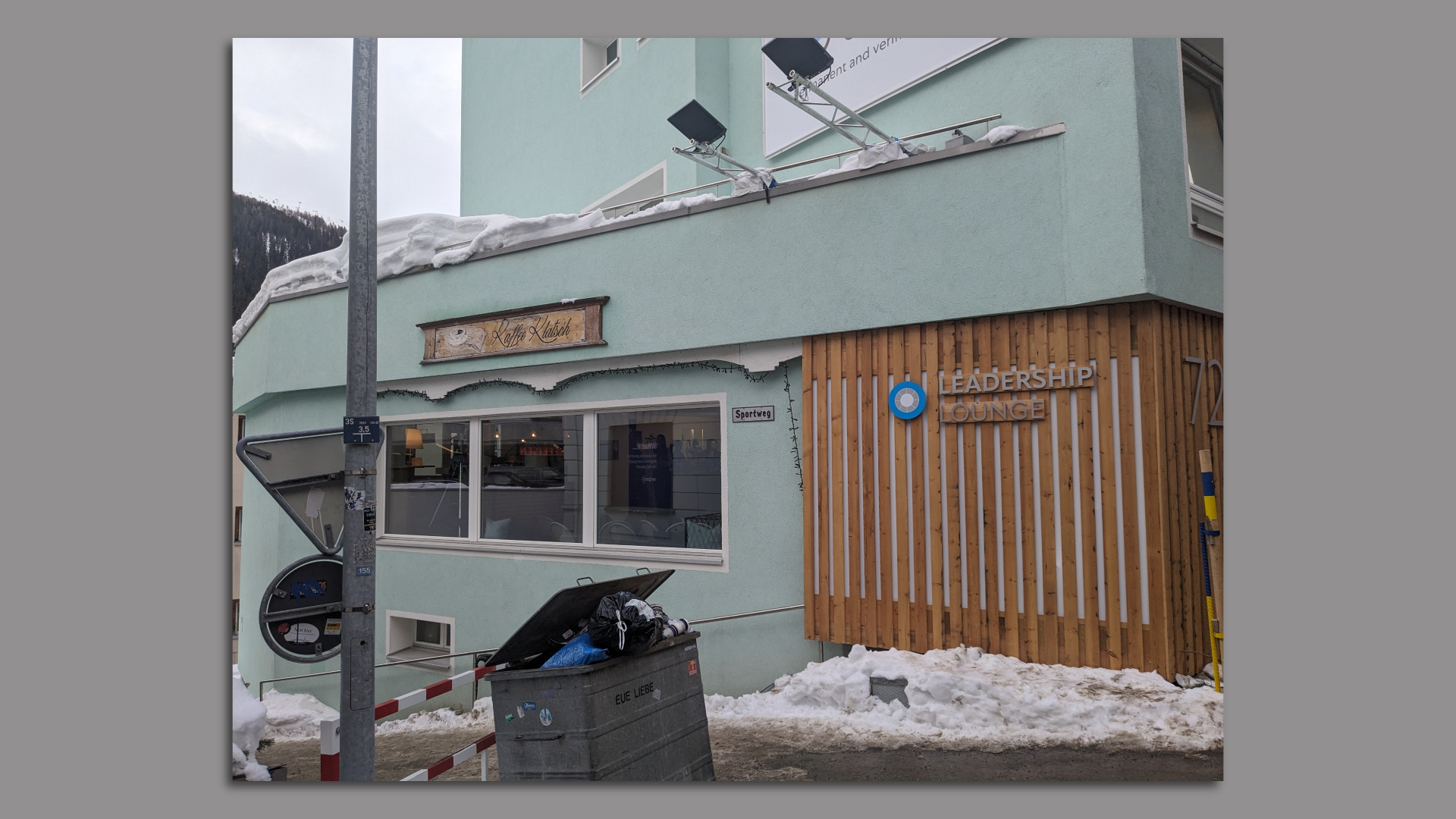
Photo: Nick Johnston/Axios
The Kaffee Klatsch is a Davos institution, a coffee shop that is generally accepted to have the best coffee in town. As this photo by Axios chief photographer Nick Johnston shows, it occupies a pretty dumpy building on a characteristically ill-plowed street corner.
Why it matters: The Kaffee Klatsch has the good fortune to be located on Davos' main drag, the Promenade, making it well-placed to attract a passing oligarch or three. Hence its transformation, this week, into the Kaffee Klatsch Leadership Lounge.
Between the lines: One of the ultra-short-term corporate tenants of the gussied-up coffee shop is Hub Culture, whose self-described "mission is to enhance collective consciousness ecosystems."
- Semafor reports that the space had previously been rented by Zoom — which then backed out a couple of months ago.
The bottom line: In Davos, even lounging in a coffee shop is an act of #leadership.
Many thanks to Kate Marino for editing this newsletter, and to Jay Bennett for copy editing it.
Sign up for Axios Markets

Stay on top of the latest market trends and economic insights