Axios Markets

April 27, 2026

1 big thing: Get creative or "get destroyed"
Comebacks in the tech industry are rare, but Intel is in the middle of an all-time turnaround: The chipmaker's stock is up 110% for the year, and it reached a new all-time high Friday, 25 years after hitting the last one.
Why it matters: The AI transition is creating clear winners and losers in the tech industry, and right now, pick-and-shovel hardware companies are slaying, while software and services firms are suffering.
The big picture: Tech is again performing capitalism's fave move: "creative destruction," in which innovation creates new industries and businesses and at the same time destroys, or at least destabilizes, jobs and companies.
- The PC industry did it to mainframe computers. Then the mobile industry did it to PCs.
- Now, AI is putting everyone through their paces.
- The information technology sector is undergoing "creative destruction on speed" — the title of a note out Saturday from Yardeni Research.
Zoom in: The S&P 500's information technology sector is up 8% year to date, Yardeni notes. But inside the sector there's a remarkable divergence between hardware and software.
By the numbers: The companies that build AI stuff are doing great, while the companies that can be replaced by AI are struggling.
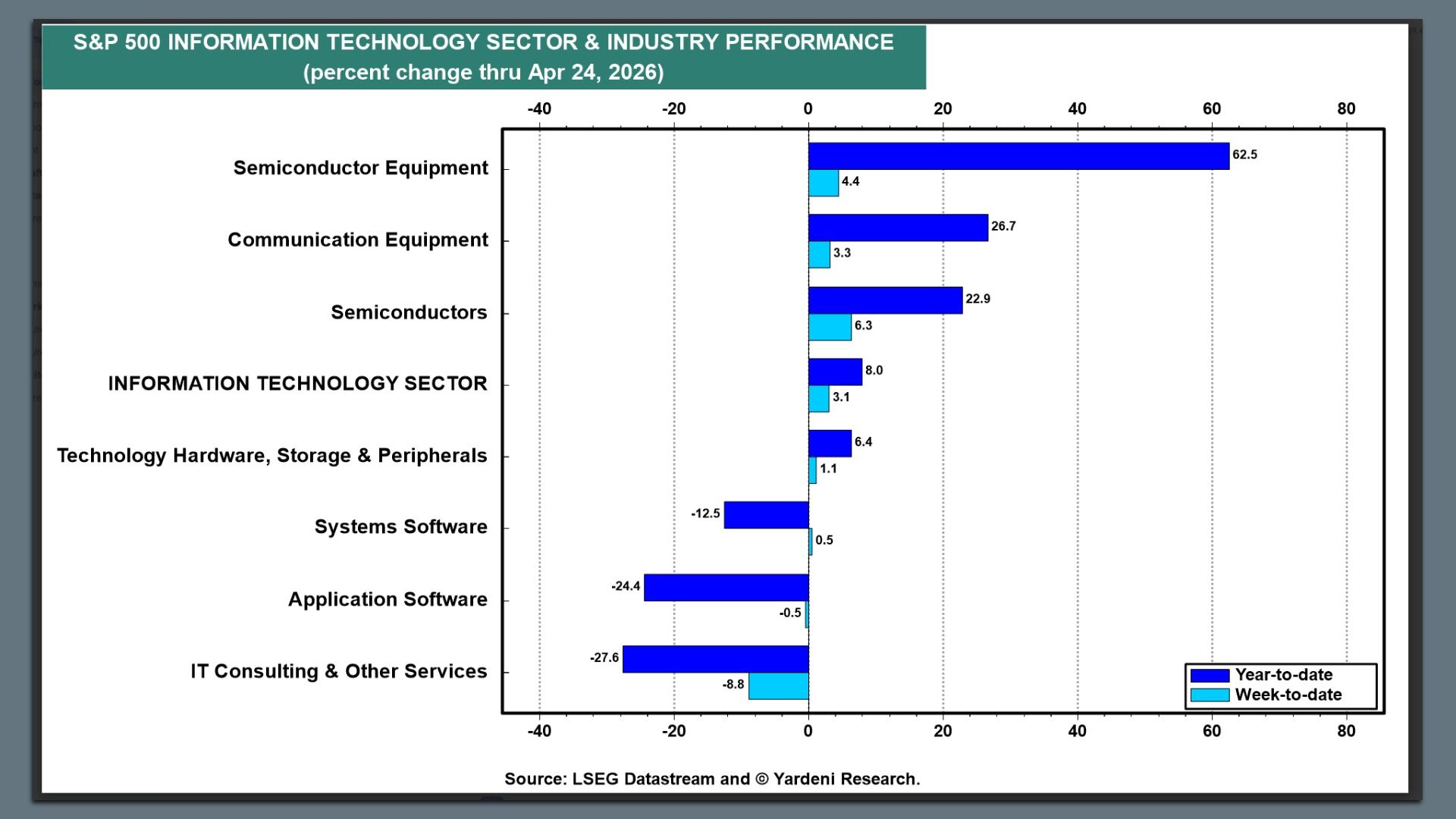
Zoom out: We're probably in the middle of this pick-and-shovel era. It started with Nvidia's explosive rise a few years ago — there was an AI training boom, and everyone needed the company's GPU technology to build AI models.
- That broadened out last year to memory chipmakers.
- Power companies and data storage firms also boomed.
- CPU chips, of the sort Intel makes, are entering the chat — where GPUs built the AI models, now the CPUs are needed to do the day-to-day work.
What they're saying: "In recent months, we have seen clear signs that the CPU is reinserting itself as the indispensable foundation of the AI era," Intel CEO Lip-Bu Tan said in the company's investor call Friday.
Reality check: Early winners in tech transformations sometimes wind up losing.
- In the transition to the internet era, telecom companies were the "picks-and-shovels," as Wall Street Journal columnist James Mackintosh wrote yesterday. Hopes were high for these businesses, but their success didn't last.
- "There's no guarantee that today's leaders will ultimately come out on top."
Yes, but: Other companies have successfully made it through these kinds of transitions — Microsoft lost its way for a while after the PC's dominance faded, but found new strength in cloud computing, for example.
- Apple, of course, was a PC company that created the mobile era.
The bottom line: "That's the way creative destruction works," Ed Yardeni tells Axios via email. "You are either creative or you get destroyed."
2. Nvidia's market cap went up $1 trillion in 4 weeks


Nvidia's market cap climbed by $1 trillion in just the last four weeks.
Why it matters: That's particularly astonishing, given that it took the company 24 years to first hit a $1 trillion market cap.
Zoom in: The stock jumped Friday on the back of Intel's gains.
- With Friday's gain, Nvidia is now valued at more than $5 trillion.
Zoom out: Semiconductor stocks are driving a market rally at the moment.
- Investors apparently believe the AI boom outweighs Iran war fallout.


Axios Markets