Axios Markets

November 05, 2025

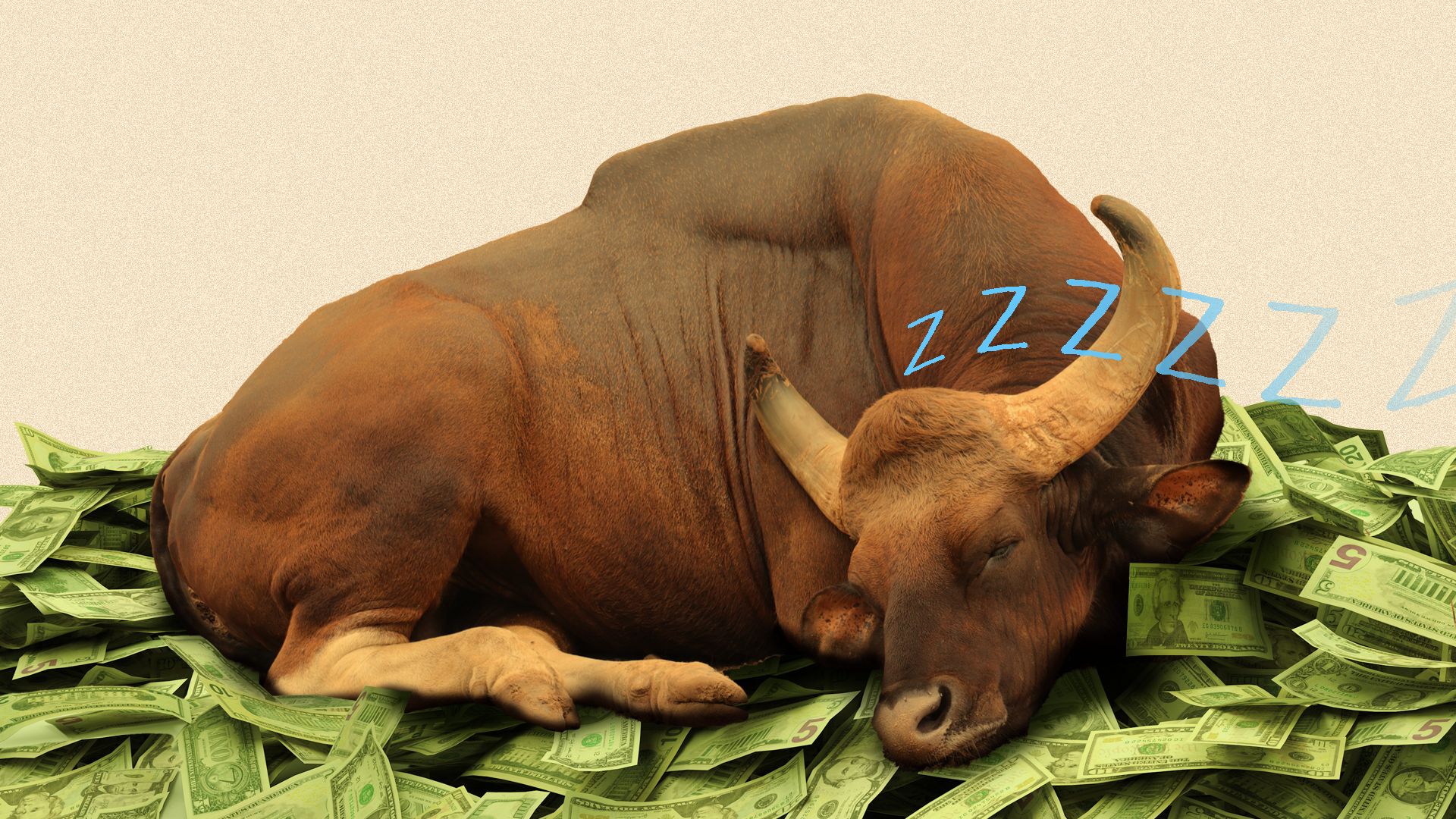
📉 Tech stocks are dragging futures lower this morning after bank CEOs reminded investors yesterday that pullbacks are normal. Stocks also slid overnight in Asia as investors moved to further reduce their global risk.
- Today: How Wall Street CEOs threw the tech rally.
- And: Tariffs get their day at the Supreme Court.
- Plus: Bonuses are surging on Wall Street (again).
Let's get into it. All in 1,140 words in 4 minutes.
1 big thing: Wall Street CEOs warn of market drop
Tech stocks led a selloff yesterday after the CEOs of Goldman Sachs and Morgan Stanley warned of a potential drop in the market.
Why it matters: Equities have rallied in the face of a shutdown, tariffs, macro uncertainty and geopolitical headwinds. The only thing they can't withstand appears to be a warning from Wall Street.
What they're saying: "It's likely there'll be a 10% to 20% drawdown in equity markets some time in the next 12 to 24 months," Goldman Sachs CEO David Solomon told the Global Financial Leaders Investment Summit in Hong Kong.
- "We should also welcome the possibility that there would be drawdowns, 10% to 15% drawdowns that are not driven by some sort of macro cliff effect," Morgan Stanley CEO Ted Pick said on the same panel.
Zoom in: It's not just the Wall Street pros warning of a market pullback.
- Michael Burry, who made his fortune shorting the housing market ahead of the financial crisis (and was portrayed by Christian Bale in the movie "The Big Short"), is shorting Nvidia and Palantir, per his latest 13F filing.
- His moves are watched, and often copied, by retail investors in particular.
Reality check: Drawdowns in the market like this are normal. (Remember we had a nearly 20% pullback in April.)
- Solomon said as much in his remarks, noting that 10% to 15% market pullbacks can happen "often, even through positive market cycles."
- Pick called these kinds of market pullbacks "healthy."
By the numbers: A source pulled a pop quiz on me during a recent interview. (I hated when sources did this when I started covering markets, and now it's my favorite hobby.)
- He asked which decade in market history had four 20% pullbacks.
- I incorrectly guessed the 1930s. The right answer? The last decade.
- We had a bear market in 2022, a regional banking crisis in 2023, and an intraday bear market this April. Yet stocks are up over 220% over that period, indicating drawdowns don't kill returns.
- Over the last 35 years, distinct drawdowns of more than 10% have occurred 13 times, or roughly once every three years, according to Wilmington Trust, which notes that market drawdowns are normal.
What to watch: Drawdowns don't stay long in this bull market because of persistent dip buyers.
- Strategists tell Axios that any break in that pattern could spook retail investors, and therefore cause a bigger and longer lasting pullback.
2. Wall Street is not ready for a change in tariffs
The Supreme Court will hear arguments today on whether President Trump's sweeping global tariffs are legal.
Why it matters: Once viewed as the biggest drag on markets for the year, investors have largely accepted the tariffs. They may not be prepared for a potential change to the levies.
What they're saying: "The market expects a benign outcome" though there is "considerable uncertainty on how the Court will rule," according to a research note from Standard Chartered.
- A pause or stop to the tariffs could weaken the U.S. dollar, and yields could then rise. Unwinding the tariffs could fuel volatility, the analysts wrote.
- Investors may want to sell out of dollar-denominated assets if they are concerned the lack of tariff revenue could hurt America's ability to chip away at the deficit.
- A ruling that lets sweeping tariffs stay in place would be "friendly to U.S. asset markets short term" as it would lower uncertainty, the bank noted.
Catch up quick: The Supreme Court will determine whether Trump had the authority under the International Emergency Economic Powers Act to enact emergency tariffs.
- If the high court finds his use of that authority illegal, the president still has other means of imposing levies, especially at the sector level.
Threat level: While the news of sweeping tariffs initially sent stocks down nearly 20% in April, the market has recovered and then some, as strategists now worry that losing tariff revenue could be a bigger market risk than the tariffs themselves.
- Standard Chartered notes that changes to current tariff policy "would damage the U.S. fiscal position" given how much revenue has come in, potentially chipping away at the deficit.
- On the flip side, a ruling against sweeping tariffs leaves "a good chance that overall tariff rates would end up lower than those prevailing today, reducing inflation and boosting economic growth," David Kelly, chief global strategist at JPMorgan Asset Management, wrote in a note.
- That could be jet fuel for consumer-facing stocks.
Reality check: Some corners of the market are feeling the tariff punch more.
- Consumer staples is the only sector of the S&P 500 in negative territory year-to-date, indicating investors have little faith in companies tied to the spending of lower-income consumers.
The bottom line: Wall Street likes certainty. As tariff policy has fallen to the back burner, a surprise Supreme Court ruling could make investors skittish, especially as stocks are already faltering this week.
3. Wall Street bonuses swell for a second year


Wall Street bonuses are expected to grow for a second consecutive year, according to a new projection by compensation consulting firm Johnson Associates out this morning.
Why it matters: Record trading revenue from most of the major banks, year two of a bull market, and interest rate cuts that could spur more dealmaking are all equaling out to higher year-end bonuses.
What they're saying: "Virtually every sector in the industry is projected to reward professionals with larger bonuses for the second straight year," said Alan Johnson, managing director of Johnson Associates.
By the numbers: Given the strength of the market, it may not be surprising that equity sales and trading professionals are estimated to see the highest percent gains on cash bonuses and equity awards, up 15% to 25% from 2024.
- Equity bonuses are expected to rise more than bonuses in fixed income.
- Real estate is the only group within financial services seeing no change.
Reality check: Despite the bonus incentive increases, hiring is "generally muted across the industry," according to the Johnson Associates report.
- AI and technology-led headcount reductions could fuel 10% to 20% lower headcount across the industry in the next three to five years.
The bottom line: With stocks up and dealmaking on the rise, Wall Street workers may be set for further gains to their bonuses ahead.
- So long as AI doesn't beat them to it.
👀 Got tips? Email me at [email protected]. I would love to hear from you about anything that may be of interest for our investor audience.
Thanks to Jeffrey Cane for editing and to Anjelica Tan for copy editing. See you tomorrow!
Sign up for Axios Markets