Axios Markets

June 12, 2025

1 big thing: The Chamber has a new chairman


2. Midsize businesses struggle with tariff costs
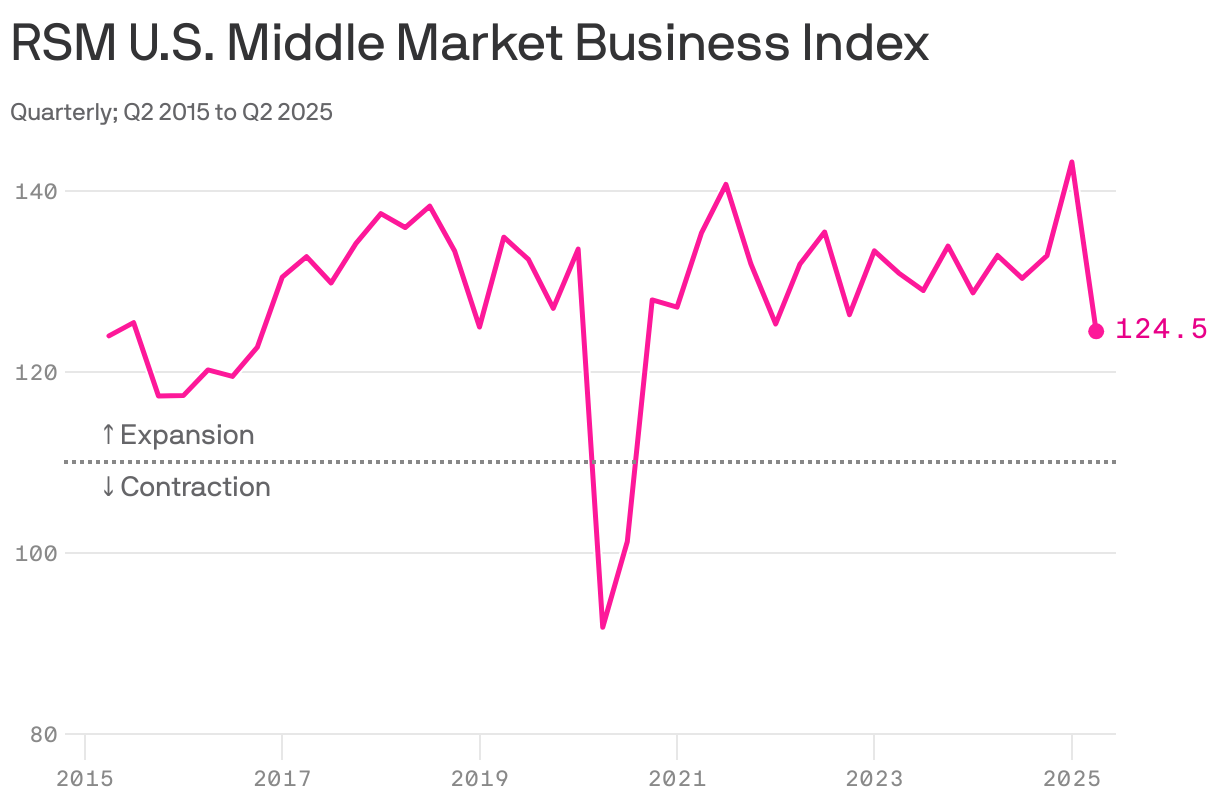
As if to underline Perot's point, a new survey out this morning suggests the trade war has torpedoed the performance of midsize businesses in the U.S.
Why it matters: Tariff turmoil is hitting smaller companies especially hard, raising the costs they're less able to absorb than the corporate giants.
The big picture: Though it will take some time, higher tariffs will likely slow the economy and raise consumer prices, the survey authors said, even if the recent headline inflation numbers still look relatively benign.
How it works: The RSM US Middle Market Business Index fell nearly 19 points to 124.5 in the second quarter.
- A number above 110 is still in expansion, or positive, territory, but this was the biggest drop (outside of the pandemic) over the decade that consulting firm RSM and the Chamber of Commerce have fielded the survey.
"The trade war unleashed real, significant changes in trade policy and at best is going to result in a significant slowing in the U .S. economy," Joe Brusuelas, chief economist with RSM, said on a call yesterday.
By the numbers: The index is based on a survey of 412 executives at middle market firms, defined roughly as those with revenue between $10 million and $2 billion.
- They were asked 20 questions about their businesses, including changes in gross revenue, net earnings and capital spending.
- About a quarter of executives reported a declines in gross revenue and lower net earnings. There was also a 20% drop in capital expenditures, or spending on buildings, machinery, long-term projects and more.
- Hiring also slowed and executives expressed more economic pessimism.
- 57% of executives said they had raised prices in the current quarter, and 63% said they intend to do so over the next six months.
The fine print: The survey was conducted in the field from April 7 to April 29, so respondents had lived through both the "Liberation Day" shock and the tariff pause that followed, while absorbing the hikes that did go through.
The bottom line: Don't get complacent about prices.
3. 🍌 Banana prices are going, well, you know


Bananas are losing some, ahem, appeal. Prices for the ubiquitous yellow fruit are rising, even as inflation cools.
Why it matters: Tariff increases are now starting to drive inflation for certain goods, and perishable items not produced domestically are first in line.
- Enter the banana, described by Axios last year as "the fruit inflation forgot." It's been heretofore resistant to rising prices.
- That's due in part to free trade agreements, which are a bit kaput thanks to the blanket 10% tariff imposed by the White House. (Coffee prices are also feeling tariff pain.)
By the numbers: Banana prices rose 3.3% in May from the previous month to 66 cents per pound, according to Consumer Price Index data out yesterday.
- Inflation overall ticked up just 0.1% over the same time period.
The intrigue: Growers have to move bananas quickly, but importers couldn't stockpile much inventory before tariffs took effect, as companies did for so many other products.
- Bananas aren't grown at scale in the U.S., as Rep. Madeleine Dean (D-Penn.) explained to Commerce Secretary Howard Lutnick at a recent hearing on Capitol Hill.
- Lutnick said that if companies build their products in the U.S. they won't face tariffs. Dean responded, "We cannot build bananas in America."
Yes, but: Even though prices have surged, bananas are still really cheap!
The bottom line: Lucille Bluth famously asked the question: "What could a banana cost?"
- Right now, even at this higher rate of price increases, we are still nowhere near her guess of $10.
Axios Markets