Axios Markets

May 27, 2025

👋 Welcome back! We hope the long weekend treated you kindly. Today we're looking at a world without the penny, and what it really means for your wallet.
- Plus: A new tax burden that could change colleges, and the effects of mounting insurance losses from tornadoes and thunderstorms.
All in 1,030 words, a 4-minute read.
1 big thing: What killing the penny means
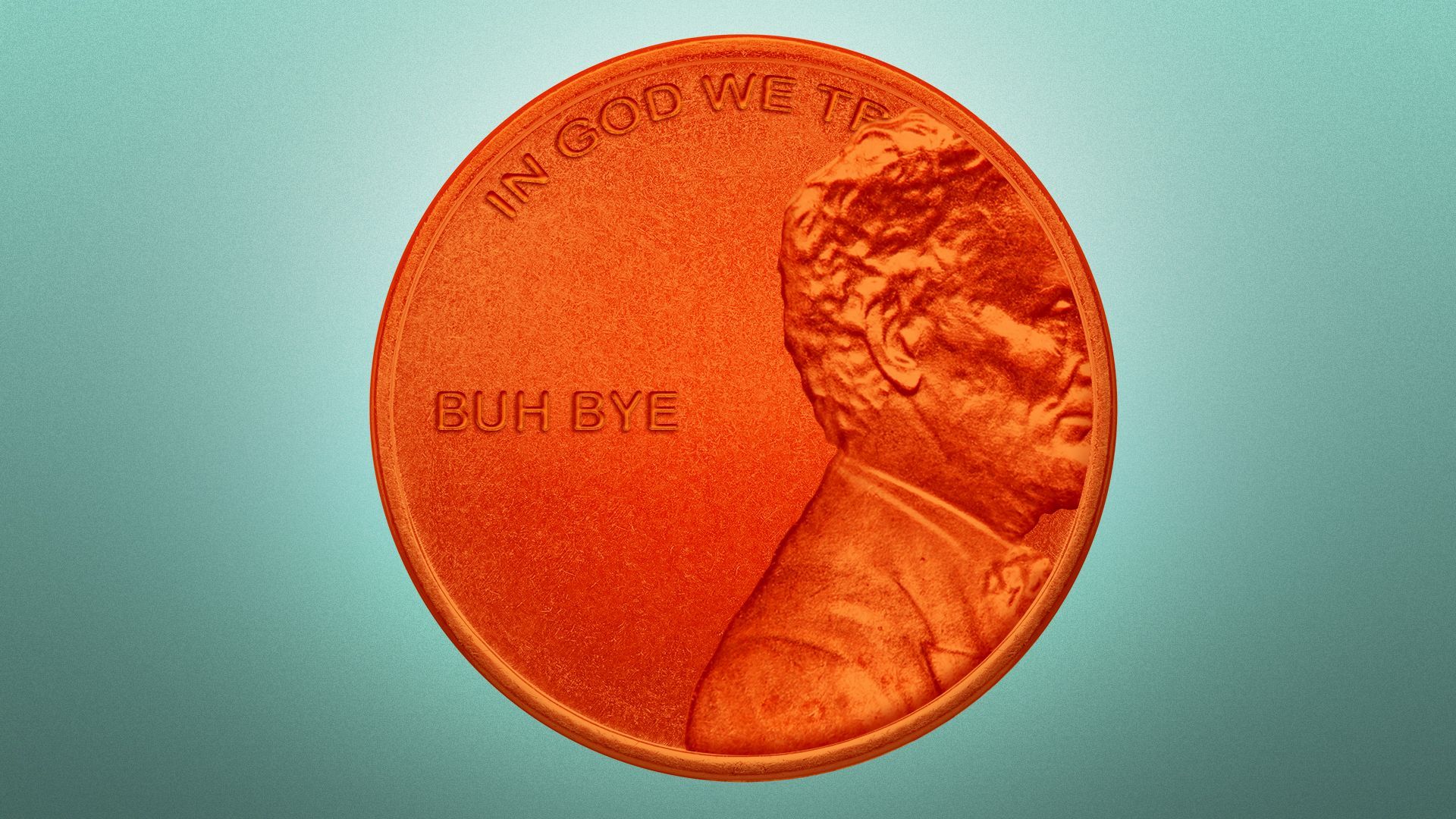
The penny is getting phased out, a cost-cutting move that could ripple across consumer behavior, retail pricing strategies and cash transactions.
Why it matters: It'll be harder to make sense out of cents and get exact change after the one-cent coin's demise.
- The penny's removal may affect how retail prices are rounded, potentially affecting both businesses and consumers, especially those who rely on cash.
The big picture: Eliminating pennies is nothing new for most countries.
- The Canadian penny was discontinued for production in 2012. Australia and New Zealand stopped producing their lowest-denomination coins decades ago.
By the numbers: The cost of making a penny increased 20% in the 2024 fiscal year, the Treasury told Axios.
- The Mint reported losing $85 million on the nearly 3.2 billion pennies it produced in the 2024 fiscal year. The Treasury said stopping production will save the government $56 million a year in reduced material costs.
State of play: The Treasury told the Wall Street Journal that businesses will need to begin rounding up or down to the nearest 5 cents once there aren't enough pennies to use in everyday cash transactions.
- Cashless transactions will still be priced at exact change.
- State and local governments should provide guidance to retailers so sales taxes are properly collected, per the Wall Street Journal.
- This is expected to change how retailers price items and end 99-cent pricing that has been known to influence buying decisions.
Zoom in: Cash accounted for 16% of all payments in 2023, according to the Federal Reserve's latest Diary of Consumer Payment Choice.
- Cash is the third most-used payment type after credit and debit cards.
- Consumers younger than age 55 used cash for just 12% of payments, compared with 22% for consumers age 55 and older.
Yes, but: Low-income and older Americans are more likely to use cash, raising concerns about fairness and unintended consequences if rounding prices isn't consumer-friendly.
- Jay Zagorsky, author of "The Power of Cash: Why Using Paper Money is Good for You and Society," told the Associated Press that Congress must include language in any proposed legislation to require rounding up in pricing.
- This would eliminate demand for pennies, said Zagorsky, a business professor at Boston University.
The bottom line: "If we suddenly have to produce a lot of nickels — and we lose more money on producing every nickel — eliminating the penny doesn't make any sense," Zagorsky said.
2. How the tax bill could change colleges


The latest version of President Trump's tax bill could profoundly transform the world of university endowments, and incentivizes some deep structural changes.
Why it matters: Those changes would not necessarily achieve the bill's stated aim of holding "woke, elite universities" accountable for purportedly abusing their nonprofit status, but they could significantly reduce the degree to which the provisions raise extra tax revenue.
The big picture: One of the driving forces behind the tax bill is the argument that if large universities behave like hedge funds with educational institutions attached, then they should start getting taxed more like hedge funds and less like educational nonprofits.
How it works: The chosen metric is endowment per student, with richer colleges on that basis facing higher taxes.
- On its face, that incentivizes universities with bigger endowments to enroll more students, though there's also an incentive for smaller colleges to enroll fewer students, since institutions with fewer than 500 students are exempt.
- The denominator also now excludes foreign students, which is likely to push some schools, like the University of Pennsylvania, up a tax bracket, per an analysis by TIFF Investment Management.
- Crucially, these aren't marginal tax rates, either. Counting the University of Pennsylvania's total roster of 24,219 students, its $1.1 billion of investment income would face a tax bill of $77 million.
- Because only its 17,316 domestic students are counted, however, that bill doubles to $154 million, enough to pay full tuition for 2,500 individuals.
Between the lines: Recent high-profile philanthropic gifts have been designed to create a tuition-free experience for all students.
- Because the proposed endowment tax only applies to schools with over 500 tuition-paying students, even schools that still charge some students should find themselves exempt.
- Smaller schools therefore now have a major tax incentive to use their endowment to bring the number of tuition-paying students below 500, rather than reducing tuition across the board.
Where it stands: When an endowment pays no tax, it can invest wherever it thinks it can achieve the highest long-term return.
- When investment income is taxed, however, that creates an incentive to move away from income-generating assets.
- Instead, endowments might shift their asset allocation to assets that don't throw off income, writes Anne Duggan of TIFF Investment Management.
The bottom line: The big question facing universities is how permanent they consider these tax-code changes to be.
3. Another year of major insurance losses

U.S. insured losses from severe thunderstorms and tornadoes this year are running well above historic averages, and the gap is only growing bigger, insurance broker Aon said.
Why it matters: The Trump administration is gutting FEMA and telling states to solve their own crises, just as the effects of disasters are getting worse.
By the numbers: From the start of the year through the end of April, severe thunderstorms caused $11 billion in insured losses, Aon said in a report last week.
- But then this month's devastating tornadoes hit, and Aon said that loss figure "could double by the end of the month."
What they're saying: "The shift to a much more seasonally active pattern with near-continuous rounds of severe thunderstorms across the U.S. in early May is likely to push insured weather losses well above the 10-year average," Dan Hartung, global head of event response at Aon, said in a statement.
Between the lines: Since 2015, the U.S. has averaged insured losses of $33 billion a year from "severe convective storms," up 90% from the prior decade.
The intrigue: Aon said more than 80% of the increase in losses was due to growing insurance exposures, as opposed to weather changes.
- Of the 10 costliest tornado outbreaks in U.S. history by insured losses, per the Insurance Information Institute, five hit since 2023 and seven since 2019.
The bottom line: Local communities face mounting losses at a time help is disappearing.
Thanks to Ben Berkowitz for editing and Anjelica Tan for copy editing. See you tomorrow!
Sign up for Axios Markets