
Axios Markets

March 20, 2025

⚠️ Welcome back. Today we're digging into Social Security, which is making massive changes to fight fraud, but there are fears the solution could make the problem worse.
- Plus: Stocks throw off more cash than ever, and Trump's coal promise meets tough numbers.
All in 1,020 words, a 4-minute read.
1 big thing: The cost of fighting small fraud
In less than two weeks Social Security is set to enact major changes that threaten to upend services for many Americans, in order to fight fraud that amounts to a fraction of 1% of the agency's spending.
Why it matters: Social Security Administration veterans and powerful lobbying groups warn the changes, made at breakneck speed, may even foment more swindling.
- The agency's own internal documents caution the changes will effectively cut some Americans off from receiving benefits.
- Former officials say the changes will overwhelm the agency's already stretched resources, with staffing at a record low and America's aging population rapidly rising.
Catch up quick: At a press conference on Tuesday, acting commissioner Lee Dudek said $100 million is lost each year to direct deposit fraud. To address it, the agency is curtailing its phone services.
- Effective March 31, Americans won't be able to call and sign up for Social Security benefits, or make major changes to their accounts that require ID verification.
- They either must use the internet or visit a field office, which is not an easy option for many of the people who rely on Social Security the most.
By the numbers: $100 million in fraud represents about 0.00625% of the $1.6 trillion the government sends out annually in Social Security benefits.
- Only around half of that $100 million was lost to phone fraud in 2024, according to a person familiar with Social Security fraud who attended a meeting last year where data on the issue was shared, speaking on the condition of anonymity out of fear of retaliation.
Zoom out: Social Security usually moves deliberately, taking months or even years to make big changes, says Bill Sweeney, vice president for government affairs at AARP, which represents nearly 38 million older Americans.
- More than 800,000 AARP members have reached out to Congress on this issue over the past week, as news of the changes first started leaking out and at the group's urging.
- Rep. Greg Landsman (D-Ohio) tells Axios the issue has been coming up a lot with constituents: "People are scared and pissed."
For the record: Neither the Social Security Administration nor the White House returned requests for comment.
Between the lines: There's no time to roll out a public messaging campaign so folks know what's happening, Sweeney says.
- That gives an opportunity for a bad actor to pounce and try to steal bank information and Social Security numbers from seniors by pretending to be a Social Security worker.
- "It is going to absolutely open the door to people committing fraud and hurting older adults, especially those who are most vulnerable," he says.
Plus: Dudek says in an effort to improve customer service, the agency would no longer put a 30-day hold on accounts that change their direct deposit bank information.
- "We put that 30-day hold there to try and limit internet fraud," says Jill Hornick, who has handled calls at a field office in the Chicago suburbs for the past 33 years.
Zoom in: Hornick says she hasn't seen a lot of fraud over the years, but what she does see typically starts on the internet.
- Hornick, an administrative director for government workers' union AFGE, usually learns about it when folks call to say they didn't get a check.
- When she verifies their account information, lo and behold: "They'll say, that's not my bank account." It was changed online.
The bottom line: DOGE is moving fast, and getting closer to breaking a beloved American thing.
Andrew Solender contributed to this report.
2. Stocks throw off more cash than ever
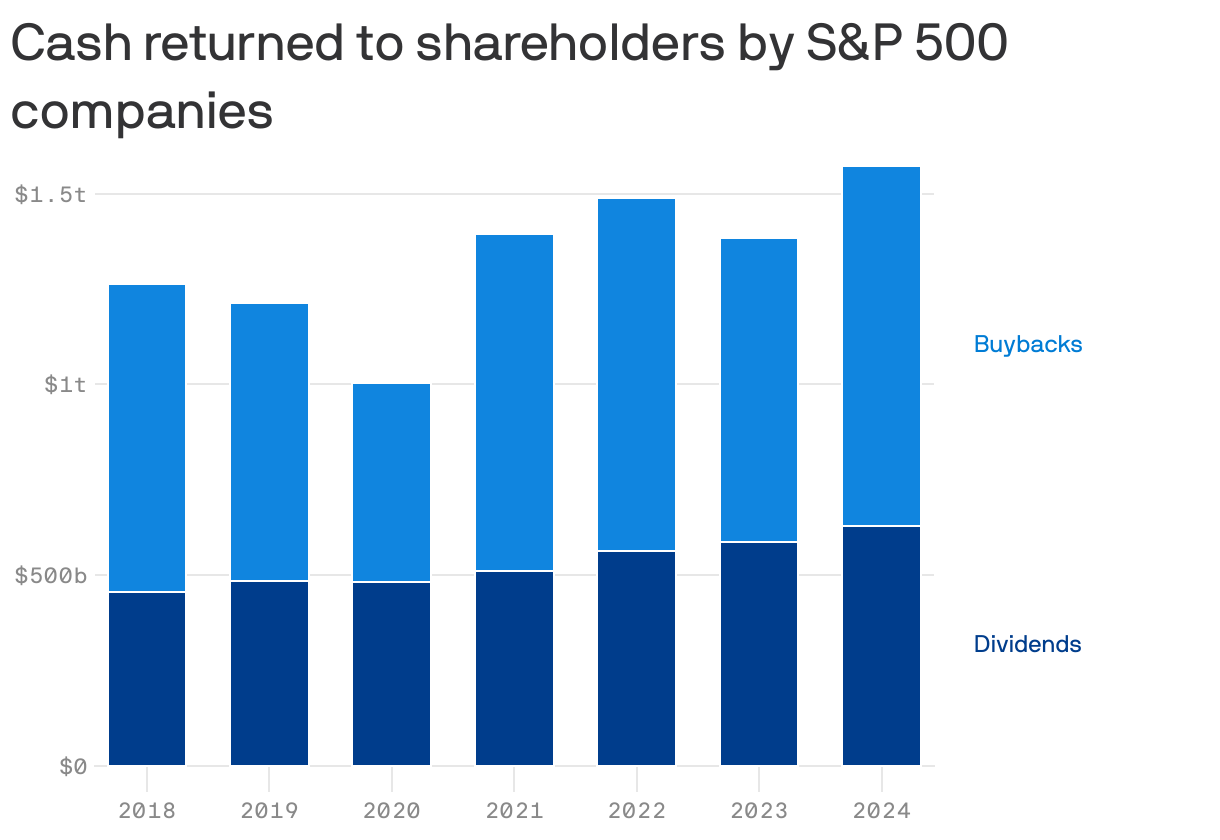
S&P 500 companies returned a record $1.6 trillion to shareholders in 2024, per S&P Dow Jones Indices, three-fifths of which was in the form of buybacks.
Why it matters: The record amounts of cash getting thrown off by U.S. stocks aren't just helping to support stock market valuations, they're also bolstering domestic consumption and international markets.
By the numbers: The $1.6 trillion returned to shareholders in 2024 represents a 14% increase from 2023.
- That's a much bigger raise than anything seen in the labor markets, allowing investors to pocket more income while also reinvesting a meaningful amount in hot markets like, say, Germany.
Between the lines: There's room for these numbers to grow even more.
- The $1.6 trillion works out to just 3.2% of S&P 500 earnings, down from 4.6% in 2022 and 6% in 2018.
How it works: As stocks repeatedly hit record highs in 2024, employee stock options became more and more in the money, and companies had to buy back stock to cover what they needed to pay out on the options they granted.
- That trend has continued into the first quarter of 2025, according to Howard Silverblatt of S&P DJI, with buybacks rising even as share prices have fallen.
Fun fact: Apple alone spent more than $100 billion on dividends and buybacks in 2024. (The total was $104.2 billion, to be exact, up 24% from 2023.)
The bottom line: America's corporations may not be giving out aggressive raises any more, but they're still happily throwing billions of dollars at their shareholders.
3. Trump coal pledge meets the numbers

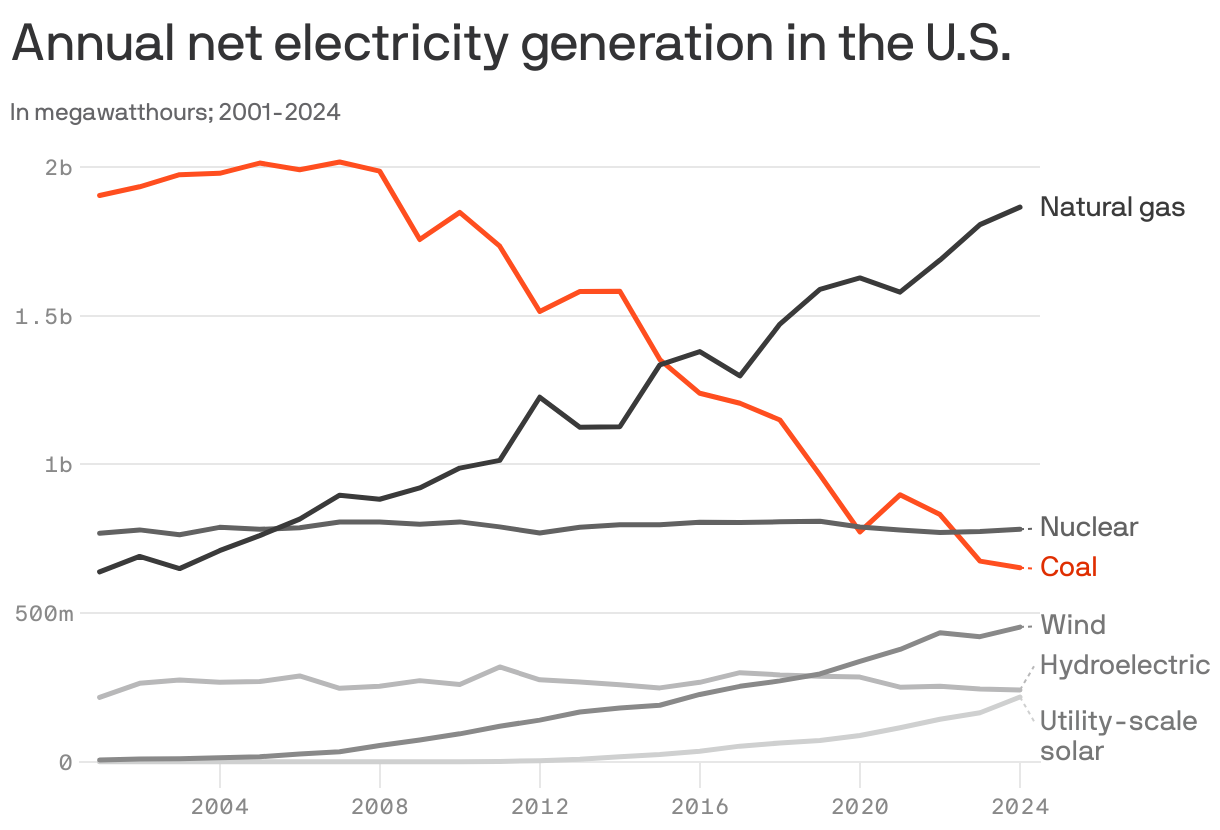
President Trump made a brief, aggressive vow to revitalize U.S. coal this week, a shoutout to policies that officials have already unveiled, but there's more to come, the White House said.
State of play: Federal agencies are "working in tandem" with Trump, a White House official said.
- The official cited EPA's work to overturn Biden-era rules on power plant carbon emissions and air toxics that "improperly targeted coal-fired power plants."
- On the coal production side, the White House pointed to the Interior Department's extension of operations at Montana's Spring Creek Mine.
Reality check: Coal's share of the U.S. power mix has long been falling.
- Abundant gas, the rise of renewables, the cost of maintaining plants, and state and federal rules are working against it.
- A true reversal of fortune for the most carbon-emitting fuel would be stunning, even as U.S. power demand is slated for a prolonged rise after years of stasis.
- But companies have delayed some planned retirements in recent years. For instance, Duke Energy has proposed adding three years to the 2035 shutoff date of an Indiana plant.
Thanks to Ben Berkowitz for editing and Anjelica Tan for copy editing. See you tomorrow!
Sign up for Axios Markets