Axios Markets

September 15, 2025

🇨🇳 Stock futures are mixed this morning after China ruled Nvidia violated antitrust laws in a 2020 deal. Officials from Beijing and Washington are in Spain for trade talks this week.
- Today: Why the AI narrative has to work for Wall Street.
- Plus: The market flashes recession signals outside of tech.
📍If you're in New York: Join Axios' Mike Allen, Courtenay Brown and me, Madison Mills, on Monday, Sept. 22 at 5:45pm ET for conversations with Circle CEO Jeremy Allaire, IBM vice chairman Gary Cohn, NYSE Group president Lynn Martin and more about the future of America's safe haven status amid global economic and tech shifts. RSVP online here.
Let's get into it. All in 1,040 words in 4 minutes.
1 big thing: Wall Street bet on AI is too big to fail


AI bulls tout lofty visions for how the technology can change our lives, claiming it could cure cancer, solve climate change and make us all rich.
Why it matters: The hype around artificial intelligence has to deliver at this point, for the sake of financial markets and the economy.
You can see the hype in investments, infrastructure and the economy.
- Companies are spending tens of billions of dollars to build data centers to power AI.
- Data center investment drove more GDP growth than consumer spending last quarter.
- The stock market is highly reliant on the AI narrative working.
What they're saying: The S&P 500 and Nasdaq hit 24 record highs this year. "Price leads narrative," and investors won't question AI unless stocks go down, Mike Treacy, vice president of risk at Apex Fintech Solutions, tells Axios.
By the numbers: The market is increasingly concentrated in a small group of tech giants, and they’re relying on each other’s AI spending to drive growth.
- Seven large names tied to AI make up 35% of the S&P 500 market cap.
- Microsoft, Meta, Amazon, Alphabet and Tesla account for more than 40% of Nvidia’s revenue by buying its AI chips.
- They have collectively poured over $400 billion into AI so far this year.
Between the lines: Investors are betting spending will pay off, but even if it doesn’t, these companies have enough free cash flow to simply pull back on spending to preserve profits.
- But if these companies have to pull back, Nvidia could lose 40% of its sales.
- That would ripple through the market, where Nvidia alone makes up 7% of the S&P 500 and 3% of the global stock market.
State of play: While companies and markets are buzzing over AI, real-world use is lagging behind, Rogé Karma reports in The Atlantic.
- Some 71% of companies are using generative AI but most (80%) of them say it's had no "tangible" effect on earnings, a March McKinsey report found.
Yes, but: Technology adoption takes time, and fits and starts at the onset are normal.
- Companies like Google, Microsoft and Meta are finally starting to generate real revenue from their AI investments, Ina Fried reports in Axios.
- Oracle’s recent blowout earnings show AI can deliver profits across the market, Mandeep Singh of Bloomberg Intelligence tells Axios.
- Hiring has already slowed, and Singh attributes this in part to AI increasing productivity. (Good for investors, tougher for workers.)
The bottom line: The promise of AI is sky-high, and with trillions of dollars, staggering energy use, and the markets behind it, so is the pressure to deliver.
2. AI hype masks recession signals in the market
AI optimism driving the market is overshadowing recession signals across asset classes.
Why it matters: Don't confuse record highs for signs of economic growth.
What they're saying: "The evidence is plentiful that the economy is slowing," Alessio de Longis, senior portfolio manager and head of asset allocation at Invesco, tells Axios.
- People are staying unemployed longer, while the chilling effect of policy uncertainty slows hiring.
- Tariffs have yet to fully affect prices, which could thwart consumer spending further.
State of play: Despite this backdrop, stocks are up. That bucks the historic pattern of stocks dropping ahead of recessions.
- It hasn't happened at the aggregate level due to the market concentration into AI names, says Kristina Hooper, chief market strategist at Man Group.
- Wall Street is more disconnected from Main Street, she says, because of the amount of money technology companies are spending on each other.
- That investment is driving market performance over consumer spending.
Zoom in: Cyclical corners of the market tied to the economy, like small and midsize firms and health care, were struggling before the Federal Reserve hinted at interest rate cuts.
- On an aggregate level, the market is still experiencing higher than expected earnings growth.
- But that aggregate data is being driven up by AI-related earnings growth, de Longis says, crowding out signs of earnings recession in more cyclical and defensive sectors.
Yes, but: A market rotation is already underway.
- Rate cut signals combined with a belief that AI could increase productivity across the market is pushing investors to unloved sectors, especially smaller companies more affected by interest rates.
The bottom line: The outlook is incredibly uncertain, adding to the need for investors to diversify and hedge, Hooper says.
- That view is part of what's driving up international stocks and gold as investors look to hedge their exposure to the U.S. without getting out.
- They can't afford to leave the states fully because of that AI growth.
3. The T word is said less often on earnings calls
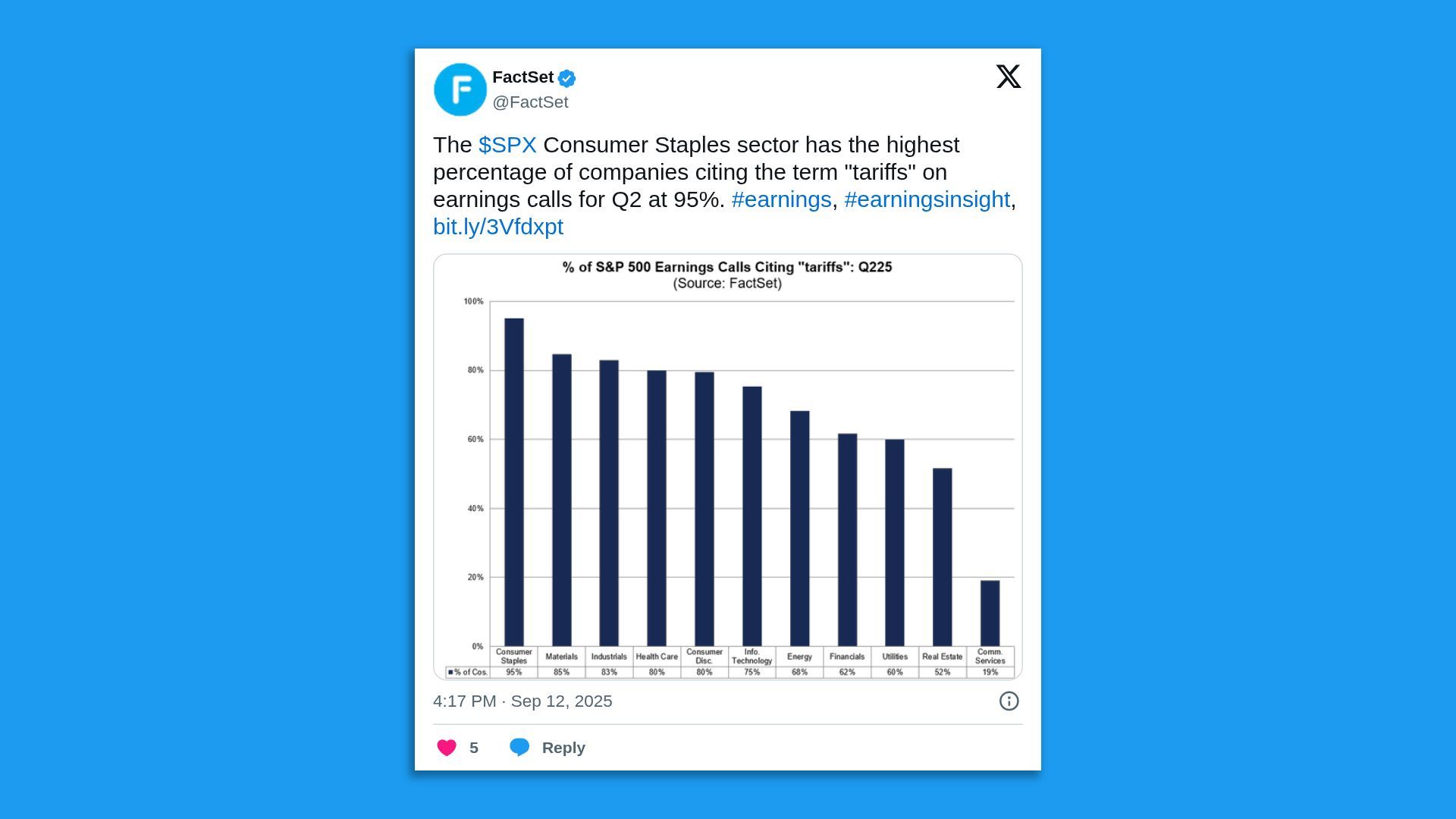
Mentions of tariffs on earnings calls dropped over 20% in this most recent quarter compared with the first quarter of 2025, according to FactSet data.
Why it matters: Even with the drop, the number of times the word "tariff" came up in calls is still the second highest it has been since tracking began.
By the numbers: Consumer staples companies had the highest percentage of tariff mentions in earnings calls. It makes sense given that these companies receive a large share of goods from overseas.
- Technology companies had the highest overall mentions of levies.
What we're watching: Tariffs raising prices is not necessarily bad news for earnings, so long as consumers keep spending.
- But if inflation thwarts consumer spending, that could present a headwind for earnings, and therefore the market.
👀 Got tips? Email me at [email protected]. I would love to hear from you about anything that may be of interest for our investor audience.
Thanks to Jeffrey Cane for editing and Anjelica Tan for copy editing. See you tomorrow!
Sign up for Axios Markets