Axios Macro

October 20, 2026


🏠 It's only Tuesday, but it's already a gnarly week for housing data. Fresh figures paint a grim picture for homebuilders and would-be buyers alike — with the AI boom and the Federal Reserve's fight against inflation making matters worse.
- More below, plus a fun study that shows that the latest status symbol among America's wealthiest households might not be a bigger house, but a bigger family. 👶
Today's newsletter, edited by Jeffrey Cane and copy edited by Katie Lewis, is 855 words, a 3-minute read.
1 big thing: Housing is getting hammered

The AI boom is sucking up all the capital. The Fed is raising rates to try to cool inflation. And one sector is bearing the brunt of the pain from both: housing.
The big picture: The situation is lose-lose for both homebuilders and homebuyers. Builders are facing more expensive capital and bidding for scarce construction-related resources. Would-be buyers are being quoted some of the highest mortgage rates of this century.
- New September housing starts data out this morning puts an exclamation point on what has been a slow-moving disaster for a sector that plays an outsized role in the economic cycle and in Americans' basic living standards.
By the numbers: The number of housing units started by builders fell 5.2% last month, the Census Bureau said, to 1.22 million. It's down 7.4% year over year and near post-pandemic lows.
- Starts of single-family homes fell 4.6% to their lowest level since March 2023.
- Pending home sales fell 7.3% last month, the National Association of Realtors said this morning, to the lowest since the data was tracked going back to 2001.
- Homebuilder sentiment fell this month to its lowest level since 2012, the National Association of Home Builders said yesterday.
State of play: The average 30-year fixed-rate mortgage rate was 7.4% earlier this month, Freddie Mac said in its most recent weekly reading. The rate was briefly higher than that in 2023, but has not been consistently above that level since the fall of 2000.
- That has kept homebuyers on the sidelines — while a parallel rise in borrowing costs for developers has made it harder for new projects to pencil out.
- In effect, the bottomless demand for capital from AI hyperscalers and the U.S. government has to squeeze something, and that something has been the housing sector.
- Residential investment has subtracted from overall GDP for five of the last six quarters.
Zoom out: Housing affordability is the crux of Americans' broader dissatisfaction with economic conditions, and all signs point to it getting worse, not better.
- For all the bipartisan emphasis on increasing housing supply — most prominently in the passage of a law to encourage more building earlier this year — conditions are weighted against a building boom.
- Housing developers are competing with data center builders for labor and materials like copper, concrete and HVAC equipment.
Of note: Restrictionist immigration policy has also crimped the supply of construction workers.
- "Nationwide, more than one-third of builders reported immigration enforcement activity in their market areas during the past month, causing construction delays and discouraging legal workers from reporting to work," said NAHB chairman Bill Owens, an Ohio homebuilder, in the sentiment release.
Between the lines: An unfortunate side effect of relying on Fed interest rate policy for macroeconomic stabilization is that interest-sensitive sectors, particularly housing, take it on the chin when the economy shows signs of overheating.
- It's particularly problematic now, when persistent undersupply of housing is a defining economic challenge of our age.
The bottom line: The current alignment of interest rates, housing supply and construction costs isn't making anybody happy.
- Builders can't afford to build, buyers can't afford to buy, and even the people sitting pretty with pre-2022 mortgages can't afford to move.
2. The ultimate status symbol
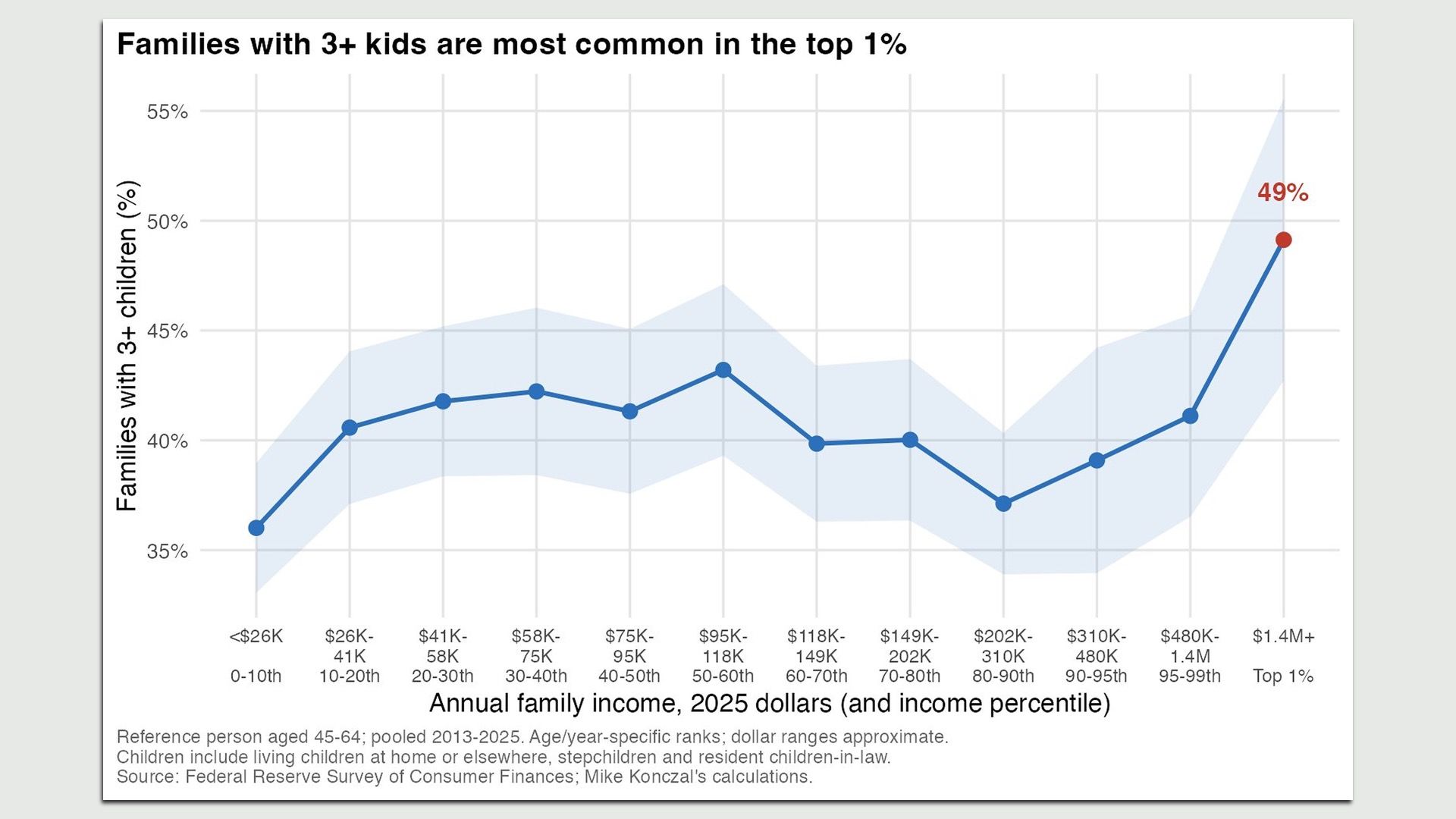
One clue that might distinguish the rich from the very rich: Count their kids.
- Having a third child has become less common in America for every income group — except the highest earners, according to a buzzy analysis of Fed data by economist Mike Konczal, a former Biden economic official who is currently the vice president of the Economic Security Project.
Why it matters: The findings suggest that having a third child may be a luxury that even well-off Americans struggle to afford.
By the numbers: Konczal analyzed Fed survey data from 2013 to 2025, focusing on families headed by someone aged 45 to 64 and counting biological, adopted and stepchildren, including those from previous relationships.
- Among the top 1% of earners, 49% have at least three children, compared with roughly 40% of families in the rest of the top 10%.
- The gap is wider when families are ranked by wealth instead of income. Half of the families in the wealthiest 1% have at least three kids, compared with 37% of those in the rest of the top 10%.
The intrigue: The share of top-1% families with at least three children has held relatively steady since the 1990s, while falling among families further down the income ladder.
- "Maybe the things that made children more difficult for the 99% just bounced right off the 1%?" Konczal wrote on X.
The bottom line: The ultimate status symbol among America's richest households might be a third child.
Sign up for Axios Macro