
Axios Macro

July 30, 2024

New job market data shows a not-so-welcome development: Companies have pulled back on the rate of hiring.
- More below, plus what to watch for in monetary policy around the world this week. 🇯🇵 🇬🇧
Today's newsletter, edited by Felix Salmon and copy edited by Katie Lewis, is 608 words, a 2-minute read.
1 big thing: Employers' big hiring pullback


The U.S. job market looks to have frozen up. Companies aren't doing large-scale layoffs — but they have slowed down hiring, and fewer workers are quitting their jobs voluntarily.
Why it matters: Employers are showing the least appetite for bringing on new workers in years. That's a byproduct of the economy cooling — though not so much that employers feel they need to let go of the staff they have.
Driving the news: There were 5.3 million hires in June, 314,000 fewer than in May, according to the latest Job Openings and Labor Turnover survey released this morning.
- The rate of hiring, at 3.4% of total employment, is the lowest since March 2020 and a half-point below its levels before the pandemic.
The other side: The freeze-up on the part of employers is benefiting workers who are already employed. The layoff and discharge rate was 0.9% — the lowest level on records that date back to 2000.
Between the lines: The Fed began a two-day meeting this morning at which its leaders will debate whether the labor market is deteriorating in ways that add urgency to interest rate cuts. The hiring numbers add to that evidence.
What they're saying: "If you hear people saying 'it's a really tough time to find a job,' this is why," tweeted Guy Berger, director of economic research at the Burning Glass Institute.
- "Last time hiring was this low, we were still digging our way out of the Great Recession," Berger added.
The big picture: Evidence that workers have less confidence about the labor market and other job opportunities has been building for months.
- The quits rate — a temperature check on workers' willingness to voluntarily leave their jobs — held at 2.1%, the lowest since August 2020.
The bottom line: Workers looking for new jobs won't find nearly the same opportunities as in recent years. But those with a job seem to have security, for now.
2. A week of central bank divergence
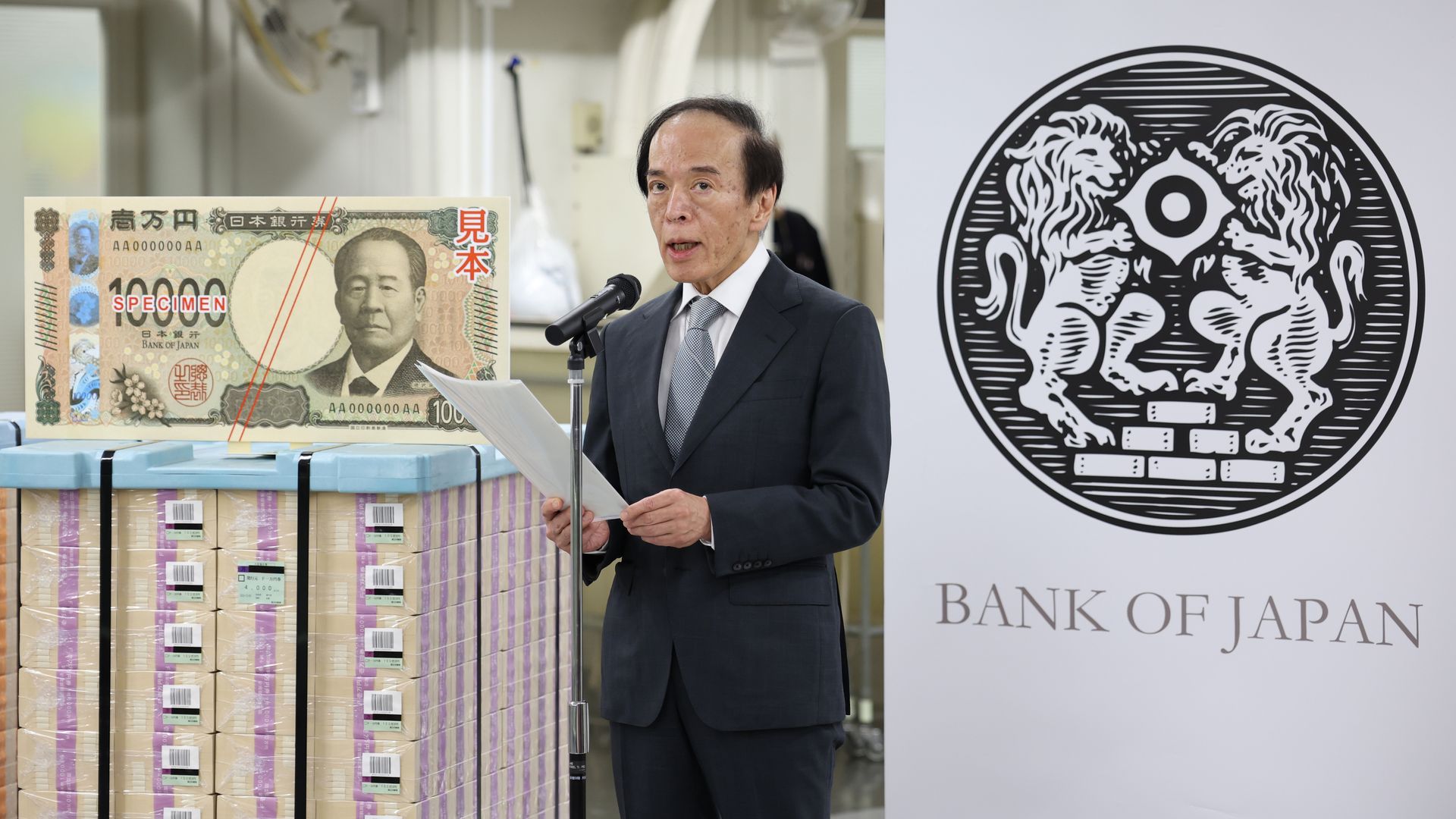
Yesterday, we teed up the Fed's meeting, which concludes with a policy announcement at 2pm ET tomorrow. But it's just one of three major global central banks gathering as the calendar flips to August.
- It is also set to be a week of divergence in international policy, as the Bank of Japan could raise rates and the Bank of England could cut them, even as the Fed looks likely to stand still.
Driving the news: First up is the Japanese central bank, with a policy announcement due out Wednesday Tokyo time (late tonight U.S. time). The yen has been strengthening in anticipation of a hawkish tone from the bank.
- A program of quantitative tightening — shrinking the bank's massive and varied portfolio of assets acquired over years of monetary stimulus — looks likely to be announced, and a rate increase could accompany it.
- Those steps would represent a continuation of a methodical process by which the bank is trying to return its monetary policy to something closer to global norms, after years of aggressive stimulus to try to end a deflationary cycle.
The U.K. is at a different stage in its economic cycle, which means the Bank of England could cut rates following its policy meeting Thursday. It is grappling with both some of the weakest growth among major advanced economies and inflationary pressures that are not yet fully stamped out.
- Pay particular attention to the vote of the bank's Monetary Policy Committee, which could show substantial dissent no matter which way the close-call decision tilts.
The bottom line: In the pandemic and inflationary aftermath, all the major global central banks rowed in the same direction. Now, they are diverging, reflecting a divergence in economic circumstances.
Sign up for Axios Macro