Axios Macro
August 23, 2024


Neil has had no hawk sightings in Jackson Hole, Wyoming, this week as the Kansas City Fed's annual symposium got underway. But this morning, he heard from a suit-wearing dove. 🕊
- More on how to interpret Fed chair Jerome Powell's big speech below, plus parsing a paper on the relationship between employment and inflation presented at the conference.
Today's newsletter, edited by Kate Marino and copy edited by Katie Lewis, is 667 words, a 2½-minute read.
1 big thing: Get ready for rate cuts
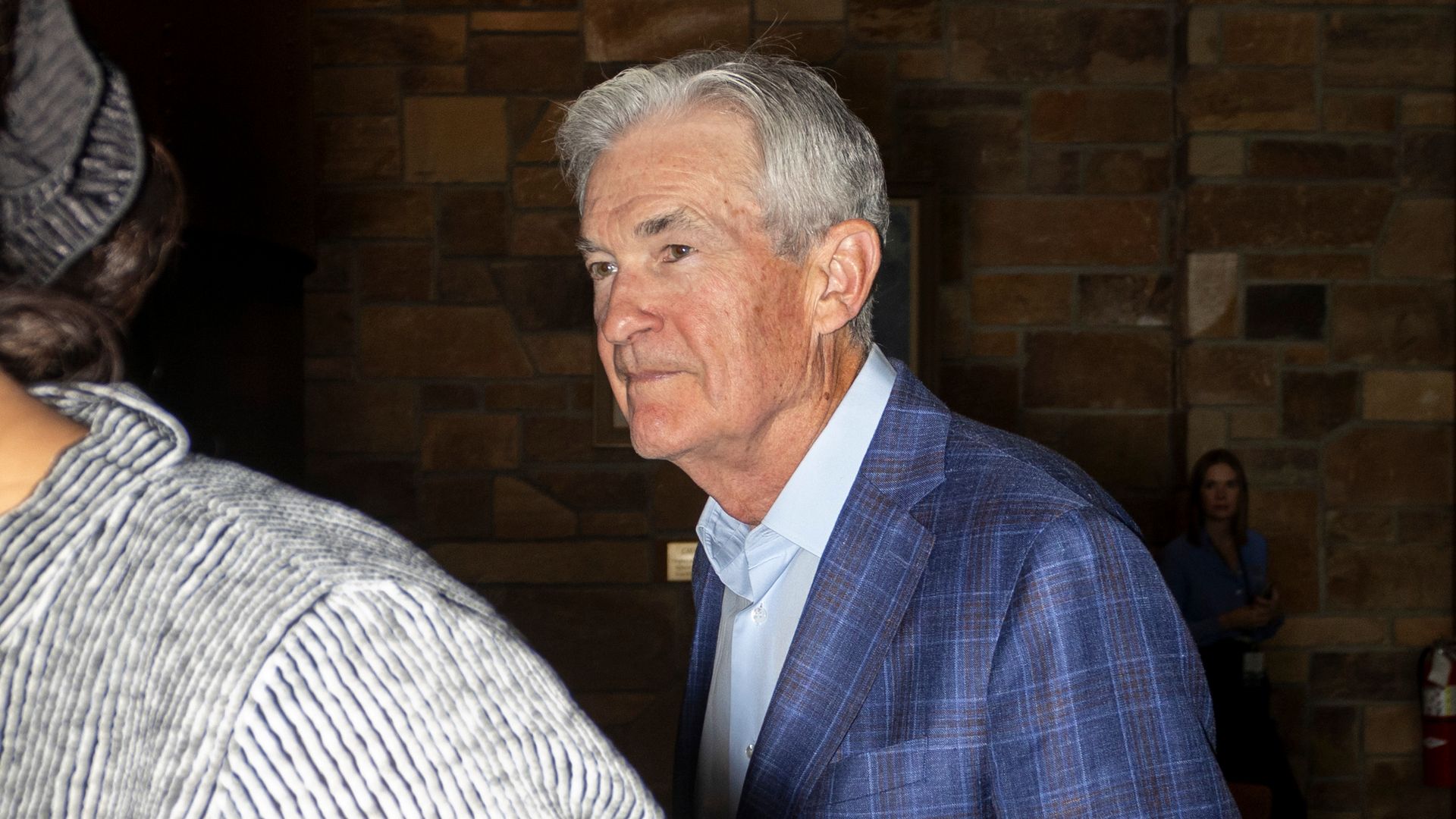
Two years ago in Jackson Hole, Powell offered a blunt, succinct declaration that the Fed was ready to tolerate economic pain in order to fight inflation. He wasn't quite as blunt, nor as succinct, in remarks today, but the message was similarly hard to miss.
The big picture: The Fed is ready to cut rates — aggressively, if necessary — to prevent further worsening in the job market. The era of elevated interest rates is near its end, and the predominant economic risk is no longer inflation.
- It sets up a rate cut at a policy meeting that concludes Sept 18, with the size of that cut — either the usual quarter-point adjustment or a super-sized half-point reduction — dependent on data between now and then, particularly the August jobs report due out Sept. 6.
State of play: The headline takeaway from Powell's speech was his comment that the "time has come for policy to adjust," with the pace of that adjustment dependent on incoming data.
- But arguably more significant: "We do not seek or welcome further cooling in labor market conditions."
Between the lines: That's the most explicit acknowledgment yet that the softening in the labor market the Fed once sought to bring inflation down has now gone far enough.
- It implies that more weak jobs numbers like those seen in July would be met with aggressive Fed action.
- The direction the Fed is heading is now crystal clear, but the pace and extent of rate cuts remain uncertain.
- Assuming growth holds up, a handful of quarter-point cuts over the next year would do the trick of adjusting the policy stance to current economic realities. But Powell implicitly acknowledged that the Fed has break-the-glass options if activity really starts to falter.
What they're saying: "The direction of travel is clear, and the timing and pace of rate cuts will depend on incoming data, the evolving outlook, and the balance of risks," Powell said.
- "The current level of our policy rate gives us ample room to respond to any risks we may face, including the risk of unwelcome further weakening in labor market conditions," he said.
- That is to say, with its target interest rate north of 5%, the Fed has a lot of room to cut rates if it were to become necessary, in contrast to much of the 2010s when rates were rarely much above zero.
2. Why inflation receded without a recession
A paper presented after Powell spoke today attempts to settle a question the Fed chair posed in his own speech: Why did inflation recede without a huge spike in the unemployment rate?
- That's what happened in the 1970s: A deep recession accompanied efforts to bring inflation back down.
- Some economists, though not all, assumed the same would happen this time.
Why it matters: In the paper, the researchers say longstanding assumptions made about the relationship between the labor market and inflation require "substantial revision."
- One key condition that accompanied the 2020s inflationary episode was a labor market so tight that supply shocks were much more amplified than would have been the case otherwise.
What they're saying: The authors noted that two terms dominate discussion about the cause of inflation: labor shortages and supply chains.
- "We argue that the labor shortage is of primary importance, partly because it is a necessary condition for supply disruptions to have a significant impact on core inflation," the University of Bern's Pierpaolo Benigno and Brown University's Gauti B. Eggertsson wrote in the paper.
The intrigue: Benigno and Eggertsson suggest there is a "threshold" at which the ratio of job openings per unemployed worker can trigger inflationary pressures. The authors acknowledged that this threshold is uncertain.
- The number of job openings for each available worker surged to the highest on record in 2022. It has since eased as employer demand for workers slowed.
The bottom line: "The good news, however, is that as long as inflation expectations remain stable, the cost of reducing inflation in terms of increased unemployment is relatively low," the authors wrote.
Sign up for Axios Macro