Axios Macro
October 27, 2023

1 big thing: Americans are spending, not saving


Americans are spending more money, but their incomes aren't keeping up.
Driving the news: Personal consumption expenditures rose a scorching 0.7% in September, the Commerce Department said, or 0.4% when adjusted for inflation. That is a key factor in the strong 4.9% annualized Q3 GDP growth number reported yesterday.
- But one not-so-great takeaway showed personal income rose only 0.3%. Real disposable personal income — what Americans make after adjusting for inflation and taxes — fell 0.1%, and is down for four consecutive months.
- That brought the personal saving rate down to 3.4%, down from 4%. It was lower than that for several months last year, but before that, it hadn't been that low since 2008.
Why it matters: Consumer spending was the main driver of a summer growth surge, but Americans can't keep cutting back their savings forever. That creates a big risk for the economy in 2024 that consumers will be forced to cut back.
What they're saying: Americans have "been running down our savings and borrowing more to fund this spending growth through the recent period, and that is not sustainable," wrote James Knightley, ING's chief international economist, in a note.
- "Savings are finite and are being exhausted at a rapid rate," he wrote, "with various estimates suggesting that excess savings accrued during the pandemic could be exhausted in the first half of next year."
The report also includes the Personal Consumption Expenditures Price Index, the Federal Reserve's favored inflation measure.
- It showed stable overall inflation year-over-year at 3.4% and core inflation — excluding food and energy — edging down to 3.7%, from 3.8%. That was the lowest since 2021.
Yes, but: Core PCE inflation ticked up month-on-month to 0.3%, the highest since May. While not enough to change the Fed's near-term policy plans — it will likely leave rates unchanged at a meeting next week — it's an unwelcome reversal.
- For the three months ended in August, core PCE inflation was rising at a 2% annual rate, spot-on the Fed's inflation target. But that rose to 2.5% for the three months ended in September.
The bottom line: The spending-driven growth of the summer may not be sustainable given weak income growth, and the path to lower inflation still looks bumpy.
2. Biden officials on the rate surge
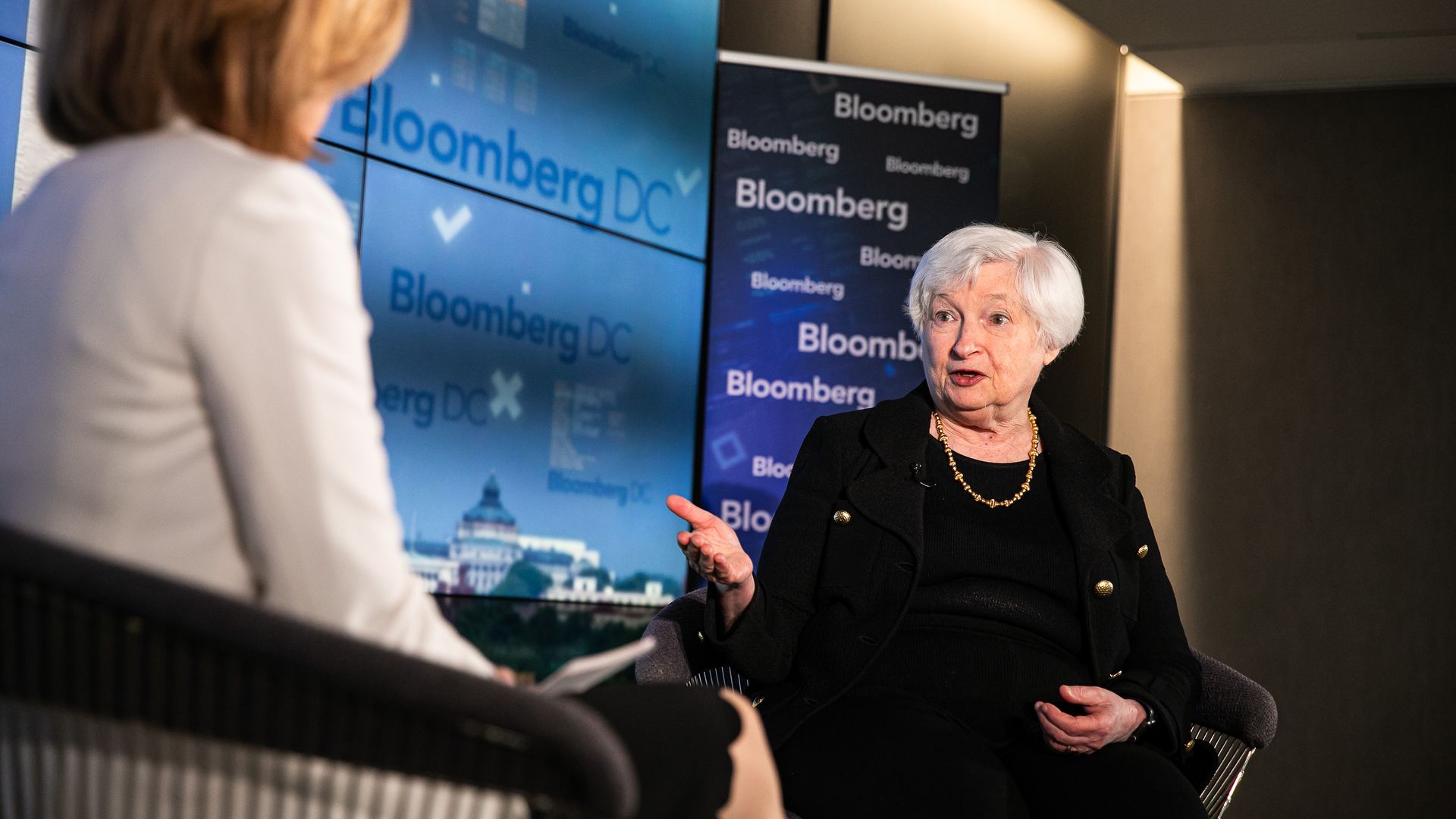
Treasury Secretary Janet Yellen yesterday. Photo: Valerie Plesch/Bloomberg via Getty Images
Axios Macro

Stay ahead of the curve on the most important economic developments with reporting and analysis on how business, policy, and markets collide.