Axios Macro
October 14, 2025


The IMF-World Bank annual meetings are getting underway, with top finance officials descending on Washington against a fraught economic backdrop.
- The IMF's new economic projections help set the scene for the week. We dig into them below.
- Plus, we examine the subtext of the latest Nobel winners for economics, announced yesterday.
Situtational awareness: Fed chair Jerome Powell is scheduled to speak at 12:20pm ET about the economic outlook and monetary policy. We'll have coverage at Axios.com.
Today's newsletter, edited by Ben Berkowitz and copy edited by Amy Stern, is 846 words, a 3-minute read.
1 big thing: Slower growth path for the global economy
The global economy is still on a slower growth track in the years ahead, the IMF says — even if tariff threats proved to be less economically damaging than previously believed.
Why it matters: New projections from the IMF show a brighter outlook relative to early 2025, though dimmer prospects compared to those outlined this time last year.
- The group is skeptical the AI boom, at least in the near-term, can make up for the global economy's tariff hit — and warn that there is risk of an AI-related bubble popping.
What they're saying: "[D]espite multiple offsetting drivers, the tariff shock is further dimming already lackluster growth prospects," IMF chief economist Pierre-Olivier Gourinchas writes in a blog released alongside the new forecasts.
- "Even in the United States, growth is weaker and inflation higher than we projected last year — hallmarks of a negative supply shock," Gourinchas adds.
By the numbers: The IMF projects the global economy will grow by 3.2% this year and 3.1% in 2026. The forecasts are better than those projected in July, but cumulatively 0.2 percentage points below the estimates from this time one year ago.
- It's a similar story for the United States: The IMF projects the domestic economy will grow by 2% in 2025, a massive slowdown from the 2.8% growth rate last year.
- That 2% growth is marginally higher than what was anticipated in the spring and summer, though still below the 2.2% rate that was anticipated a year ago.
The intrigue: AI-related investments — along with lower tariffs implemented by the U.S. —are the key reason why growth has fared slightly better than expected.
- But the IMF warns that the investment surge is among the biggest downside risks for the global economy.
- "Markets could reprice sharply, especially if AI fails to justify lofty profit expectations," Gourinchas writes, adding that "continued exuberance may require tighter monetary policy just as in the late 1990s" during the dot-com boom.
- "That would dent wealth and curb consumption, with adverse effects potentially reverberating through the financial system."
Yes, but: Investment surge aside, the IMF says the productivity effects from AI could be a tailwind for growth in the months and years ahead — though growth effects could be undercut by continued trade tensions.
- "Under modest assumptions, the combined effects of lower uncertainty, lower tariffs and AI could raise global output by about 1% in the near term," Gourinchas says.
- Reducing tariff rates to levels that prevailed before President Trump took office could raise global growth by roughly 0.3 percentage points, the IMF projects.
What to watch: Renewed tensions between the U.S. and China last week show the tricky balance for the global economy, with trade seemingly at risk of being upended at any moment.
- Trump threatened to impose an additional 100% tariff on all Chinese imports on Nov. 1 if China moved ahead with stricter export controls.
- Over the weekend, Trump said it "will all be fine" with China — without taking the tariff threat off the table.
2. The not-so-hidden message of the Nobel
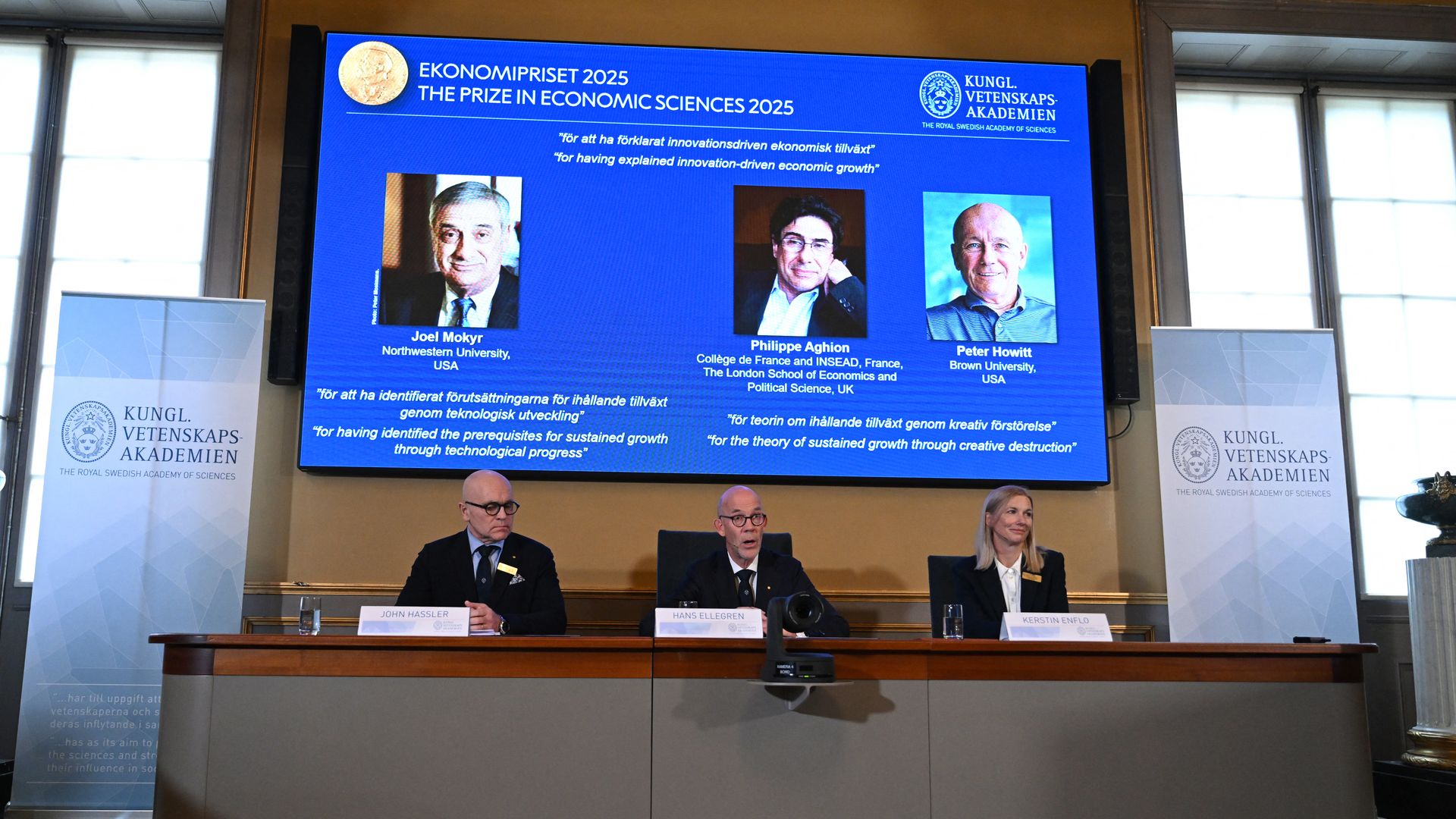
You don't need much imagination to see what the Nobel Prize committee was saying with its choice of three scholars of growth and innovation as the latest winners of the economics profession's grandest prize.
The big picture: Societies become more prosperous over time thanks to a process of innovation and creative destruction that relies on scientific research, the free exchange of ideas, and competition to convert those ideas into practical technology.
- Those conclusions have been developed over decades by prize-winners Joel Mokyr (of Northwestern University), Philippe Aghion (INSEAD) and Peter Howitt (Brown).
Between the lines: The prize comes as biomedical research, science funding and free trade are under attack by the Trump administration.
What they're saying: "The laureates' work shows that economic growth cannot be taken for granted," John Hassler, chair of the Nobel's committee on economics, said in the announcement.
- "We must uphold the mechanisms that underly creative destruction, so that we do not fall back into stagnation," he said.
Driving the news: The Nobel committee awarded the prize to Mokyr "for having identified the prerequisites for sustained growth through technological progress" and to Aghion and Howitt "for the theory of sustained growth through creative destruction."
Zoom in: Mokyr's work amounts to a "description of the mechanisms that enable scientific breakthroughs and practical applications to enhance each other and create a self-generating process, leading to sustained economic growth," the committee writes.
- "Because this is a process that challenges prevailing interests, he also demonstrates the importance of a society that is open to new ideas and permits change."
Sign up for Axios Macro