Three economists win Nobel for work on innovation and growth

Add Axios as your preferred source to
see more of our stories on Google.
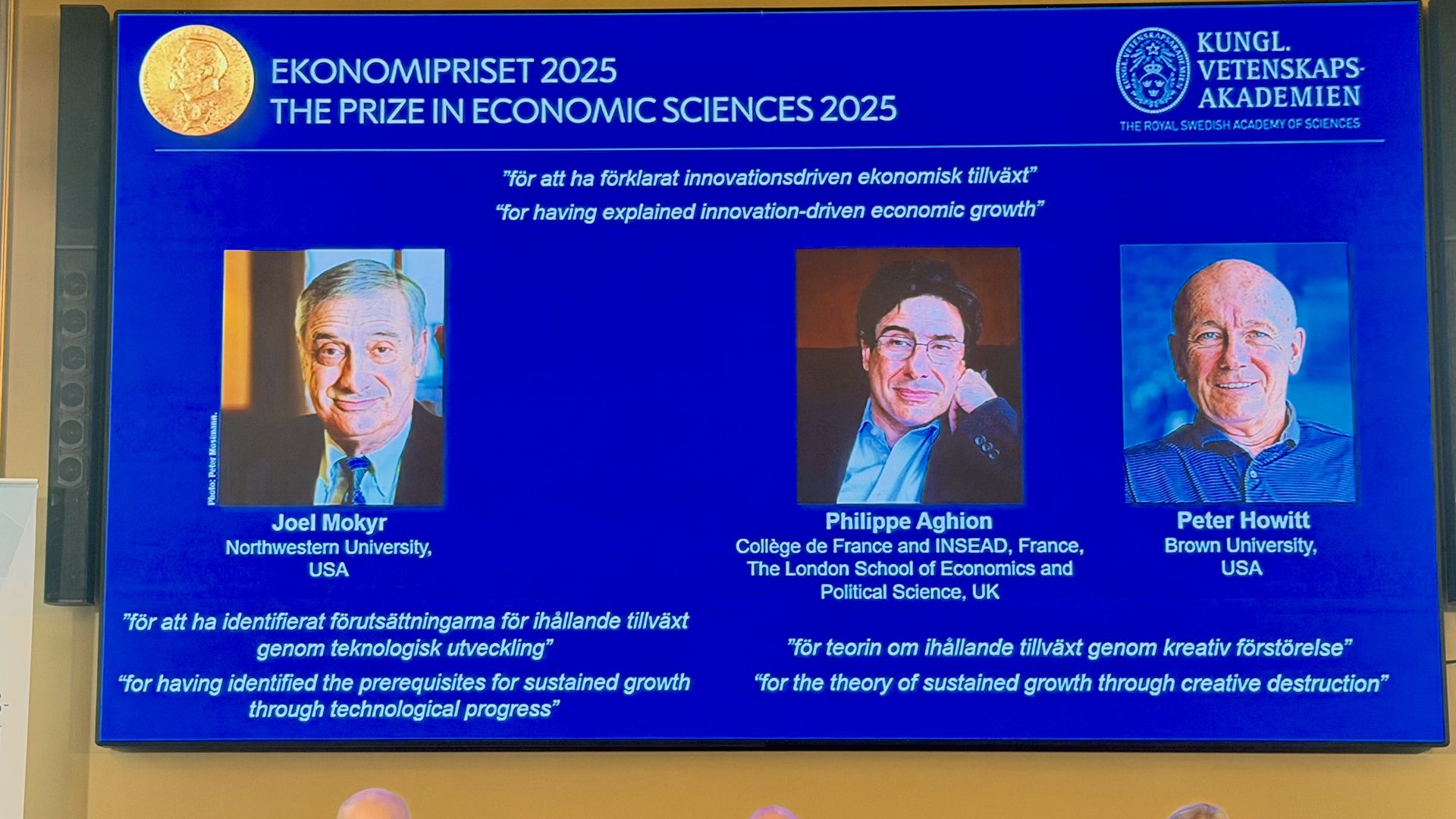
The Nobel prize announcement Monday. Photo: Atila Altuntas/Anadolu via Getty Images
Three scholars have been awarded the Nobel prize for economics for work that shows how societies become more prosperous over time, describing and modeling how technological innovation fuels growth.
The big picture: The award comes at a moment of worry that some of the underpinnings of future growth — like biomedical research and science funding — are under assault in the U.S., raising questions about future innovation.
- "The laureates' work shows that economic growth cannot be taken for granted," John Hassler, chair of the prize committee, said in the announcement.
- "We must uphold the mechanisms that underly creative destruction, so that we do not fall back into stagnation," he said.
Driving the news: The Nobel committee awarded the prize to Joel Mokyr "for having identified the prerequisites for sustained growth through technological progress" and to Philippe Aghion and Peter Howitt "for the theory of sustained growth through creative destruction"
- Mokyr is a professor at Northwestern University, Aghion at the French business school INSEAD, and Howitt at Brown University.
Zoom out: For most of human history, living standards were relatively stagnant for long periods of time, the Nobel committee writes. The Industrial Revolution changed that.
- Mokyr, an economic historian, has described the mechanisms by which the world achieved the sustained growth and improvement in living standards that resulted.
- Aghion and Howitt developed a mathematical model of how companies invest in new products and production processes, and the ways creative destruction — old ways becoming outmoded and cast aside — is crucial to growth.
What they're saying: Mokyr's work amounts to a "description of the mechanisms that enable scientific breakthroughs and practical applications to enhance each other and create a self-generating process, leading to sustained economic growth," the committee writes.
- "Because this is a process that challenges prevailing interests, he also demonstrates the importance of a society that is open to new ideas and permits change.
Of note: The prize — formally known as the Sveriges Riksbank Prize in Economic Sciences in Memory of Alfred Nobel — comes with 11 million Swedish kroner ($1.2 million) to be divided among the recipients (half to Mokyr, a quarter each for Aghion and Howitt).
