Axios Macro

September 09, 2024


Our biggest takeaway from former President Trump's speech to leading financiers last week is that he's fully prepared to double down on using tariffs as his key tool of economic policy, viewing them as a solution to any and all problems.
- We unpack it below.
Situational awareness: Consumers' median inflation expectations held steady at 3% for the year ahead, but edged up 0.2 percentage point to 2.5% in the medium term, according to the New York Fed's Survey of Consumer Expectations.
Today's newsletter, edited by Kate Marino and copy edited by Katie Lewis, is 732 words, a 3-minute read.
1 big thing: Trump is more locked in on tariffs than ever before
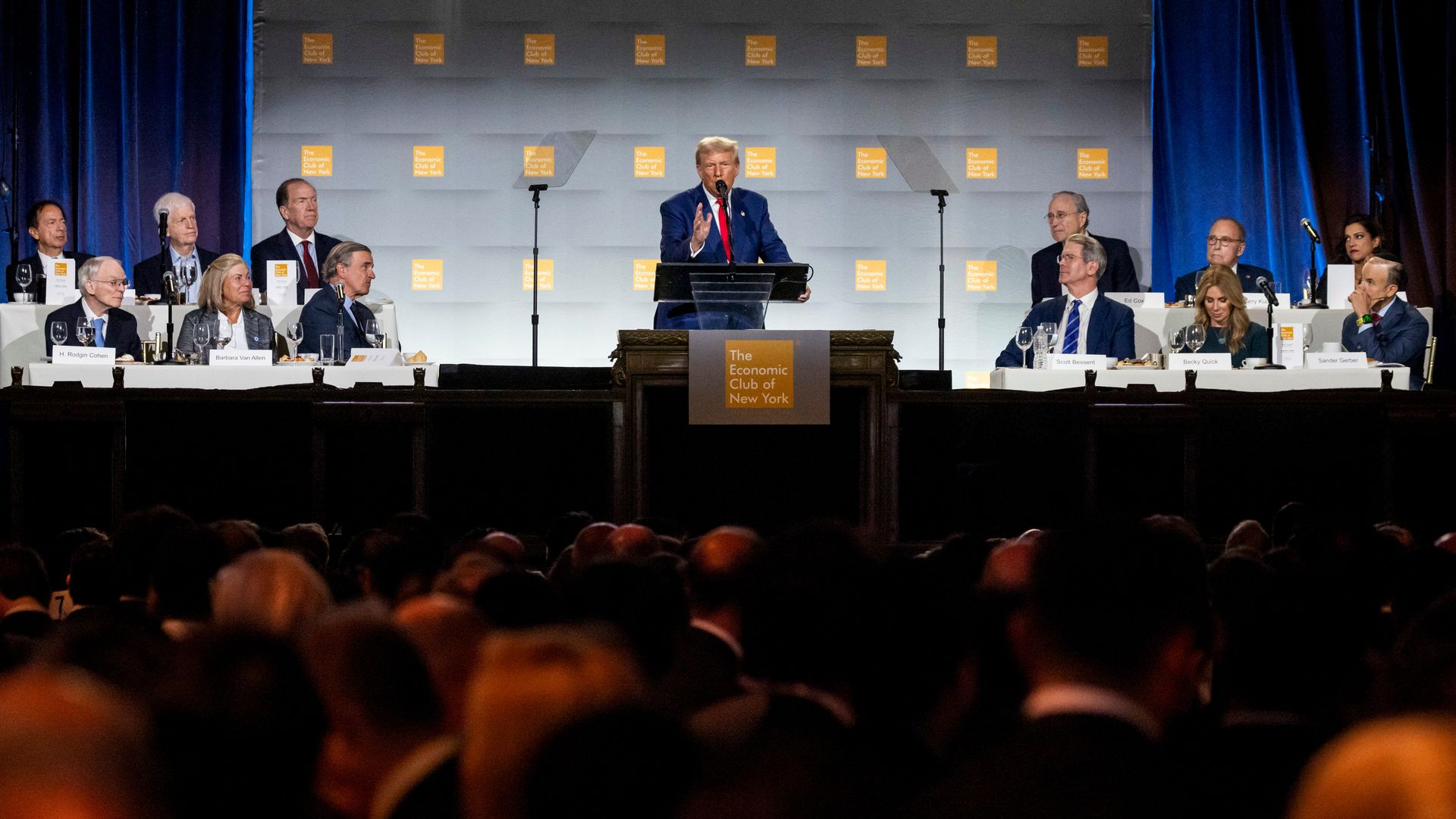
Trump wants to solve a long list of the United States' economic challenges — a huge budget deficit, fraying of the dollar-dominated international financial order, even the cost of child care — with the policy equivalent of one weird trick.
Why it matters: A new Trump administration would likely rely even more heavily than the first on tariffs as a policy tool, he repeatedly conveyed in remarks last week.
- His words imply more radical shifts to the workings of the global economy than many business leaders have assumed and than were seen when he was last in the White House.
- That is particularly notable as tariffs are one of the policy areas in which a president has largely unchecked power.
Catch up quick: The former president, in a lengthy speech to business and Wall Street leaders at the Economic Club of New York, returned to a topic that has been core to his political identity for decades — namely, an eagerness to tax imports.
- He offered extended praise for William McKinley, who was president at the turn of the 20th century, a time of American industrial ascent and a government funded mainly by tariffs.
- "Smart tariffs will not create inflation," Trump said. "They will combat inflation." Mainstream economists do not agree and have calculated that the sorts of import levies Trump advocates will raise prices of U.S. consumer goods.
- He advanced tariffs as a key tool for bringing down U.S. budget deficits and mentioned them as a source of funds for both child care costs and launching a U.S. sovereign wealth fund.
Reality check: The numbers do not add up. Total U.S. goods imports were $3.1 trillion last year, which implies a 10% global tariff could raise about $310 billion, a fraction of the nation's $1.7 trillion budget deficit last year.
- But that simple math doesn't account for the dynamic effects. The whole point of tariffs is to trigger reshoring manufacturing activity, which would reduce the volume of imports and revenue collected.
- Moreover, the inevitable retaliation against American export industries could damage major U.S. industries like agriculture, energy and aerospace, curtailing tax revenue.
- The Peterson Institute for International Economics calculated that Trump-proposed tariffs of 10% on all nations and 60% on China would raise about $225 billion per year in federal revenue, before accounting for negative effects on economic growth.
For the record: "President Trump successfully imposed tariffs on China in his first term AND cut taxes for hardworking Americans here at home — and he will do it again in his second term," said Karoline Leavitt, national press secretary for the Trump campaign.
- "President Trump's plan will result in millions of jobs and hundreds of billions of dollars returning home from China to America."
2. Tariffs as global reserve currency cudgel

One of the more out-of-the-box ideas Trump advanced, both in Thursday's speech and a rally over the weekend, was using the threat of tariffs to ensure the continued dominance of the U.S. dollar in the global economy.
- "You leave the dollar and you're not doing business with the United States because we are going to put a 100% tariff on your goods," Trump said at a rally in Wisconsin on Saturday.
Between the lines: This is a rejection of mainstream thinking of why the dollar is central to global commerce and finance, which is that businesses and governments around the world freely choose to use dollars because of superior financial infrastructure and perceived reliability.
- In other words, countries invest their reserves in U.S. Treasury bonds — and companies trade in dollars — precisely because they don't fear they will be treated capriciously by the U.S. government.
- Moreover, many of the countries most eager to create alternatives to the dollar-denominated financial world are already frozen out of trade with the U.S., including Russia, Iran and North Korea.
Yes, but: There are real signs that the U.S. government's repeated use of sanctions as a tool of geopolitics has created new incentives for countries to invest in non-dollar-based financial infrastructure.
- Countries including China, Brazil and India would like alternatives to the dollar-based financial infrastructure lest they be frozen out of the global economy if they end up at odds with the U.S.
Of note: Trump's vice presidential nominee JD Vance, in a Senate hearing last year, seemingly took the opposite view, expressing concern that the dollar's role as a global reserve currency artificially props up its value, undermining U.S. manufacturing.
Sign up for Axios Macro