Axios Macro

April 16, 2026


Today, we have the U.S. dollar on our minds — and how its role in the world economy has proven resilient despite fraying global relationships.
- Plus, a first look at new AI job disruption research. 🤖
Today's newsletter, edited by Jeffrey Cane and copy edited by Katie Lewis, is 895 words, a 3.5-minute read.
1 big thing: Rumors of the dollar's demise look much exaggerated
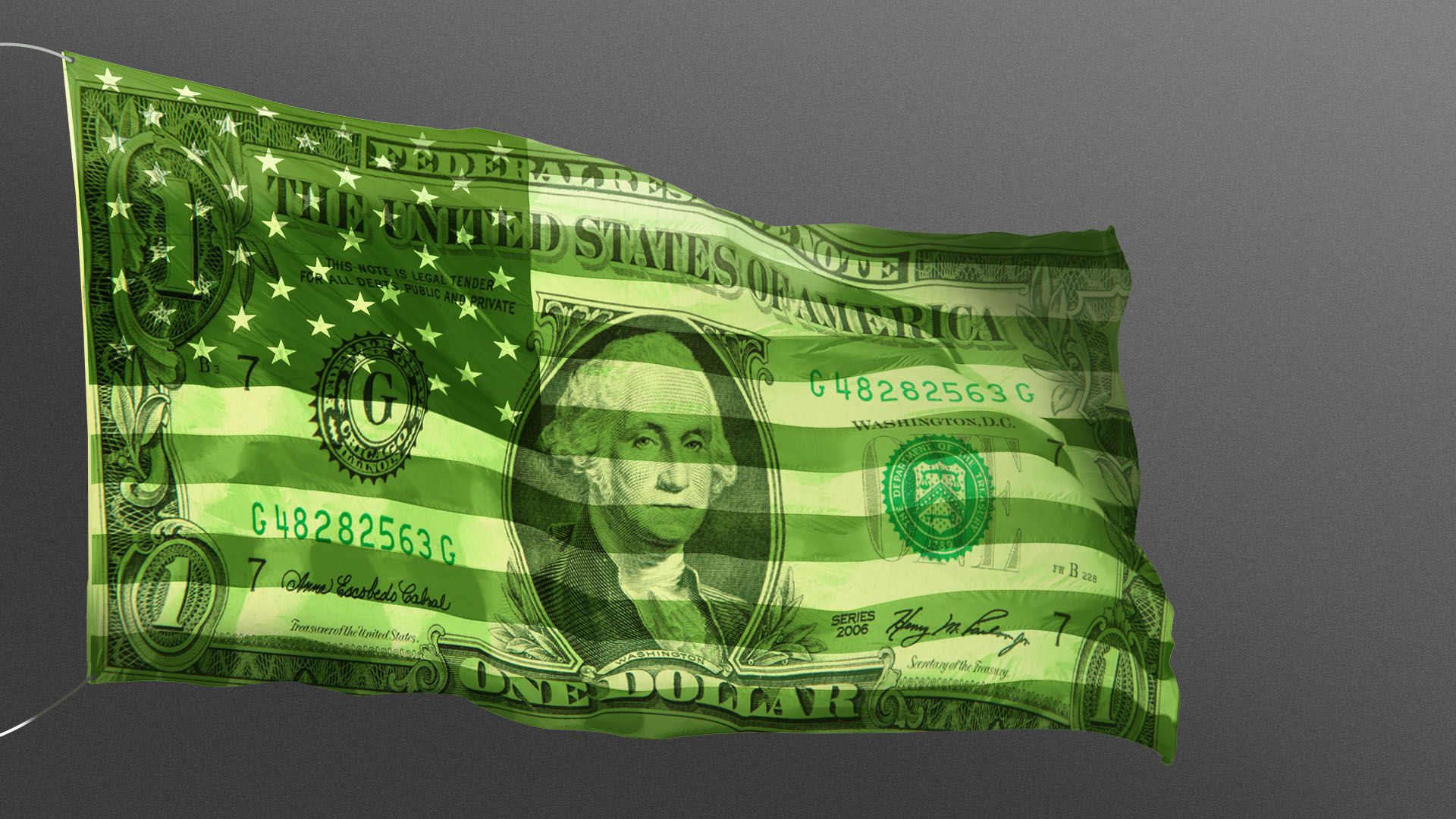
The Iran war may well be heightening countries' desire to diversify away from the U.S. dollar. But desire alone won't change the underpinnings of global commerce.
The big picture: There has been plenty of chatter about the breakdown of the petrodollar system under which Middle East oil exporters accumulate and redeploy dollars, and about the world's broader reliance on the dollar as a reserve currency. But there's not much evidence of an accelerating shift along those lines.
- Indeed, the war has coincided with a surge in the dollar's value on currency markets.
Between the lines: The U.S. relationship with many historic allies has become frayed over the last year. Geopolitical rivals, first and foremost China, have long wanted to knock the dollar down a peg.
- But the events of the last year haven't changed the underlying logic that underpins the dollar's role.
- There are powerful network effects in play — countries use dollars to trade because everybody else does. There's a huge financial infrastructure, built over decades, that a rival can't quickly replace.
- And the U.S. Treasury market is enormous and one that foreigners can readily access, meaning that those with dollars to save can easily do so.
Of note: There's a school of thought — with adherents on both the political left and the Trumpian right — that this is a bad thing for the country.
- America's role as provider of the global reserve currency is seen as resulting in a systemically overvalued dollar that disadvantages U.S. manufacturing.
- A former chief economist at the IMF argues against that view in a much-talked-about paper this week, saying that persistent U.S. trade and current account deficits are a result of home-grown imbalances.
What they're saying: The theory that global demand for dollars is the cause of U.S. current account deficits "fundamentally misconstrues how international financial markets work — harmfully so, because it deflects attention from the main major drivers of current account imbalances today," writes Maurice Obstfeld, a senior fellow at the Peterson Institute.
- "Those include the unsustainable U.S. federal budget outlook and China's failure to shift its economy further toward a non-deflationary, consumption-driven growth model, both of which would be easier to modify in the medium term than the dollar's global role," he adds.
- He argues that the widespread use of the dollar outside U.S. borders doesn't inherently require trade deficits. The U.S. can export dollars through financial flows, and dollar assets can essentially be created offshore, most notably via the eurodollar system, through which banks outside the U.S. are able to create dollar-denominated deposits and loans.
The bottom line: The dollar's role, Obstfeld writes, has resulted in "huge efficiencies in global trade and finance."
- "That role has also benefited the United States specifically, not least by giving America a powerful tool of economic statecraft."
2. Exclusive: New AI jobs risk paper

Workers whose jobs are most vulnerable to automation — data-entry keyers, bookkeepers and more — are already using AI for three times as many of their relevant tasks as workers in less-exposed jobs, according to a new study by OpenAI.
Why it matters: The research, first seen by Axios, shows that those workers are using AI for only a fraction of what it could theoretically do.
- The researchers posit a less doom-and-gloom outcome: Workers might not automatically be on the frontlines of a jobs bust, even as AI use expands.
- Paradoxically, it could ultimately expand demand for certain types of work.
By the numbers: OpenAI sorts the 900+ occupations that cover nearly all of U.S. employment into four buckets.
- 18% face the highest near-term automation risk, relative to other groups (think data-entry, bookkeeping, customer service)
- 24% of roles could see employment shrink, even as those jobs are still human-led (HR specialists)
- 12% of jobs could see employment expand because of AI (software developers, for one)
- 46% face the least threat of immediate change (teachers, home-health aides)
The intrigue: Signs of disruption aren't evident in unemployment data yet.
- Workers in the highest-automation-risk jobs have seen a smaller rise in unemployment than have workers in the "less immediate change" category, OpenAI finds.
- The paper cautions: "These categories are not job loss forecasts. They are a map for understanding where near-term labor market pressure may emerge first."
Zoom in: Workers in the most vulnerable categories are using AI more than those in any other bucket for the tasks most central to their work. Yet they've barely closed the gap between current usage and what AI could hypothetically do in their jobs.
- AI could theoretically handle 90% of tasks in the highest-risk occupations. But those workers are currently using it for less than a quarter of that, according to OpenAI usage data.
Yes, but: Whether AI ultimately destroys or creates jobs hinges on a critical tension — when AI makes a task easier to perform, people may simply consume more of it.
- "When coding tools first came out, people assumed maybe we would always write a fixed amount of code," OpenAI chief economist Ronnie Chatterji tells Axios.
- "Now I'm writing code, you're writing code — you produce more of something, and more people might demand it and pay for it."
Sign up for Axios Macro