Axios Macro

October 07, 2026


🇬🇧 Neil is just back from a short trip to London and has the reset in global interest rates top of mind.
- The most dramatic headlines right now are out of France, but French challenges carry warnings and implications for the U.S., U.K. and others. More below.
- Plus, new research shows why the full inflationary punch from tariffs can take months to arrive.
Situational awareness: Consumers' inflation expectations rose in September, with the one-year figure reaching 3.9% — the highest since May 2023, according to the New York Fed's Survey of Consumer Expectations.
- Three-year expectations edged up to 3.3%, while the five-year figure held at 3%.
Today's newsletter, edited by Jeffrey Cane and copy edited by Katie Lewis, is 1,118 words, a 4-minute read.
1 big thing: The global fiscal reckoning is here
The good news about the epic shifts in global bond markets is that they mostly reflect economic fundamentals, not the kinds of panicky swings seen in a crisis.
- The bad news is that there's a risk the disruptions metastasize into a broader crisis in an era of fractured politics across major democracies.
The big picture: Turmoil in the streets this week in France is the latest sign of hazards that await elected leaders who try to address yawning fiscal deficits head-on.
- They are squeezed between voters who want to maintain public benefit levels and tax levels and a bond market that is resetting long-term interest rates higher — meaning that carrying on with wide deficits will come at a greater and greater cost to service debt.
- That's why even what has been a relatively orderly repricing so far carries risks that are bigger than just high mortgage or corporate borrowing rates.
Driving the news: The relentless upward march of bond yields continued this morning. The French 10-year yield soared 0.18 percentage point, to 4.93%.
- French yields are also surging relative to other countries that use the euro, especially Germany — the kind of fragmentation seen in the eurozone debt crisis of the early 2010s that originated in Greece.
- But France is not alone. U.K. 10-year yields are up 0.12 point, to 5.49%, while the 10-year U.S. Treasury yield is up 0.08 point this morning, reaching 5.36%, the highest since 2002.
Reality check: These are massive moves in markets that form the bedrock of global financial markets. And yet they don't appear to be driven by the kind of crisis dynamics and forced selling that fueled bond market volatility in the 2008 crisis, the 2014 Treasury flash crash and the March 2020 pandemic.
- Rather, they've been driven by bottomless demand for capital from AI hyperscalers and deficit-running sovereign governments, exacerbated by surging energy prices that increase inflation risk.
What they're saying: "When you look at outright yield levels and/or spreads, a lot of this is still quite rational, and within the realm of what fair valuation should be, just given where nominal growth is and where we are in the cycle," Kunal Shah, the co-CEO of Goldman Sachs International, tells Axios.
- "At this point, I still wouldn't say that we're anywhere close to the point of this being a broad financial stability risk or issue," says Shah, who is also co-head of fixed income, currency and commodities.
- "What policymakers in Europe have shown us, though, is that when there's broader issues on contagion and/or disorderly functioning markets, that's when they can be quick to respond."
- "Whilst the move in spreads has been very quick and sharp, in the broader context, we're still nowhere close to where we had got to in that previous European crisis," he says. "Financial conditions are tightening, but it's still not, I'd say, flashing red to the point that you need a backstop from the policymakers."
Yes, but: The European Central Bank has more powerful tools than it did in 2010 to address imbalances between European countries, and has shown willingness to use them. But it can't do much about the fundamentals of governments spending consistently far more than they raise in taxes.
- And the global nature of the yield surge shows the common fiscal challenge across major economies.
State of play: In France, there have been violent clashes with police as teachers and students protest proposed wage freezes and school funding cuts.
- In the U.K., a central political dispute is over the future of the "triple lock" pension adjustment mechanism, which all but guarantees pension costs will grow faster than the overall economy.
- The U.S. Social Security trust fund is on track to be exhausted in 2032.
- The rate adjustment of the last several weeks will increase already-onerous debt service costs for all advanced countries.
Of note: Those forces can create destabilizing effects for business even apart from the impact on rates. Shah, for example, says that U.K. governments lurching from budget to budget has made it hard for businesses making long-term decisions.
- "I hope that at some point we'll be able to break out of this cycle, because it does stifle confidence and it just makes planning for the long term very hard," Shah says.
2. Tariff inflation lag
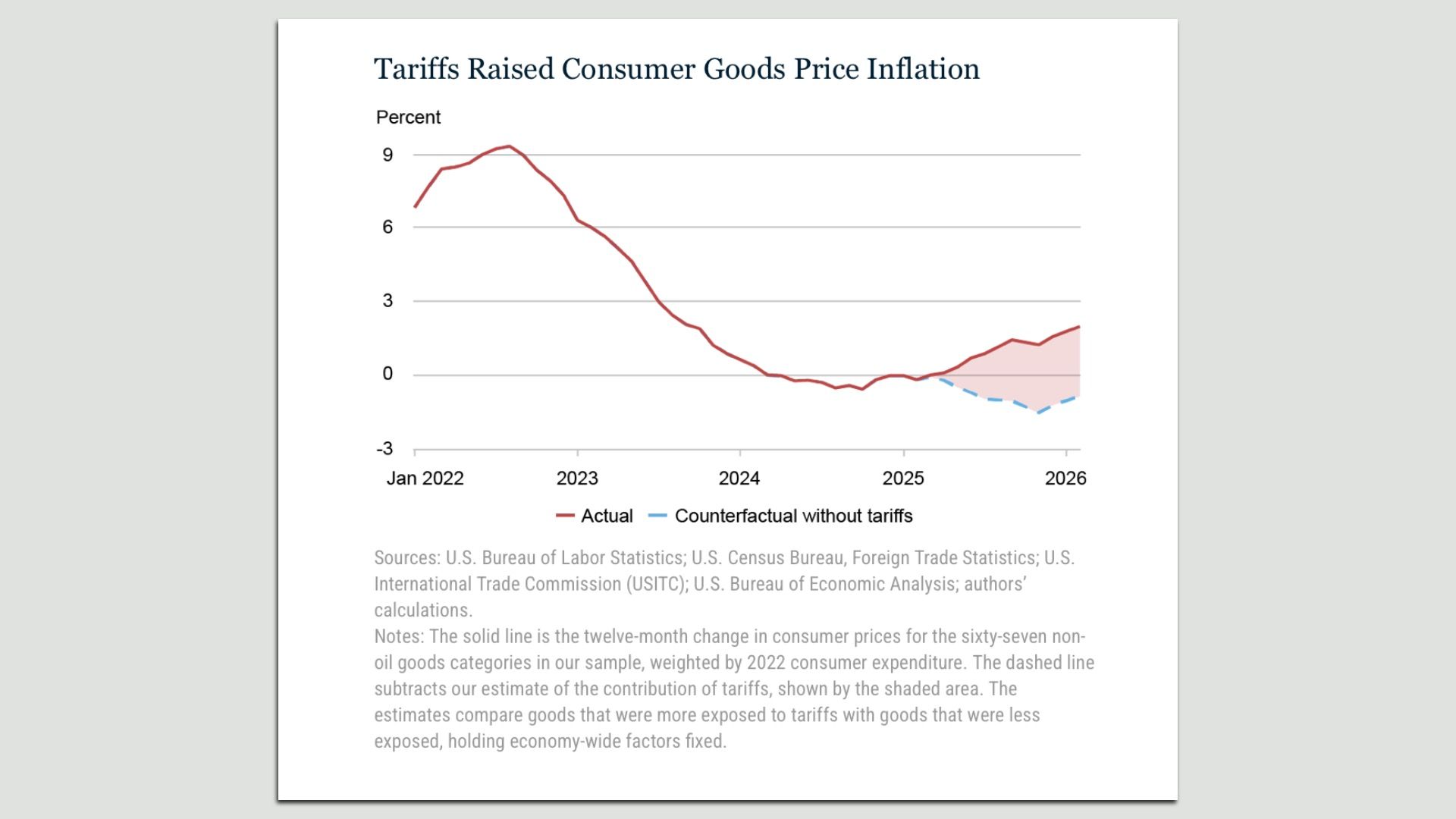
Tariff inflation has a long tail. Higher import costs can ripple through U.S. supply chains, with effects on domestically produced goods emerging as much as a year later, according to New York Fed researchers.
Why it matters: The inflation hit from 2025 tariffs is fading, but newer levies are still feeding through to prices as inflation is already too high for policymakers' comfort.
What they're saying: "For every percentage point increase in average tariffs, consumer goods prices increase by about a quarter of a percent after one year," New York Fed economists Mary Amiti, Sebastian Heise and David E. Weinstein wrote.
- The authors previously found that U.S. companies and consumers bore most tariff costs earlier this year — research that Trump economic officials sharply criticized.
How it works: Tariff price effects unfold in stages.
- Nearly 90% of a tariff increase passes through to import prices almost immediately.
- Retail prices move more slowly: About half the direct effect appears within three months, and nearly all within six months.
- Effects on U.S.-made goods more than double between six and 12 months. About one-third of the overall price increase comes from those goods.
State of play: The researchers estimate that President Trump's tariffs added 2.9 percentage points to consumer goods inflation by February 2026 (excluding services and oil).
- Without them, goods prices would have fallen slightly.
- The effect on consumer goods prices peaked near 3% in February and eased to about 2% by August after a Supreme Court ruling struck down Trump's emergency powers tariffs. Those were replaced by a lower 10% import tax.
What to watch: The economists expect tariff price pressures to pick up again as Canadian levies continue to filter through, with higher auto tariffs taking effect next year.
Sign up for Axios Macro