Axios Macro
November 21, 2024


Companies are preparing for the tough tariff policies ahead with a race against the clock. That might make economic data a little bumpy in the coming months. More below.
💼 Situational awareness: Another week, another benign reading on job losses. The Labor Department said 213,000 Americans filed new claims for jobless benefits last week, down 6,000 from the previous week.
Today's newsletter, edited by Ben Berkowitz and copy edited by Katie Lewis, is 647 words, a 2½-minute read.
1 big thing: The Trump hoarding effect

Economists warn that the tariffs promised by President-elect Trump will be a drag on the economy. For now, attempts to get ahead of tariffs might be a meaningful, if fleeting, boost to growth.
Why it matters: Some companies are pushing through orders sooner to try to beat the clock on the expected harsher trade regime — the type of activity that, if widespread enough, could temporarily jolt GDP.
- These maneuvers to navigate the tariff agenda can potentially make economic data messy, volatile and difficult for policymakers to judge the underlying economy's health.
What they're saying: "The economy is already strong and it might get a boost via an increase in orders," Joe Brusuelas, chief economist at accounting firm RSM, tells Axios.
- Brusuelas estimates there could be a 0.2 percentage point increase in the current quarter — an effect he expects to reverse in the following quarters.
- "We're going to get this noise in one part of the economy that has to do with trade," he adds.
The intrigue: Brusuelas said he got inquiries from companies after the election, all asking about pulling inventory forward.
- "Eight years ago, companies thought tariffs were a negotiating tactic and they ended up on the wrong side."
- Businesses bear the cost of tariffs and typically pass it on to consumers. But that would be tough if buyers balk at higher prices.
- "Not every firm has the same pricing power," says Brusuelas.
The big picture: Trump wants businesses to rely less on imports. But the opposite is happening now: Companies are importing goods at a historic pace because of his election win.
- Toolmaker Stanley Black and Decker told investors yesterday that it was investing in some inventory "for a number of reasons, not the least of which is tariffs," an executive said.
West Coast ports are handling more cargo than usual for the season. The consumer is strong, and shippers might divert containers to head off delays from possible East Coast dockworker strikes.
But port leaders say the Trump hoarding effect can't be counted out: "Most of the factories we talk to are running full tilt," Gene Seroka, head of the Port of Los Angeles, told reporters yesterday.
- "People have been preparing for some time, 'How much cargo can I bring in before warehouses start busting at the seams?'" Seroka said.
- Seroka said a similar hoarding phenomenon happened in 2018: The port saw a run-up in cargo before tariff implementation, followed by a drop-off so sharp that the port's business fell by double digits.
2. The limits to racing against tariffs
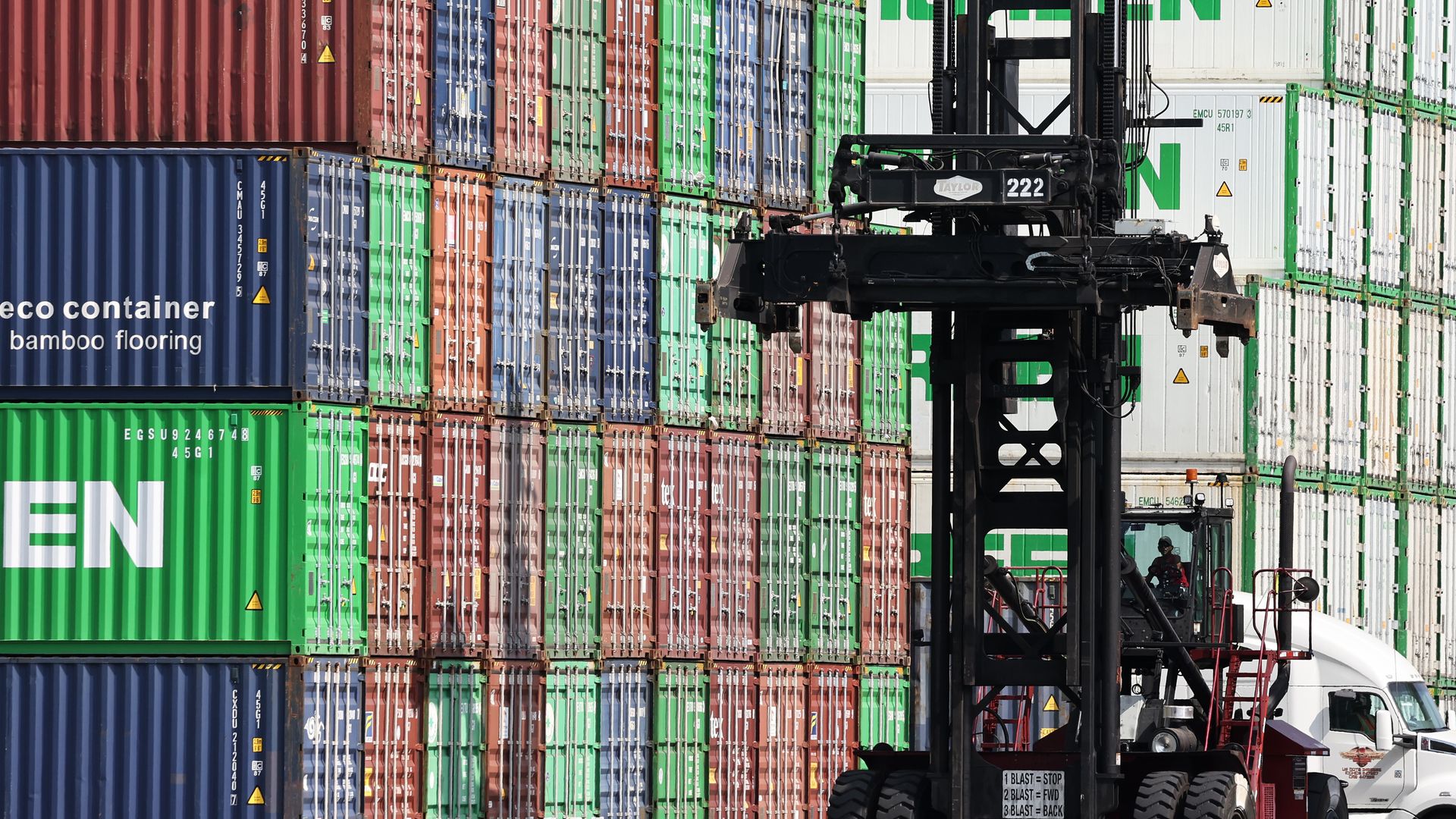
All that said, any impact from these effects is, almost by definition, temporary. Companies aren't going to tie up capital and pay for warehouse space for years' worth of supplies just to front-run a tariff.
- "They can bring it forward but they can't do that much," Minneapolis Fed president Neel Kashkari told Axios last week.
- "It's a little bit like airlines that sometimes hedge fuel, but they can't do that for the next 10 years," Kashkari added.
- "It's a pretty long supply chain from Asia so it would be hard to pull forward very much," Norfolk Southern's Claude Elkins said at a conference yesterday.
What's next: The longer-term question is how much a new tariff regime triggers fundamental rethinking of international supply chains.
- In what situations do companies reshore manufacturing activity, as the Trump administration will desire, versus paying tariffs and either passing higher costs on to customers or taking a hit to margins?
- As we noted last week, companies have already been rethinking the complex global supply chains with heavy dependence on China.
- Rather than make goods in one place and ship them worldwide, they are shifting toward locating production closer to the markets being served — a pattern a new wave of tariffs could accelerate.
The bottom line: Trump has yet to take office, but policies promised on the campaign trail might already be impacting the economy.
Sign up for Axios Macro