Axios Macro
May 03, 2024

Today's jobs report had something for everyone, with signs of cooler — but not frozen — labor market conditions. More below.
- Plus, Treasury Secretary Janet Yellen wades into surprising territory.
🌎 Join Axios on May 21 and May 22 for cross-continental events hosted in NYC and London where we'll examine the complexities of diverse regulatory environments and investment opportunities for private equity in the U.S. versus Europe. Request an invite and check out our lineup here.
Today's newsletter, edited by Kate Marino and copy edited by Katie Lewis, is 627 words, a 2-minute read.
1 big thing: The job market's steady state

Illustration: Shoshana Gordon/Axios
The labor market isn't the turbocharged hiring machine of the last couple of years. Instead, hiring looks to be moderate, steady and solid.
Why it matters: Today's employment report should ease fears that the job market is reaccelerating — while offering reassurance that it's still healthy, with few signs the economy is in trouble.
Driving the news: Employers added 175,000 jobs in April, down from an upwardly revised 315,000 payrolls in March.
- Meanwhile, the unemployment rate ticked up slightly to 3.9% from 3.8% — a move that looks even smaller if you go out an extra decimal place, as it rose from 3.83% in March to 3.86% in April.
- It's the 27th consecutive month that the jobless rate has been below 4% — matching the longest stretch since the 1960s.
The big picture: There's a lot to like in the report — both for workers who are still in high demand and Federal Reserve officials looking for proof that inflation pressures are subsiding.
By the numbers: The details point to both ample jobs and diminishing wage pressures.
- The share of employed prime-age workers, those between 25 and 54, rose a tick to 80.8% — hovering near the highest in more than 20 years. (For women, it hit an all-time high of 75.5%).
- Average hourly earnings rose just 0.2% in April, down a tick from the prior month. Over the past three months, they rose at a 2.8% annualized rate — sharply lower than 4% in March.
State of play: Yields on the two-year Treasury note — most sensitive to policy moves by the Fed — dropped by 0.09 percentage points after the report, as it is consistent with the Fed delivering interest rate cuts at some point this year.
What to watch: "This is the jobs report the Fed would have scripted," Seema Shah, chief global strategist at Principal Asset Management, wrote in a note.
- "Today's weaker numbers need to mark the start of a new slower trend for multiple rate cuts to seriously be back on the agenda — but, by then, the new fear could be a slowing economy," Shah added.
2. Yellen on why the economy needs democracy
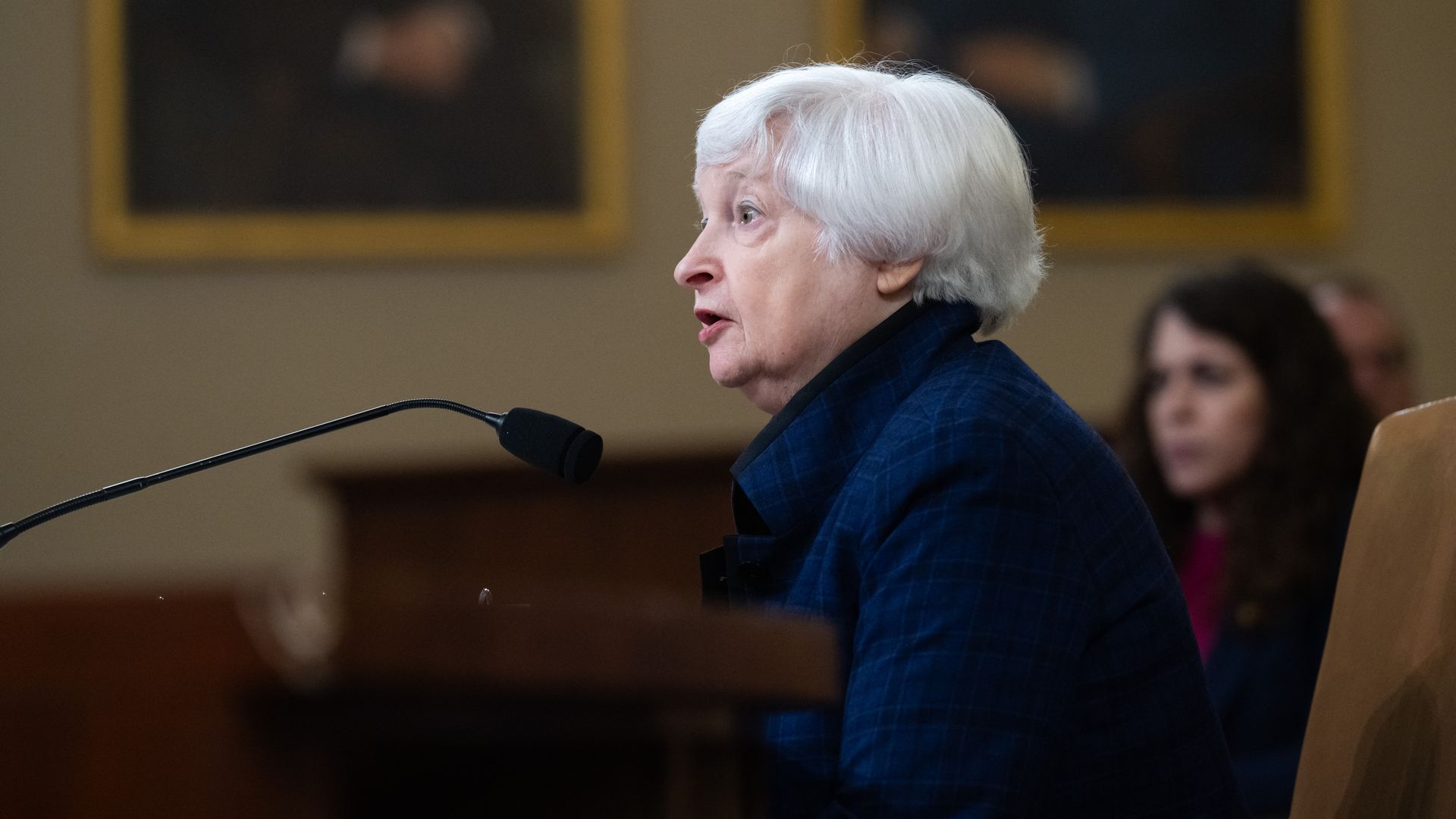
Treasury Secretary Janet Yellen. Photo: Saul Loeb/AFP via Getty Images
It wasn't quite the typical speech from a U.S. Treasury secretary that Yellen delivered this morning in Arizona, as she herself acknowledged. But these aren't quite typical times.
Driving the news: Yellen, speaking at the McCain Institute's Sedona Forum, offered "the economic case for democracy," arguing that America's democratic traditions and economic prosperity are fundamentally interlinked.
- As our colleague Hans Nichols noted in previewing the speech, it is an example of the Biden administration not-so-subtly casting attention to risks should former President Donald Trump win the presidency in November.
What they're saying: "It is Americans' respect for their fellow citizens' views and needs that truly underlies America's success," Yellen said.
- "That is what allows us to work out our disagreements and to address legitimate concerns."
- She said that "the argument made by authoritarians and their defenders that chipping away at democracy is a fair or even necessary trade for economic gains is deeply flawed. Undercutting democracy undercuts a foundation of sustainable and inclusive growth."
State of play: Yellen noted the storming of the U.S. Capitol on Jan. 6, 2021, and Vladimir Putin's Russia invading Ukraine in 2022.
- She expressed skepticism that China will be able to reach the income levels of the United States and Europe, given its limits on transparency, censorship and coercion of businesses.
Between the lines: Yellen also argued that "the rule of law can be bolstered by institutions that are insulated from political interference" like the Fed, which she once chaired.
- Her remarks come amid reporting from the Wall Street Journal suggesting that at least some Trump advisers seek to obliterate the tradition of Fed independence from the White House.
Sign up for Axios Macro

Stay ahead of the curve on the most important economic developments with reporting and analysis on how business, policy, and markets collide.