Axios Macro
June 03, 2026


In case you went to bed early, you may have missed the late-night signal that more trade pressure is ahead for global allies — the latest action in a quiet ramp-up of tariff action this week.
- More below, plus new forecasts that lay out the two rocky paths ahead for the global economy. 🌍
Situational awareness: The private sector added 122,000 jobs in May, according to ADP, with the "most broad-based hiring" in years, the payroll processor's chief economist told reporters this morning.
Today's newsletter, edited by Jeffrey Cane and copy edited by Katie Lewis, is 1,017 words, a 4-minute read.
1 big thing: Trade pressure comeback
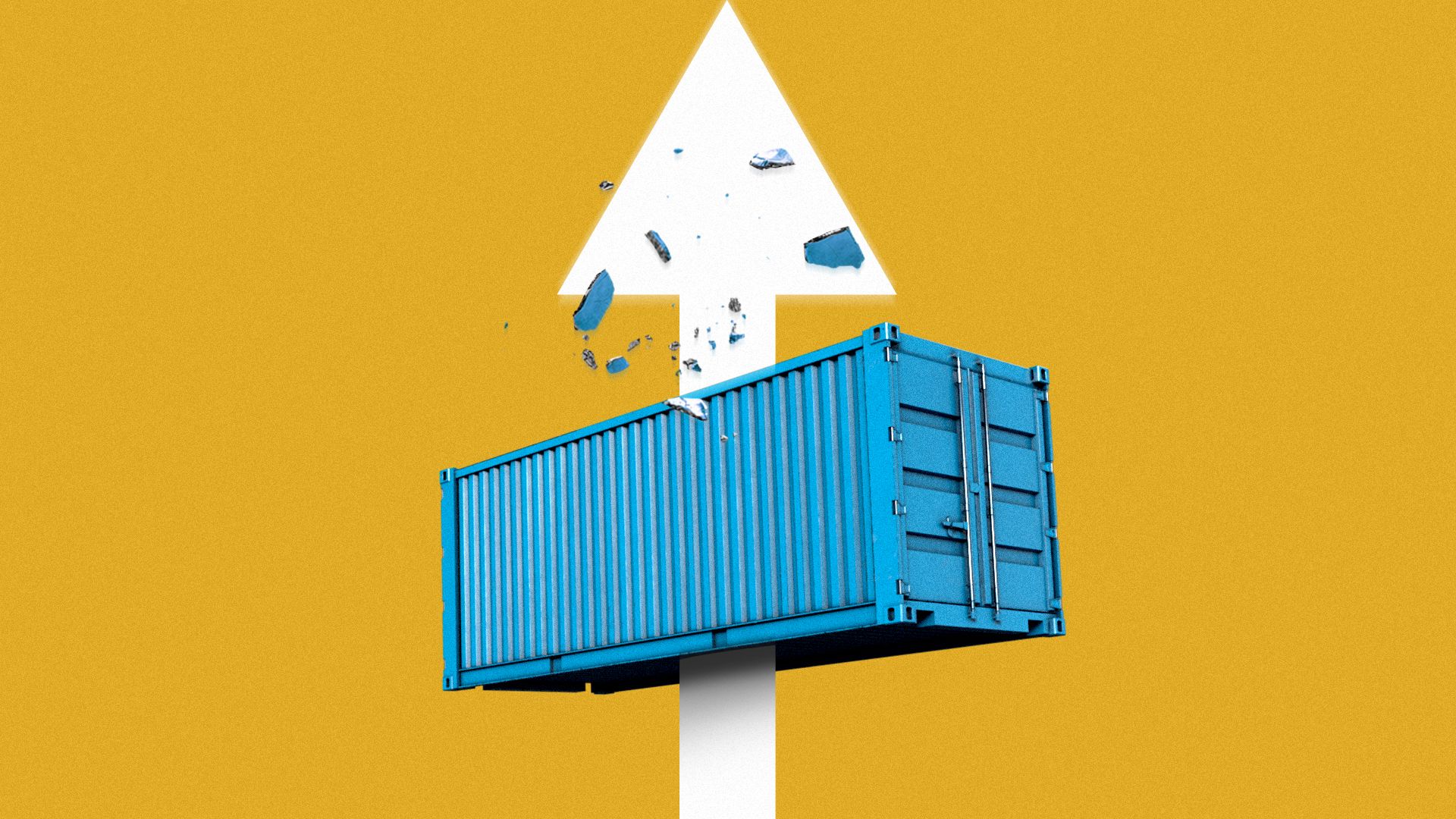
Global trade drama is back, with new tariffs on worldwide allies in the hopper.
Why it matters: This round is quieter. The Truth Social threats have been replaced by a more legally tested, bureaucratic process. Still, it is the clearest sign yet of the Trump administration's commitment to reinstate a tariff regime that was torn down by the Supreme Court.
- The signal to Americans, investors and economic watchers: The tariff inflationary risk is here to stay, even as effects from the Iran war raise prices in other areas hitting household budgets.
The intrigue: The tariff proposals come alongside the Department of Justice formally appealing a court order that extends tariff refunds to all importers, a move that threatens to freeze repayments.
Driving the news: Last night, U.S. Trade Representative Jamieson Greer proposed fresh tariffs on 60 economies — covering nearly every major U.S. trading partner — over failures to ban (or enforce blocks on) imports made with forced labor.
- Most of the 60, including China, Japan, South Korea and Brazil, would face a 12.5% rate.
- A smaller group that already restricts forced-labor imports to some degree — among them Canada, Mexico, the European Union and the U.K. — would face 10%.
- The duties are not final: They are subject to a public comment period, as well as hearings that begin next month.
What they're saying: "The failure of our most important trading partners to address the importation of goods made with forced labor is unacceptable. We will no longer tolerate this disparity," Greer said in a statement last night.
Catch up quick: The duties conclude one of two investigations Greer's office launched in March under Section 301 of the Trade Act of 1974.
- A separate probe, examining structural excess manufacturing capacity in 16 economies, including China and the EU, is still open.
The big picture: The duties are part of a patchwork approach to reinstate those overturned earlier this year.
- President Trump's emergency replacement — a 10% global baseline imposed under Section 122 of the Trade Act — expires next month. The law caps those tariffs at 150 days, with an extension requiring a sign-off from Congress.
- That flat rate has been a reprieve for some of the hardest-hit partners, including Vietnam.
- Greer signaled earlier this year that the other Section 301 investigations would be wrapped before the expiration, giving a legally sturdier basis to keep tariff pressure on.
What to watch: It has been one of the busiest stretches for tariffs in months, with three actions in the past 48 hours.
- Greer on Monday proposed a 25% tariff on many Brazilian imports after a separate Section 301 investigation determined the nation's practices in a slew of areas — digital trade, electronic payments and more — were unfair.
One action cut in the opposite direction: The same day, the administration eased tariffs on imported farm and construction equipment to 15% from 25% through the end of 2027, relief the White House pitched to farmers squeezed by higher fuel and fertilizer costs.
The bottom line: The trade deals are non-binding frameworks, more Section 301 actions are on deck, and the U.S.-China truce lapses later this fall — leaving businesses to plan around tariffs that are still shifting under them.
- "Some companies may be weighing options to stockpile or front-load their imports to hedge against the uncertainty," Augustine Lo, a trade attorney at Dorsey & Whitney, wrote last night in an email to reporters.
- "It's possible that the tariff rates could go back to the elevated levels seen under the IEEPA tariffs for other countries, and the proposed 12.5% rate under the Tuesday announcement may be only a first step," Lo wrote to Axios.
2. The world's forked outlook

The Iran war has divided the global outlook into two tracks: A modest slowdown if the conflict ends soon or a severe hit, with some economies near recession, if it drags on and the disruption deepens.
Why it matters: Either path leaves the global economy worse off than before the war, with slower growth and hotter inflation. The scenarios — laid out in new economic projections from the Organisation for Economic Co-operation and Development this morning — determine the scale of the damage.
- "The conflict in the Middle East has become the dominant force shaping the global economic outlook," wrote Stefano Scarpetta, the chief economist of the Paris-based group's latest economic projections.
Between the lines: The OECD's central scenario assumes energy disruptions ease as talks move toward a durable peace. The downside scenario has the conflict dragging through much of next year.
- In the first, the group projects global growth at 2.8% this year, only slightly below the 2.9% projected in March — though absent the war, the OECD says it would have upgraded growth. Growth rebounds to 3.1% in 2027.
- Under a more severe scenario, global growth slows more to 2.1% in 2026 and 1.8% in 2027, hitting hardest the economies most reliant on Middle East energy — much of Asia outside China — with Persian Gulf output falling outright.
- G20 inflation is projected to hit 4% this year before easing to 3.1% in 2027; a prolonged war would boost that by an additional 0.4 percentage point this year and 1.3 points in 2027.
The big picture: Both scenarios play out against an AI-boosted economy, with the U.S. the clearest beneficiary as it's more insulated from the energy shock.
- The OECD sees U.S. growth near 2% this year, the strongest in the G7, on "enormous AI-related investment" and resilient spending by higher-income households, before easing to 1.8% in 2027 even as the rest of the world recovers.
Sign up for Axios Macro