
Axios Macro

August 08, 2024

Today, Neil pulls upon his experiences as the father of two young children to look at central bankers' decisions on when to try to stop a financial market tantrum and when to let the markets cry things out. 👶
- Plus, some reassuring new data on jobless claims.
Today's newsletter, edited by Kate Marino and copy edited by Katie Lewis, is 708 words, a 2½-minute read.
1 big thing: The central banks vs. the toddlers
The Bank of Japan blinked. After its surprise interest rate hike last week sent tremors through global markets, a top BOJ official yesterday gave the central bank equivalent of a "never mind," helping restore calm.
Why it matters: It shows that, no matter how much policymakers might wish to brush aside the ups and downs of financial markets, when conditions get rough they can't help but use their powers to calm things down.
- It is the latest example in a series of policy responses — going back decades and around the world — that may have fueled asset price bubbles and diminished the ability of markets to correct their own excesses.
Driving the news: Speaking in northern Japan yesterday, deputy governor Shinichi Uchida said, "I believe that the Bank needs to maintain monetary easing with the current policy interest rate for the time being," given "extremely volatile" developments in markets.
- It was a backtracking from barely a week earlier, when governor Kazuo Ueda signaled that more rate hikes were on the way.
- The Bank's hawkish tone last week, paired with a worsening U.S. outlook, drove a collapse in Japanese stocks on Monday as traders unwound yen-based trades.
What they're saying: "They have become far too sensitive of market movements on the downside," Ruchir Sharma, author of a provocative new book called "What Went Wrong with Capitalism," tells Axios. "They are happy to let markets rip on the upside but at the slightest sign of any trouble on the downside want to react to it."
- "Central banks justify such a reaction function by saying that markets going down can have a negative impact on the economy, but they are only strengthening the feedback loop between the markets and the economy by being so sensitive to market movements," he said.
- "This asymmetrical risk is what investors have come to believe in, letting markets get larger and larger as a share of the economy over time," added Sharma, the chairman of Rockefeller International.
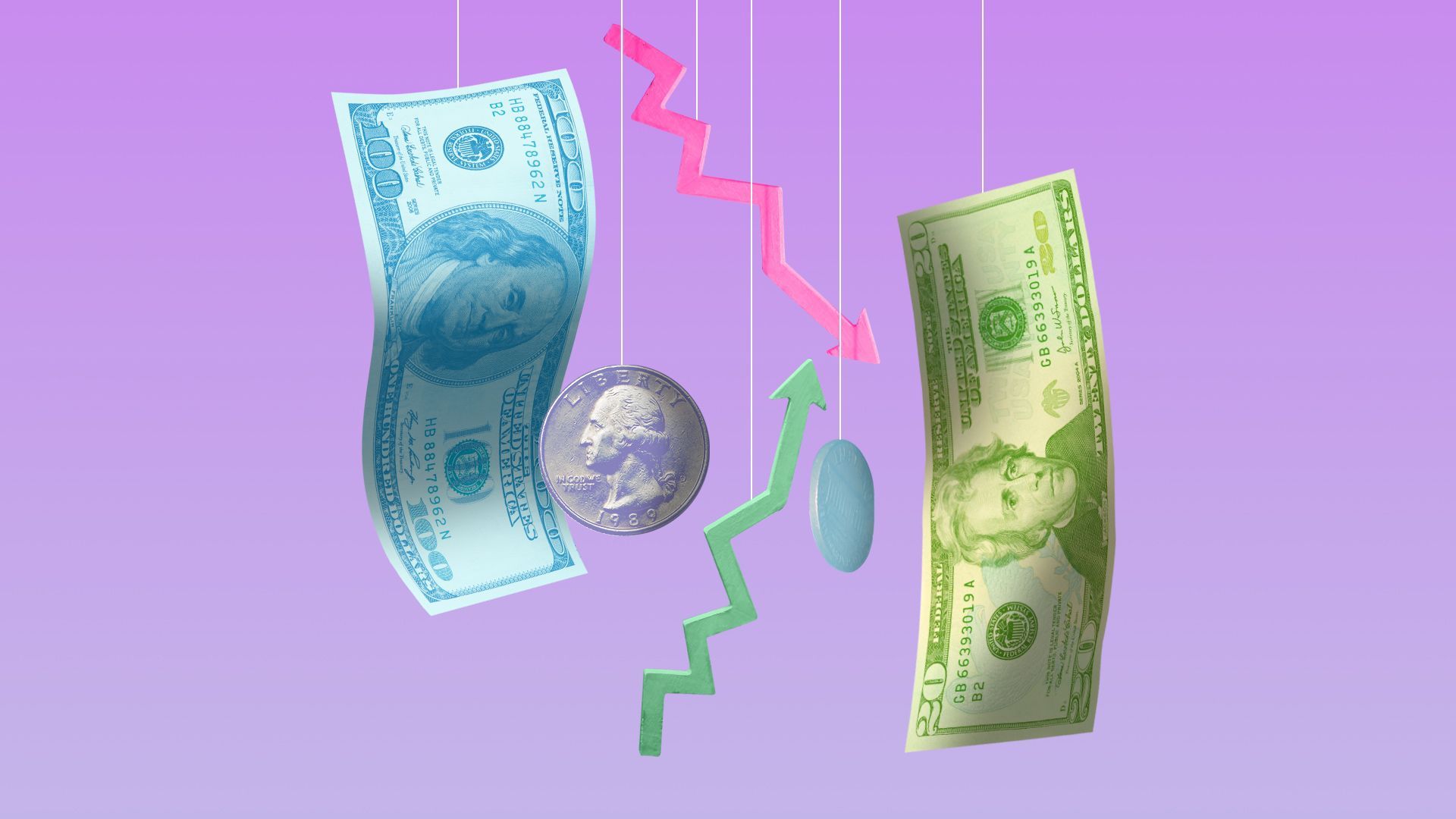
Between the lines: Economist Justin Wolfers compares the gyrations of the stock market in recent days to a toddler throwing a fit. Traders are "impulsive, demand attention and throw tantrums when they don't get what they want," he wrote in the New York Times.
Yes, but: The problem is that not all market moves are created equal. As seen most vividly in 2008, when market declines trigger a contraction in credit, it can cause a broad, painful recession that it is central bankers' job to prevent.
The bottom line: To abuse Wolfers' metaphor, there are times when a parent has to stand firm, letting their toddler scream and cry and make a scene lest they learn they can get whatever they want if they complain loudly enough.
- Other times, the wise move is to relent and give them whatever snack or toy they demand so you can go about your day.
- In central banking, as in parenting, the hard part is deciding which moment is which — knowing you can never be 100% sure you made the right call.
2. Jobless claims offer some good news


The latest data on jobless filings helps soothe concerns about the U.S. economy.
- Weekly unemployment claims fell to 233,000 last week after spiking to the highest in a year (a revised 250,000) in the previous week.
Why it matters: Unemployment filings are the closest thing to a real-time indicator of job market health, but the data is volatile.
- It's the second time this week that better-than-expected data has offered reassurance about the economy. The Institute for Supply Management's purchasing managers' index on Monday showed the service sector was back in expansionary mode.
By the numbers: In normal times, financial markets don't react very much to the weekly claims data. These are not normal times: Markets are looking for any hint, however small, about the state of the economy.
- After the data, the yield on the 10-year jumped to 4%. Stocks rallied, with the S&P 500 up 1.9% as of 10:30am ET.
What they're saying: "In a week when even the smallest sign of economic weakness could spook the market, the drop in new claims was much-needed good news," RSM economist Tuan Nguyen wrote in a note.
- "However, we don't think we are out of the woods yet," he added.
Sign up for Axios Macro