Axios Macro
July 13, 2023

1 big thing: A sign the Fed won't sweat soaring stocks
On the Friday before the July Fourth holiday, a staff paper was published on the Federal Reserve's website — a rollout of a new index hardly designed to maximize buzz.
- But it has made a splash nonetheless, offering a window into how financial market swings may affect the central bank's policies.
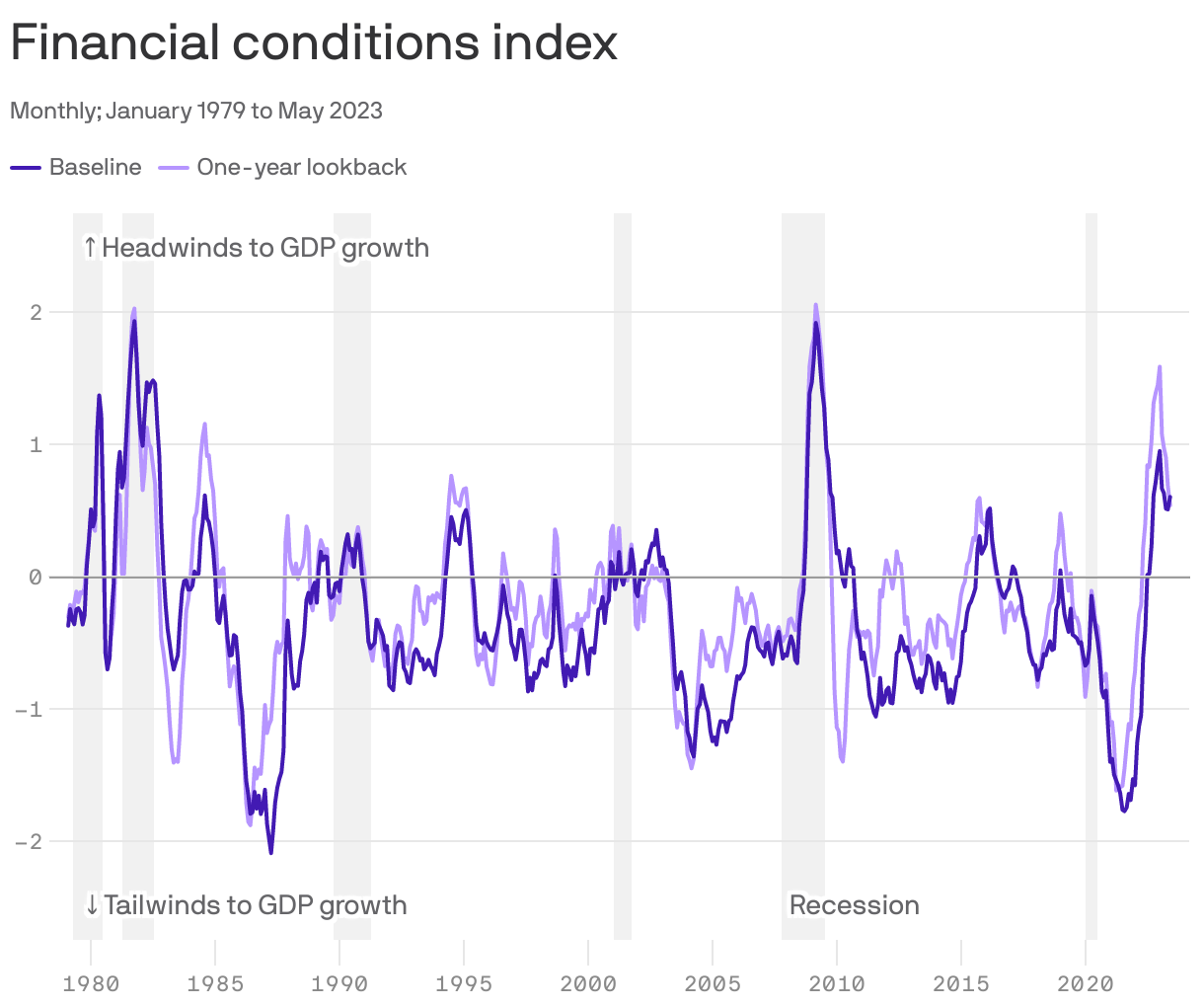
Why it matters: The new financial conditions index attempts to quantify how the situation in stock, bond and other markets will likely affect growth.
- It points to conditions being very tight as of May, in spite of a market rally this year — implying the Fed may not need to crank interest rates much higher to achieve its economic goals or overreact if markets keep rising.
The details: The index, created by six staff economists, incorporates data including bond yields, mortgage rates, the stock market, Zillow's house price index and the dollar's value on global currency markets.
- They're weighted based on how, in the Fed's powerhouse model of the economy, their swings translate into more or less economic activity in the year that follows.
- "The new index assesses the extent to which financial conditions pose headwinds or tailwinds to economic activity," the authors write.
By the numbers: The index's recent peak was in December, meaning market conditions that month were poised to be more of a drag on growth than at any time in recent decades, other than the 2008 financial crisis.
- The number in December was 0.95 for the baseline version of the index, suggesting financial conditions that month would be expected to subtract about a percentage point from growth this year.
- The index receded in the first five months of this year, to 0.6 in May — still higher than in many past periods of financial stress, like the 2001 dot-com crash or the 2016 industrial mini-recession.
What they're saying: Evercore ISI analysts Krishna Guha and Marco Casiraghi wrote that the new index is "likely to prove one of the most market-relevant staff papers in a long time."
- Compared to other such indexes, it puts less emphasis on the stock market and more on market interest rates, they said. So long as rates remain high, the Fed will be "relatively tolerant" of higher stocks.
- "In other words, the Fed is less likely to oppose the stock market rally – unless it gets completely out of hand – than widely feared," they wrote.
Yes, but: The new index hasn't received any explicit mention from Fed policymakers, so it isn't a given that decision-makers will give much weight to it.
- However, the message that the Fed shouldn't overreact to the latest market swings has been consistent with top officials in recent months — so long as higher interest rates are doing their job of restricting growth.
2. Wholesale inflation plunges


Another day, another data point suggesting a more benign inflationary environment.
What's new: Inflation for wholesalers, which can signal future trends for consumer costs, has plummeted from the peak reached last spring, the Labor Department said this morning.
- In fact, in the 12 months through June, the Producer Price Index barely rose at all: up just 0.1%, the smallest increase in three years.
- In other words, by this measure, the entire COVID-era inflationary shock has completely reversed for wholesalers.
Details: The "core" PPI measure — which excludes volatile components like food, energy, and trade services — moderated further: In the 12 months through June, it increased 2.6% (compared to the 2.8% the prior month).
What they're saying: "Strong downward pressure on wholesale price inflation indicating profit margin compression" will help feed disinflationary pressures, EY-Parthenon chief economist Gregory Daco wrote in a note.
Why it matters: The data is the latest encouraging inflation reading this week — following yesterday's Consumer Price Index report — offering more hope that price gains could continue to ease in the months ahead.
The intrigue: Some underlying details in the PPI report, including health care and hotel accommodations, are used to calculate the all-important Personal Consumption Expenditures Price Index — the Fed's go-to measure of inflation that will be released in the coming weeks.
Axios Macro

Stay ahead of the curve on the most important economic developments with reporting and analysis on how business, policy, and markets collide.