Axios Macro

September 09, 2026

The Federal Reserve's interest rate decision next week may come down to some verrrrry fine-grained details of inflation reports out tomorrow and Friday. More below.
- Plus, new research on how AI could remake the economy in the next four years. 🔮
Situational awareness: The Treasury Department is ramping up its support for the bond market, announcing a $6 billion buyback of longer-dated debt — above the high end of the range it laid out late last month.
- The initial drop in yields after that surprise announcement has since faded, and yields rose again after this morning's announcement.
Today's newsletter, edited by Jeffrey Cane, and copy edited by Amy Stern, is 974 words, a 3.5-minute read.
1 big thing: "This precision is ludicrous"
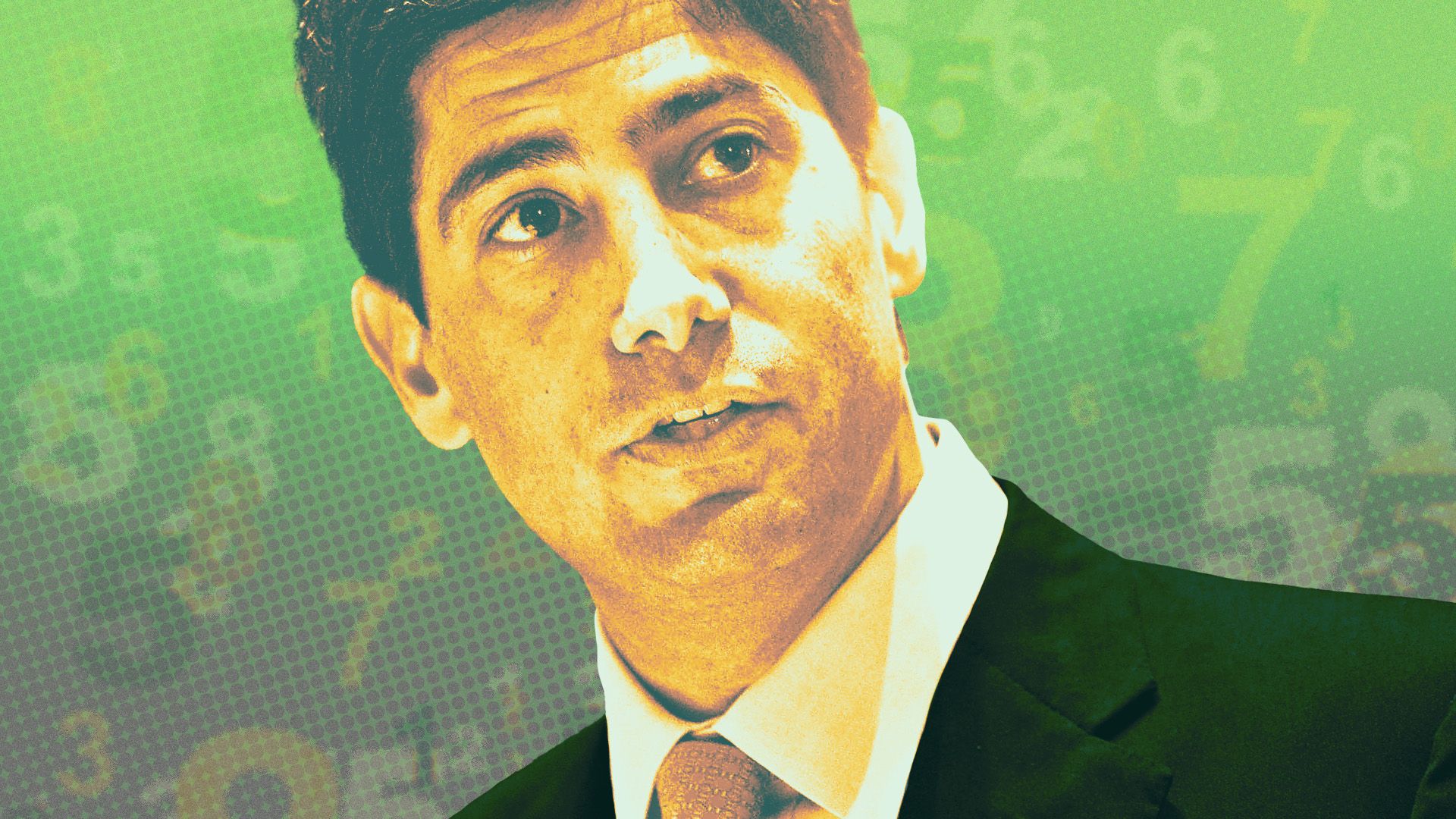
It looks like a jump ball as to whether the Fed will raise interest rates at a meeting concluding a week from today — and the decision may hinge on a few hundredths of a percent of a single month's inflation data.
The big picture: This is the opposite of what chairman Kevin Warsh wants. He has long criticized the Fed's proclivity for fine-tuning policy based on the smallest blips in economic data.
- But in the absence of a persuasive, fully developed alternative framework for setting monetary policy, much of the Federal Open Market Committee seems to be focused on parsing the numbers.
- As such, two August inflation reports on tap this week could tip the decision on whether to hike rates or not.
State of play: The Labor Department will release the August Producer Price Index tomorrow and the Consumer Price Index on Friday.
- Analysts can crunch those numbers to arrive at a good estimate of where the Fed's preferred inflation measure — the Personal Consumption Expenditures Price Index — will land when it is announced Sept. 30.
- If the month-over-month core PCE inflation number is on track to be 0.2% or lower, it would suggest that inflation is falling toward the Fed's target. If it is 0.3% or higher, it implies a worrying re-acceleration. If it's somewhere in between, well, that's where things get interesting.
- A 0.2% monthly inflation rate, sustained for a full year, would translate to 2.43% annual inflation, while 0.3% works out to 3.66%. (It would take 12 months of 0.165% monthly inflation to achieve the Fed's 2% target.)
Zoom in: This has Fed watchers turning to extraordinarily granular detail of how this week's numbers will map onto PCE inflation, and in turn how various levels of August PCE inflation are likely to shape Fed policymakers' debate this coming Tuesday and Wednesday.
- Deutsche Bank economists led by Matthew Luzzetti published an elaborate table last week with their best guess on the policy stance of each of the 18 non-Warsh members of the Federal Open Market Committee in the event that August inflation looks to be 0.19% or lower, 0.2-0.24% and 0.25% or higher.
- "To give you a sense of how close call the September rate hike decision is, my team is operating on 1000th decimal points for our [PCE] inflation forecasts," wrote Bloomberg chief U.S. economist Anna Wong on X last week.
- "This precision is ludicrous," writes Krishna Guha at Evercore ISI in a note, "but for what it is worth," he sees a reading of 0.21 or 0.22% (or lower) as favoring a hold on interest rates, while 0.23 or 0.24% "could well go to a hike."
Of note: The government is tweaking the calculation method for some components of PCE inflation, including portfolio management fees, at the end of the month, another factor for modelers to grapple with.
Reality check: A frequent criticism that Warsh made of the 2010s-era Fed was that it got overly worked up over false precision. Officials fretted that inflation was undershooting the 2% target because it was routinely coming in around 1.8%.
- That looks downright sensible compared with a policy call hanging on a couple of hundredths of percent of one month's projected data.
2. 3 AI economic scenarios to watch


The scale of AI's economic transformation and disruption could become clearer within the next year or two.
- New research from Anthropic models three radically different paths for the economy through 2030, ranging from another internet-like boom to an economic transformation with no historical precedent.
Why it matters: If these scenarios prove anything like reality, AI could produce extraordinary growth with huge political consequences. The strongest growth comes with the greatest disruption for white-collar workers.
- The scenarios assume that AI remains an economic technology, not an existential threat. (Anthropic researchers last night warned that advanced AI could pose catastrophic risks to humanity.)
The intrigue: Anthropic's economists say early clues will come from how quickly AI capabilities improve, how widely the technology spreads and the productivity gains it delivers.
- Separate economic shocks could obscure those signals at first, before the scenarios diverge more sharply later this decade.
By the numbers: In Anthropic's "modest" scenario, AI is used for just 4% of tasks economy-wide by 2030. GDP is 1.6% larger than it would be without the technology, with little effect on jobs or unemployment.
- In the "substantial" scenario, AI is used for 12% of tasks and GDP is 8.3% larger, while unemployment rises only modestly, to 4.6%.
- In the extreme scenario, AI performs nearly a third of the economy's work. GDP is 32% larger, while unemployment surges to nearly 12%.
Zoom out: The more transformative AI becomes, the more income shifts from labor to capital.
- In the extreme scenario, labor's share of income plunges to 45% from 60%. Even with an economy roughly a third larger, workers collectively earn about as much as they would without AI.
The bottom line: "These scenarios are not predetermined. It's not like an inexorable march," Anthropic economist Peter McCrory tells Axios.
- "Part of the value of doing scenario modeling is so that you can do scenario planning," he adds. "In some real sense, we have agency over which future is likely to materialize."
Sign up for Axios Macro