Axios Macro
November 21, 2025


New York Fed president John Williams was in Chile this morning for a speech, but his comments — suggesting there's room for a near-term rate cut — moved markets worldwide. We unpack the signal below. 🇨🇱
- Plus, we game out how the voting might go at the Fed's December policy meeting, including a very funny, plausible outcome. 🙃
👀 Situational awareness: The data fog keeps rolling in. The Bureau of Labor Statistics announced that the October Consumer Price Index has been canceled because the data was not collected and cannot be collected retroactively.
- The November report is now scheduled for Dec. 18, after the Fed meets.
Today's newsletter, edited by Ben Berkowitz, is 930 words, a 3½-minute read.
1 big thing: New York Fed chief tips a rate cut ahead
After weeks in which the Federal Reserve's policymakers have seemed more divided over interest rate policy than they've been in years, this morning brought the clearest hint yet that a rate cut is on the way 19 days from now.
Why it matters: Williams' words only make sense if the central bank's inner circle of leadership has decided that they think another interest rate cut is justified at the December 9-10 meeting, and are confident they'll have the votes to make it happen.
Driving the news: "I still see room for further adjustment in the near term to the target range for the federal funds rate to move the stance of policy closer to the range of neutral," Williams said at the Central Bank of Chile Centennial Conference.
- That was enough to send rate cut expectations — and the stock market and other risky assets — soaring.
- The CME Fedwatch tool put 73% odds on a December rate cut after Williams's speech, up from 39% yesterday.
- The S&P 500 was up 0.4% as of 10am ET, and Treasuries rallied on expectations of lower rates.
Between the lines: The New York Fed president traditionally is part of a leadership triumvirate at the central bank, along with the chair and vice-chair of the Board of Governors.
- Williams is vice-chair of the interest rate-setting Federal Open Market Committee, has a permanent vote on monetary policy, and his bank is the one that executes policy.
- As such, it would be highly unusual for the New York Fed chief to offer guidance about the direction of rates policy — especially at such a fraught time, and particularly in prepared remarks — without it being the consensus view of leadership.
Of note: We also see evidence that some of Williams's FOMC colleagues are looking to turn down the temperature on what has been a messy period for central bank communications.
- "I believe rates will settle at some place that's well below where it is right now," Chicago Fed president Austan Goolsbee told us in a press roundtable yesterday. "And I still think that. My unease is about the short-run front-loading too many rate cuts," in light of recent inflation.
- "I'm trying to come with an independent monetary view, informed by the folks I talk to in my district… I don't find it that disturbing if, at moments of potential transition, we have honest disagreements, and some people vote one way or vote the other way."
The other side: Dallas Fed president Lorie Logan, who previously ran the markets division under Williams at the New York Fed and is a voting member of the committee next year, laid out the case for the hawks in a separate speech.
- "[W]ith two rate cuts now in place, I'd find it difficult to cut rates again in December unless there is clear evidence that inflation will fall faster than expected or that the labor market will cool more rapidly," Logan said in Zurich this morning.
2. The funniest possible FOMC outcome
Usually, as a Fed watcher, you don't spend much effort counting votes. The policy committee reaches a consensus decision, and if there is a dissent or two, that is a footnote at best.
- These are not normal times. The details of the vote count matter in light of policy divides. And there is one particular outcome of the December interest-rate vote that would offer some stunning irony.
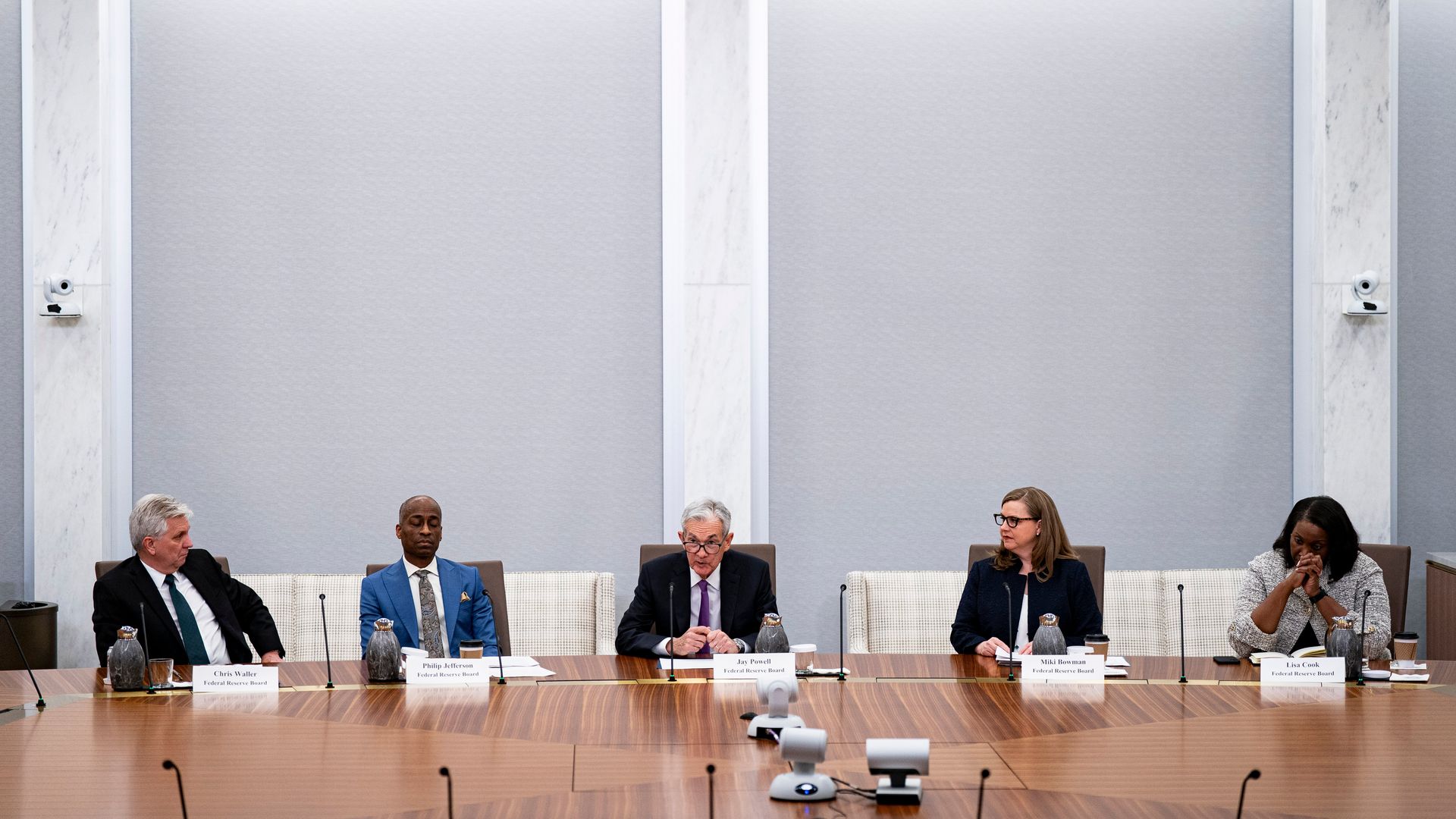
State of play: If the leadership triumvirate of chair Jerome Powell, vice-chair Philip Jefferson, and Williams decide a rate cut is in order, they will surely be joined by the three Trump-appointed governors on the committee (Michelle Bowman, Stephen Miran, and Christopher Waller).
- But that only gets them to six votes of the 12 voting members of the FOMC. They need a seventh for a majority.
- Where, oh where, will the seventh vote come from?
Zoom in: All four presidents of non-New York reserve banks who have a vote at this meeting (Goolsbee, Boston's Susan Collins, St. Louis' Alberto Musalem and Kansas City's Jeff Schmid) have expressed reservations about a rate cut.
- That's no guarantee they'll all dissent, of course (Goolsbee was noncommittal yesterday, saying "I want to hear what my colleagues have to say"). But it is a live possibility.
- In that scenario, there are two Biden-appointed governors Powell could turn to to get his majority.
- One of those is Michael Barr, who seems awfully worried about inflation right now and argues for caution. The longstanding norm that governors don't dissent has been blown to smithereens in the last 14 months. So he could plausibly be a "no" vote.
Between the lines: That leaves one other Biden-appointed governor Powell could turn to for his seventh vote. It's an official who is highly focused on the health of the labor market and has kept her views on the next policy move close to her vest.
- That governor, of course, is Lisa Cook, whom President Trump is attempting to fire.
Sign up for Axios Macro