Axios Macro

October 25, 2024


The World Bank is all in on trying to drive the creation of good jobs in developing countries, its president said this morning. 👷
- More below, but first, one of our big takeaways from the annual meetings of international financial institutions this week: lingering inflation fears hung over many conversations.
Situational awareness: The University of Michigan's gauge of consumer sentiment increased for the third straight month in October to the highest level since April.
Today's newsletter, edited by Kate Marino and copy edited by Katie Lewis, is 789 words, a 3-minute read.
1 big thing: The inflation boogeyman

The inflation shock is over. The sense of crisis it triggered still haunts global policymakers.
Why it matters: That was the underlying tone of conversations on the sidelines of the annual meetings of the International Monetary Fund and World Bank.
- Concern that the world economy is more inflation-prone than in years past is keeping officials on edge, with more jitters than usual about moves that might reignite price pressures.
What they're saying: "Officials feel like they need to stay on alert," John Lorié, chief economist at credit insurance firm Atradius, told Axios on the sidelines of the annual meetings. "It's a different world."
- Nations will have limited fiscal room to maneuver in response to another shock. "They will have to invent another trick," he said.
Between the lines: The week started with a warning from the IMF's chief economist about the type of shocks that policymakers might have to endure in the years to come.
- "We have now entered a world dominated by supply disruptions — from climate, health, and geopolitical tensions," IMF chief economist Pierre-Olivier Gourinchas wrote in a blog post at the start of the week.
- In the future, Gourinchas said, raising interest rates might not be a cure-all: "It is always harder for monetary policy to contain inflation when faced with such shocks."
What to watch: Headline inflation rates across major nations are approaching central bank targets. But inflation in the service sector is "too elevated, almost twice as high as before the pandemic," the IMF said in a report.
- European Central Bank president Christine Lagarde warned about risks to that sector: "latecomer" firms in the service sector that might adjust prices on an annual basis — or wage bargaining agreements that might push up labor costs for firms.
- "We need to be as granular as we can in the analysis of inflation of services, because that is the one that is tricky and resistant," Lagarde said at an event hosted by Bloomberg.
The big picture: If elected, former President Trump has promised to put high tariffs on all goods imported into the U.S.
- That threat, and the inflationary risk posed by such a policy, was top of mind for policymakers this week.
- "Trade barriers — tariff or non-tariff — are likely to have a negative impact on growth," Lagarde said in a separate appearance at the Atlantic Council this week.
- "I think it would have an impact on inflation as well, and that is not something that would be particularly welcome."
The intrigue: There was fear of previous shocks alongside one that has long been warned about: the blowback from high government debt.
- As officials gathered in Washington, yields on the U.S. Treasury bonds continued to surge — reflecting the possibility of a Trump presidency and what that might mean for deficits.
Politicians, including those in the U.S., "have moved away from anything resembling fiscal tightening," Josh Lipsky, a former IMF official who now serves as a director at the Atlantic Council.
- "There's no prospect there will be fiscal consolidation, no road map to get things under control," Lipsky added.
2. The World Bank's new focus
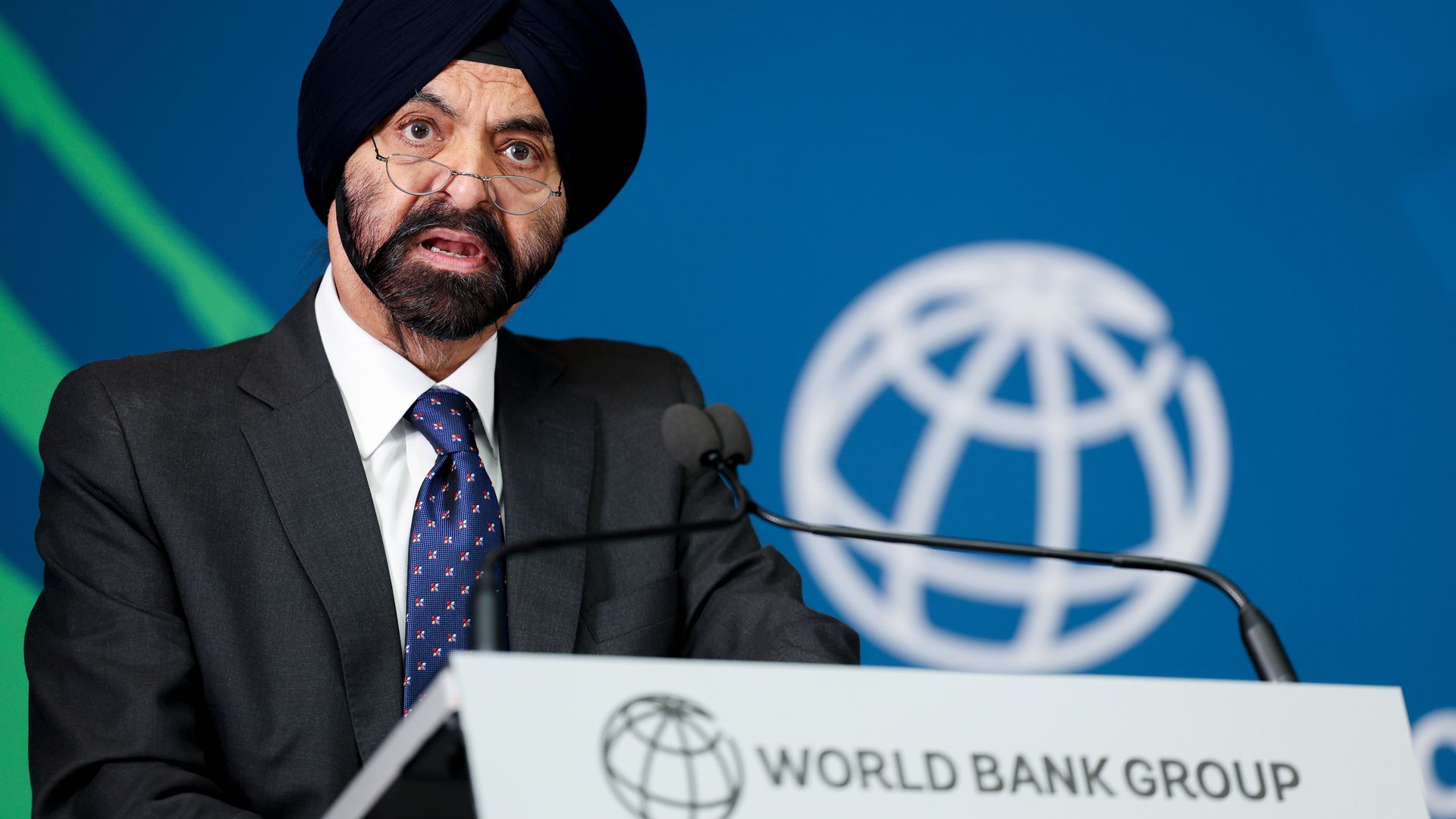
Ajay Banga became president of the World Bank 16 months ago, aiming to modernize an institution choked with bureaucracy.
- Today, he claimed partial victory on that agenda and laid out his plans for the institution — an emphasis on creating good jobs for "young people" across the developing world.
Driving the news: In a plenary session this morning, Banga said that the bank, founded as part of the Bretton Woods agreement 80 years ago, has made great strides in reforming itself over the last year.
- He said the bank has reduced project approval from an average of 19 months to 16, with the goal of getting to 12 by June.
- "We are faster," he said. "Because development delayed is development denied." The bank is also simpler, he added, "because process should never overtake substance."
What's next: "The World Bank Group is poised to embark on the next phase of our mission: Ensuring job creation — and employment — are not the byproduct of our projects but an explicit aim of them," Banga said.
- Across the world's emerging economies, he said, a generation of 1.2 billion young people, "eager and brimming with potential," is set to join the workforce. Employment opportunities are not expanding at the same pace, he said.
- "The specter of unemployment looms large, potentially leaving 800 million young people without meaningful employment, and threatening to destabilize societies and hinder economic growth," said Banga.
The bottom line: Banga said this will require "a marriage between preparing people and preparing opportunities." That means investing in areas where the World Bank has deep experience, including health care, infrastructure, education, food security, and clean air and water.
Sign up for Axios Macro