Axios Macro

February 03, 2023

We almost spit out our coffee this morning when the jobs report published. Today, we break down some extraordinary new numbers on the state of the U.S. labor market.
- Situational awareness: Payrolls weren't the only blockbuster number out this morning, as the Institute for Supply Management's service index came in at 55.2, comfortably above the 50 level that separates expansion from contraction. It was 49.2 last month.
Today's newsletter, edited by Javier E. David, is 673 words, a 2.5-minute read.
1 big thing: America's mind-blowing labor market

Illustration: Shoshana Gordon/Axios
Jobs reports simply don't get any better than the one we received this morning.
- No caveats needed: This is a rip-roaring labor market, in stark defiance of months of recession chatter — and the Federal Reserve's efforts to slow things down.
Why it matters: American workers — outside of a handful of sectors — are experiencing some of the most plentiful opportunities in generations — even as inflation has been coming down.
- That is a precarious balance (more on how the Fed might react below), but it is a remarkable state of affairs. The jobless recoveries of the early 2000s now look like ancient history.
The details: Economists expected jobs growth to decelerate, but instead it surged ahead, with an addition of more than half a million jobs (517,000) in January.
- The unemployment rate hit an ultra-low 3.4%. To find a water mark lower than that, you'd have to go all the way back to 1953.
State of play: The blowout job gains may be exaggerated by seasonal adjustments or other statistical quirks. But even if they are ultimately revised lower, a consistent message is being sent by labor data across the board with ultra-low jobless claims and rising numbers of job openings.
- The hiring slowdown that was supposed to come alongside the Fed's aggressive tightening has not materialized. It sets up something of a conundrum for officials.
- "It's difficult to see how wage pressures can possibly soften sufficiently when jobs growth is as strong as this," Seema Shah, chief global strategist at Principal Global Investors, wrote in a note.
- "It's even more difficult to see the Fed stop raising rates and entertain ideas of rate cuts when there is such explosive economic news coming in."
Yes, but: For now, wage pressures appear to be flat or diminishing, contrary to what economic theory would predict in a booming job market. Rock-bottom unemployment paired with decelerating inflation is an economic dream scenario.
- Average hourly earnings rose 0.3% in January, slowing slightly from December's upwardly revised 0.4% pace. Over the year through January, hourly earnings are up 4.4%.
- Over the last three months, wages rose at a 4.6% annual rate — on the high side of what the Fed would consider consistent with achieving its 2% inflation target, but not accelerating.
The intrigue: January is a notoriously difficult month to interpret jobs data, with annual adjustments made by the Labor Department — some of which are done to account for seasonal patterns.
- "We got a lot of these gains because employers kept on seasonal workers they would typically lay off," says Diane Swonk, chief economist at KPMG U.S. "This is a lot of labor hoarding, everywhere from leisure and hospitality to retail to construction."
2. What's next for the Fed
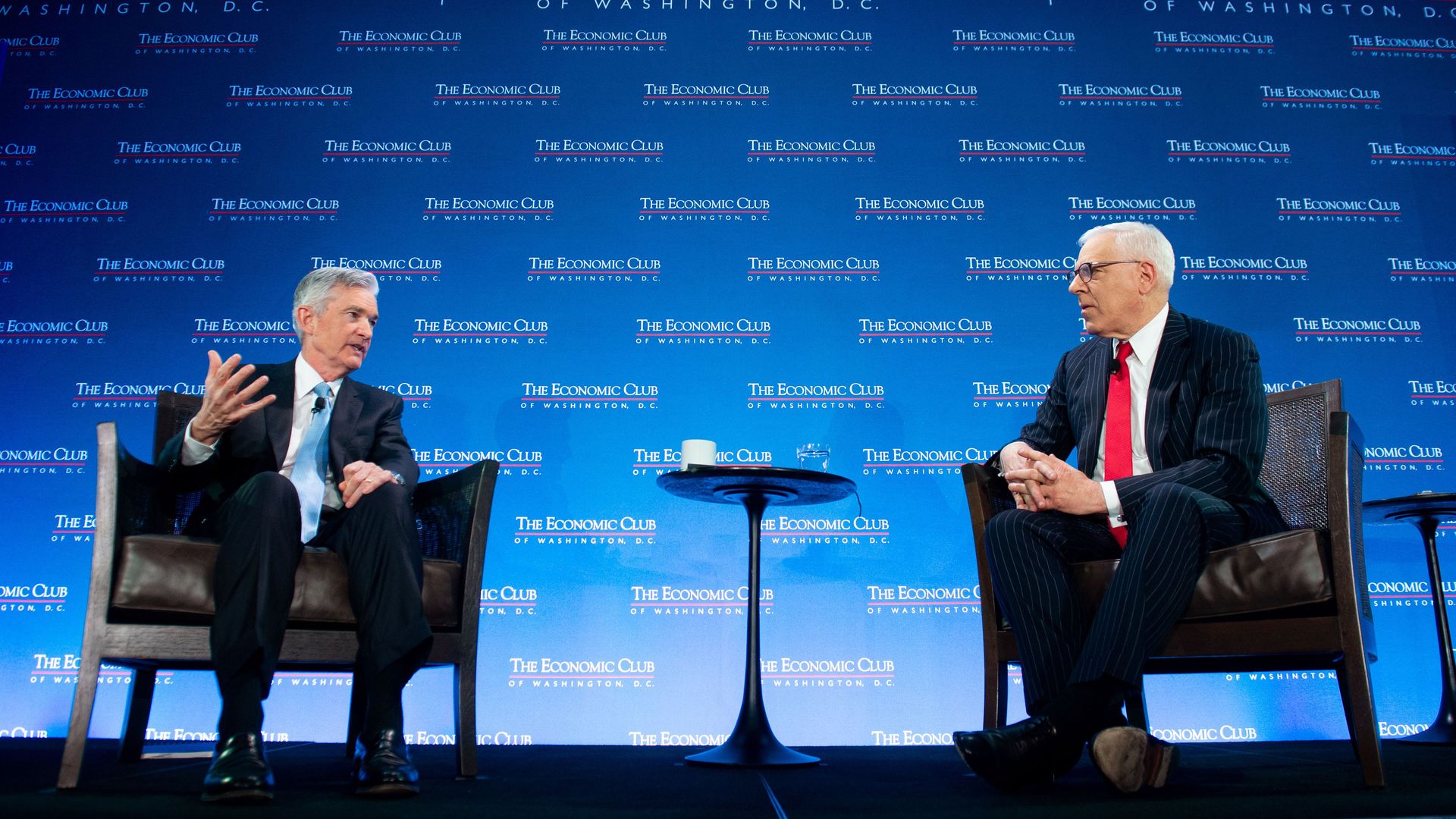
Fed chair Jerome Powell in a 2019 appearance before the Economic Club of Washington. Photo: Saul Loeb/AFP via Getty Images.
Just two days ago, Fed Chair Jerome Powell acknowledged that a "disinflationary process" was underway, which markets seized on as reason to believe rates won't get hiked by as much as some previously thought.
- The jobs numbers reversed that perception, as traders and analysts assigned higher odds to continued rate hikes.
By the numbers: The yield on two-year Treasury securities was up a whopping 0.17 percentage points this morning, reflecting expectations that the central bank will push rates higher for longer than seemed likely before the jobs numbers.
- The odds the Fed will raise rates at its May policy meeting rose from 30% yesterday to 55%, according to calculations based on futures prices from the CME Group.
What to watch: On Tuesday, Powell will appear at the Economic Club of Washington, where he can tweak his messaging, and convey whether the jobs numbers shifted the policy outlook as much as markets imply.
- He is not scheduled to deliver prepared remarks at the event, but rather will be interviewed on stage. Powell is no stranger to using the Q&A format to signal a shifting policy stance, as Neil has seen firsthand.
The bottom line: The Fed often emphasizes the importance of not placing too much weight on any single data release. But this was a hard one to not take notice of.
Sign up for Axios Macro

Stay ahead of the curve on the most important economic developments with reporting and analysis on how business, policy, and markets collide.