Axios Macro

July 24, 2026


The name of this newsletter is "Axios Macro," but today we're going especially macro — which is to say, looking at the extremely big picture of global assets, debt and risks. It's not often you can talk about numbers in the quadrillions.
- Plus, the new fiscal math from President Trump's latest tariff announcements. 💰
Today's newsletter, edited by Jeffrey Cane and copy edited by Katie Lewis, is 968 words, a 3.5-minute read.
1 big thing: The great wealth wedge
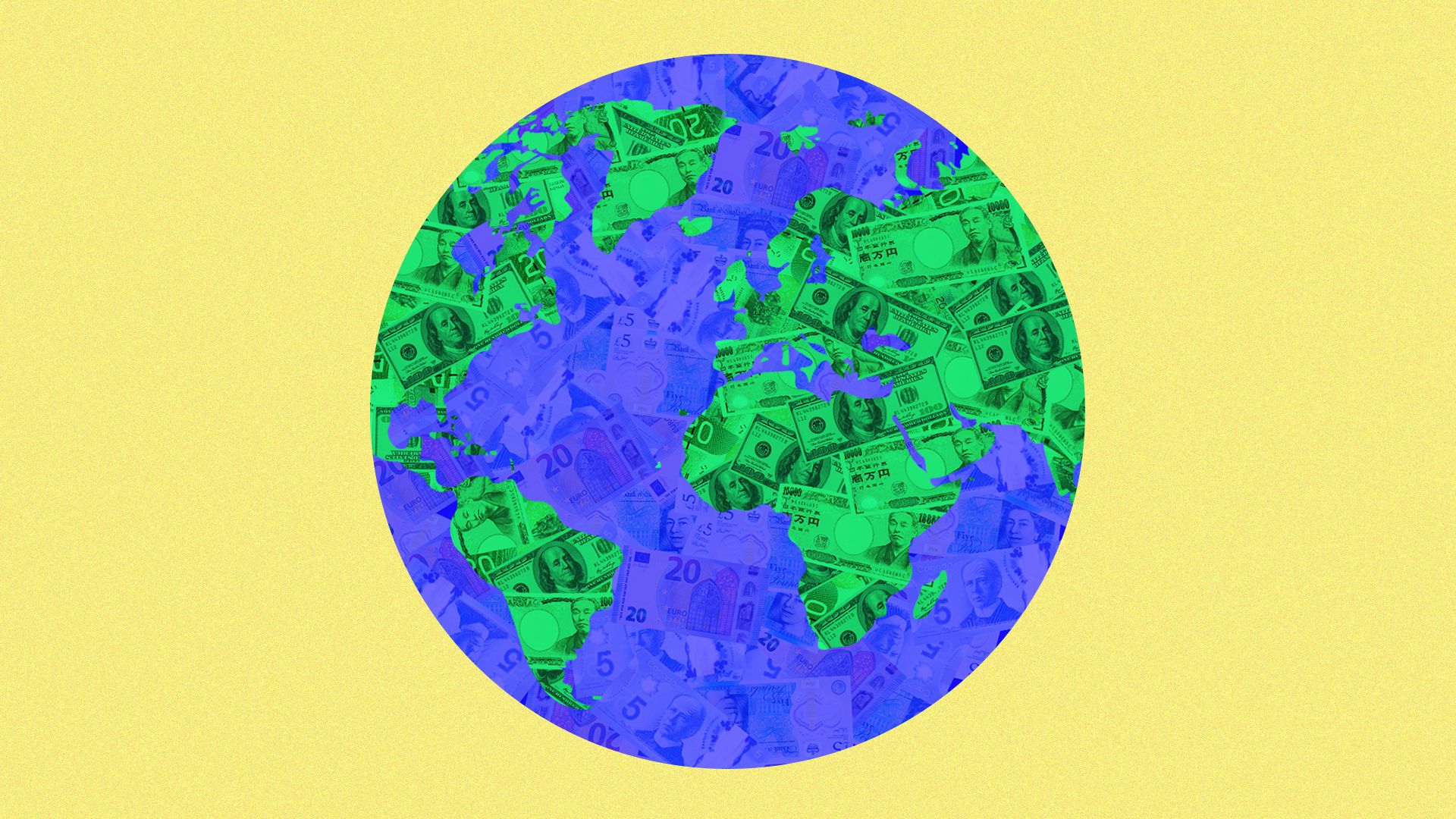
The world is wealthier than ever before. But it is built on ever-more stretched valuations of paper assets, rather than real output. How that wedge resolves itself will determine the future of the world's major economies.
The big picture: That's the implication of new research out this week from the consulting firm McKinsey, which lays out both the shocking numerical scale of global wealth accumulation — and the hazards created by its composition.
- The reliance on higher valuations, as opposed to increased stock of capital that creates real output, fuels the risk of a painful correction through either falling asset prices or prolonged inflation.
- There is a sunnier scenario, however, in which the world essentially grows into high asset valuations with help from an AI-driven productivity boom.
By the numbers: McKinsey researchers find that total global assets rose to $1.8 quadrillion last year, from $1.7 quadrillion in 2024. (A quadrillion is a thousand trillion.)
- Global household wealth reached $570 trillion, the researchers find, up $40 trillion from 2025.
- But only 20% of that gain came from real capital formation: net new investment in machinery and equipment, homes and buildings, infrastructure and intellectual property. The rest was driven by a mix of inflation and rising market valuations of existing assets.
- That's a more extreme version of a longstanding pattern. From 2000 to 2024, 30% of the rise in global wealth was from net investment.
What they're saying: "You could say that every asset on this planet is now financialized," Jan Mischke, a partner with the McKinsey Global Institute, tells Axios.
Zoom out: There are several plausible ways that these elevated asset valuations can resolve themselves.
- One is simply the muddling-along approach — low growth translates into low interest rates, which means high valuations simply persist. That's more or less what happened across major economies in the 2010s.
- But more dramatic possibilities are in play, some happy and some scary.
Zoom in: The best case for the global economy would be for productivity to surge, generating a boom in GDP growth — from AI or other sources — that justifies the high valuations of stocks and other forms of wealth. That's essentially what happened in the late 1990s.
- A more grim possibility is that a sustained surge in inflation chips away at the real value of assets, bringing them back into line with historic norms while leaving people poorer in real terms. That arguably happened in 2021-2022.
- The most worrying possibility of all would be for a resetting of global asset prices of the sorts seen in 2002 and 2008.
The intrigue: "Inflated scenarios have a history of mean reverting, including in benign ways, like a productivity acceleration," Mischke says. "But every now and again you also have a big debt crisis or market crash."
- "The real question for us in the U.S. is, will productivity and GDP be higher, in which case you're in a productivity surge, or do we end up in an inflationary scenario?" says Arvind Govindarajan, another McKinsey partner and co-author.
The bottom line: What does this super-big-picture analysis mean for those of us just trying to make wise business or personal financial decisions?
- "The uncertainty of the economic outlook is much wider than it usually is," Mischke says. "You better harden your balance sheet a little bit, have some operational flexibility and plan scenarios."
2. Tariff revenue gap
The White House has found new legal ways to keep tariffs flowing. But it's not enough to fully replace the revenue from the import taxes the Supreme Court struck down.
The intrigue: The administration's replacement tariffs would raise about $105 billion a year — replacing about 60% of the revenue lost when the Supreme Court invalidated the administration's emergency tariff regime, according to the Committee for a Responsible Federal Budget.
Why it matters: The administration's new tariffs are narrower and include more carveouts than the emergency duties they replaced, reducing both the potential economic fallout and the revenue they generate.
By the numbers: CRFB estimates that Trump's latest tariff actions — including the new duties on dozens of trading partners that took effect overnight, those on Brazil and the proposed tariffs on Canada — would raise about $950 billion through 2036, compared with $1.7 trillion from the broader emergency tariffs, a gap of roughly $825 billion.
- The projections assume the new tariffs survive legal challenges and remain in place. They also don't account for any additional trade actions the administration could announce in the months ahead.
The big picture: The new tariffs generally carry lower rates than the regime enacted under IEEPA, generating substantially less revenue, and are imposed under Section 301 of the Trade Act of 1974.
- That process allows U.S. trade officials to tailor product coverage — and exclude a range of goods they believe would cause unnecessary economic disruption — after a formal investigation and public comment.
- Notably, the exclusions include energy products, limiting the risk that new tariffs amplify the inflationary effects of the Iran-related oil shock.
The other side: The White House rejects the idea that the new tariffs were aimed at replacing the illegal duties.
- A senior official said synchronizing them with the expiration of temporary tariffs was intended to provide continuity and predictability for businesses, not necessarily to recreate the earlier regime.
What to watch: The Treasury Department is still unwinding the old tariffs. In June, net customs receipts fell to negative $25.6 billion as refund checks to importers outpaced new tariff collections.
Sign up for Axios Macro