Axios Macro
April 23, 2025


Courtenay was in the room this morning as Treasury Secretary Scott Bessent spoke about reforms of the International Monetary Fund and World Bank, and took questions from reporters about an eventful 24 hours of trade war de-escalation.
- Her takeaways are below. But first, how we read President Trump's backing off on both China tariffs and attempts to fire the Fed chief.
Today's newsletter, edited by Ben Berkowitz and copy edited by Katie Lewis, is 810 words, a 3-minute read.
1 big thing: Lessons from Trump's climbdown
The big lesson of the last 24 hours is that financial market reality remains a constraint on Trump's most aggressive impulses. But that doesn't mean the economy is out of the woods.
The big picture: Yesterday brought a presidential climbdown on both his threats to fire Federal Reserve chair Jerome Powell and to slam Chinese imports with tariffs so high as to virtually shutter trade between the world's biggest economies.
- It is an indication that for all his administration's talk about being willing to tolerate pain in order to restructure the economy, the kinds of abrupt sell-offs in U.S. assets — stocks, bonds, and the dollar — seen in the last few weeks get the president's attention.
- However, plans to negotiate sweeping deals with dozens of major trading partners over the next 76 days create a risk of further market volatility and economic pain.
Catch up quick: Yesterday, as first scooped by Bloomberg, Bessent told a private audience of investors that the status quo — a 145% tariff on Chinese imports — amounts to essentially a trade embargo, but that the U.S. and China will de-escalate.
- Later in the day, Trump confirmed that, saying China tariffs will "come down substantially" and that he did not expect to play hardball with the country.
- He also said that he had "no intention" of firing Powell, after days of social media posts pillorying the Fed chief and demanding rate cuts.
Between the lines: Those developments — paired with the decision April 9 to pause reciprocal tariffs for 90 days in hopes of seeking deals with 75 other countries — show that the "Trump put," named for a financial contract that protects against losses below a certain point, remains alive.
- The president may be willing to tolerate some market and economic pain to enact his agenda, but there is a limit to that tolerance.
- The change in tone on China and Powell came followed steep market drops. It also came after an Oval Office meeting with top retail CEOs where, our colleague Marc Caputo reports, Trump was warned that his tariff policies would lead to higher prices and empty store shelves.
Yes, but: That doesn't mean that looming negotiations over the reciprocal tariffs will be all sunshine and rainbows. As Apollo chief economist Torsten Slok notes, it typically takes 18 months for the U.S. to negotiate a trade deal, a grinding process of give-and-take.
- The administration is seeking to rewire the U.S. relationship with pretty much the entire world in a relative instant, something trade negotiators view as implausible.
- Business lobbyists anticipate something along the lines of simple memoranda of understanding between the U.S. and trading partners, perhaps sharing a common template across nations.
- In the meantime, importers face tariffs on imported goods — from nearly every nation — higher than in generations plus deep uncertainty about where they will go from here.
What they're saying: "While markets wait for trade negotiations with 90 countries at the same time, global trade is grinding to a standstill with problems similar to what we saw during Covid," Slok wrote.
- Namely, "growing supply chain challenges with potential shortages in US stores within a few weeks, higher US inflation, and lower tourism to the US."
The bottom line: While most hard data on the economy has held up fine so far, the uncertainty generated by the trade war is hitting manufacturing and other sectors in ways that will play out across the economy in the coming months.
- The pullback on Powell and China provides some relief to markets, but doesn't change that underlying dynamic.
2. The "unsustainable" trade war
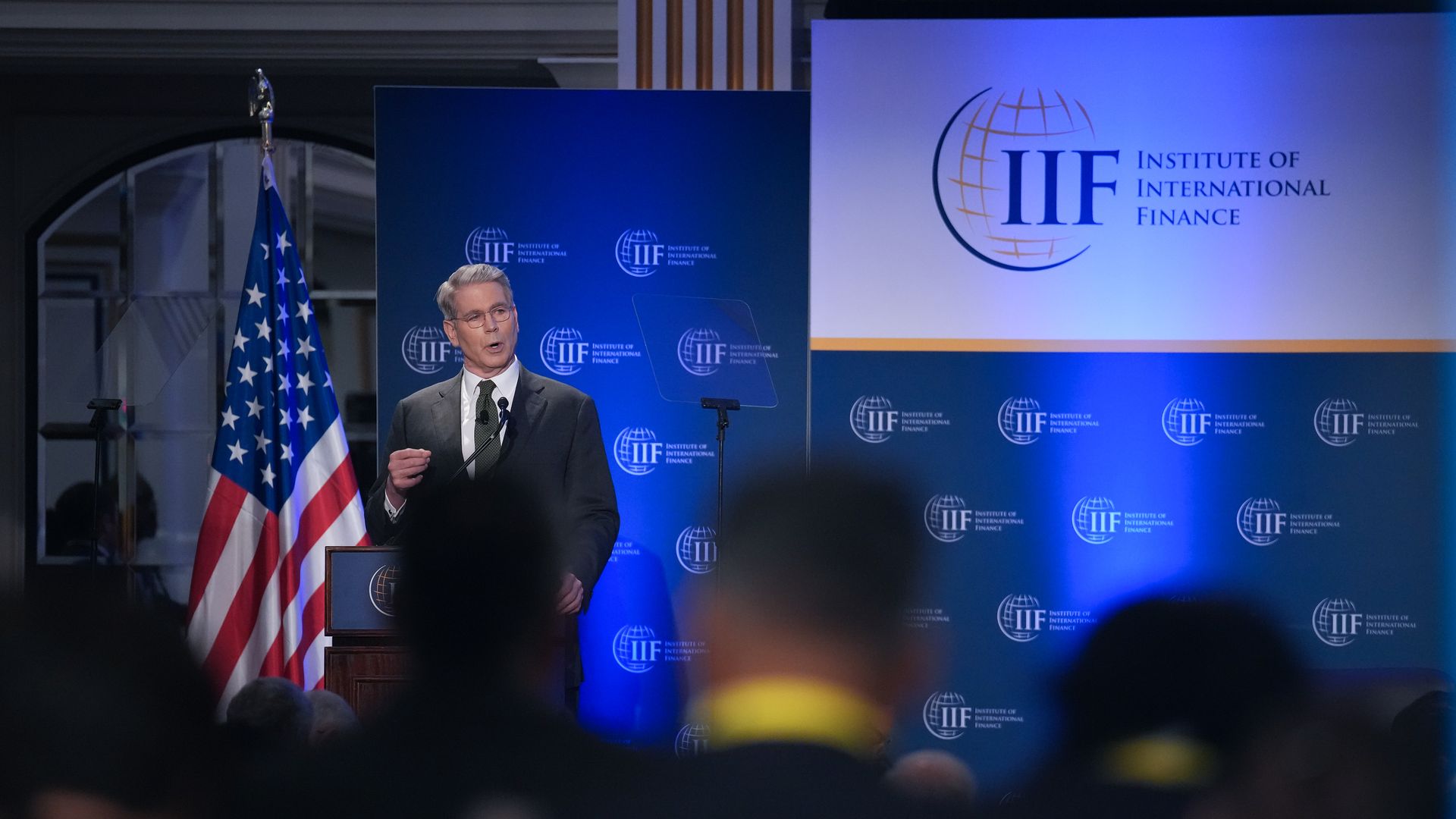
The trade war with China is "unsustainable" in its current form, Bessent told reporters this morning — but the U.S. will not move unilaterally to reduce tariffs.
Why it matters: As recession worries grow, the Trump administration is signaling intentions to tamp down trade tensions with China.
- The steep tariffs threaten to all but shutter commerce between the world's two largest economies.
What they're saying: "I think both sides believe that the current status quo is unsustainable," Bessent said after a speech at the Institute of International Finance in Washington, D.C.
- "I think at this point there would have to be a de-escalation by both sides," he added. "I would not be surprised if they went down in a mutual way," though he said there is "no unilateral offer from the president to just de-escalate."
The intrigue: Bessent shed some light on what new tariff deal talks might look like: "A satisfactory arrangement does not necessarily mean the actual trade document," he said.
- "It means that we have reached agreement in principle, and then we will start implementing those."
The backdrop: In a speech, Bessent demanded fixes at IMF and World Bank — the strongest hint yet that the administration will try to nudge groups to better align with the Trump agenda.
Sign up for Axios Macro