
Axios Macro

June 23, 2026

📊 The labor market has spent years looking gloomier in hindsight, with job creation regularly downgraded in data revisions. But that pattern may be changing. More below.
- Plus, how the costs of Brexit have piled onto the U.K. economy over the past decade. 🇬🇧
Situational awareness: Kevin Warsh will make his first appearance before Congress as Federal Reserve chairman on July 14 for the semiannual monetary policy testimony amid questions about the Fed's next move.
Today's newsletter, edited by Jeffrey Cane and copy edited by Katie Lewis, is 873 words, a 3.5-minute read.
1 big thing: The labor market's quiet upgrade

For the first time in years, data revisions could end up adding jobs to the official U.S. tally rather than erasing them.
Why it matters: Early indicators point to a labor market that might be stronger than the monthly employment reports suggest.
- Even a mild positive revision would reverse a stretch of after-the-fact updates that showed the labor market was notably weaker than it appeared in real time.
- Last year's gloomy update showed that net job creation had all but come to a halt.
The intrigue: Some Fed officials have been on the hunt for weak spots. But the labor market in recent months has defied the slowdown narrative.
- Payroll growth has surpassed last year's pace.
- Unemployment has held steady.
- Now, the employment records behind the annual revisions no longer suggest another hiring downgrade.
What to watch: The next annual update to the government's jobs figures, due out early next year, will revise employment estimates through March 2026.
- Wall Street is already picking up a signal from employment records that cover roughly three-quarters of the period used for the revision.
What they're saying: "A lot of folks, myself, and the Fed included, assumed we were headed for another negative benchmark revision ... but that assumption seems increasingly incorrect," Access/Macro economist Guy Berger wrote in a note this month.
- Berger estimated that the records so far suggest the economy created roughly 230,000 more jobs through the end of 2025 than what's currently reflected in the payroll data.
The big picture: Monthly payroll reports — the headline figure that often leads news coverage of the employment report — are based on surveys.
- The government updates those estimates with the Quarterly Census of Employment and Wages: a larger but much less timely census of employment records.
- That process has brought downward revisions in the past three years, including in the latest report, which said that employment was nearly 900,000 lower than initially reported through early 2025.
Between the lines: Forces that previously might have made the labor market difficult to measure could now be fading.
- Economists at Bank of America point to slowing immigration flows, while Standard Chartered argues that tweaks to how the government estimates newly formed businesses may help bring monthly payroll figures and underlying employment records back into closer alignment.
Zoom in: The "overstatement issue" that ultimately led to large downward revisions in recent years "may have become less of a problem," Standard Chartered economists wrote in a note.
- They estimated employment growth of 1.3% between March and December 2025, a slight upgrade to the 1.2% suggested by payroll data.
The bottom line: If that's the case, it supports "the hawkish argument that monetary policy may not be restrictive and favoring the case for Fed rate hikes," Evercore ISI's Marco Casiraghi wrote in a recent note.
- Bank of America economist Aditya Bhave said that if the pattern of large downward revisions has ended, it's "one less reason to be dovish."
2. The cost of Brexit, 10 years later
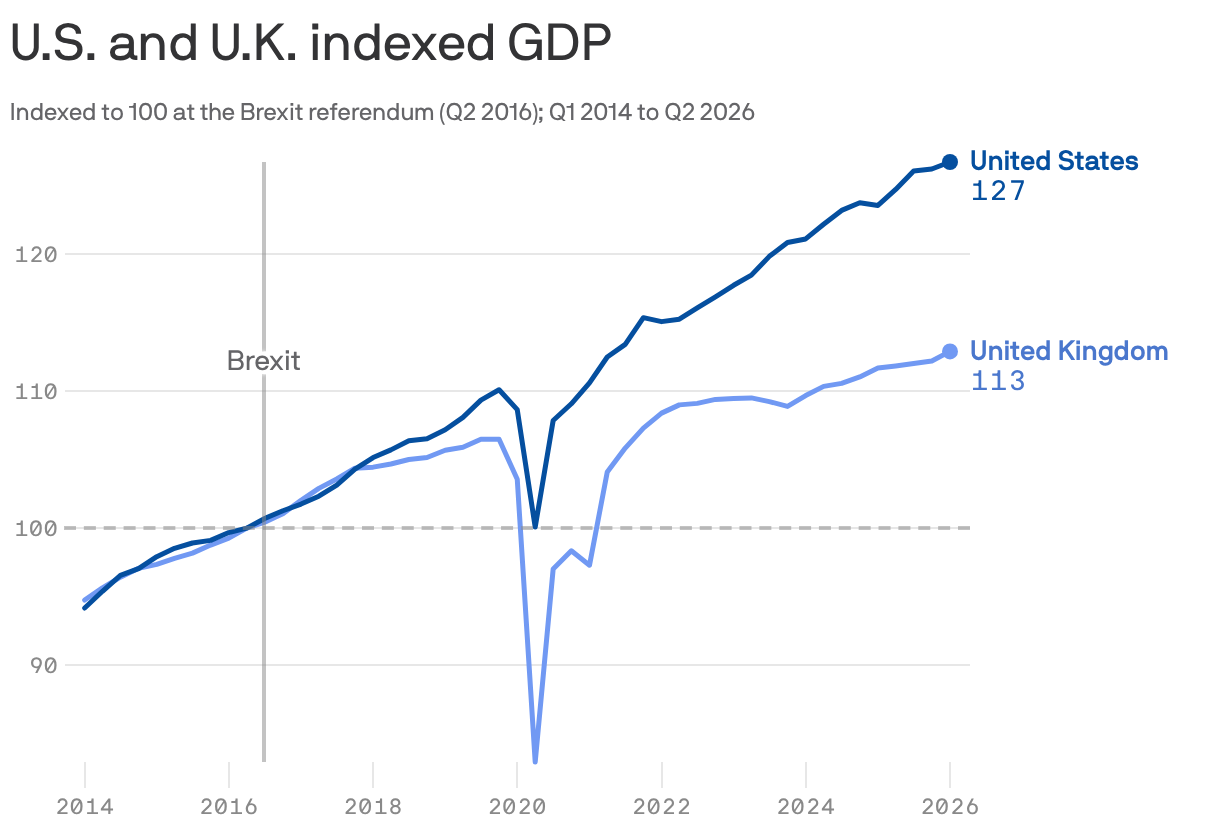
Brexit is the real-world test of what happens when a major economy voluntarily raises trade barriers, restricts the free flow of workers and generates years of policy uncertainty — all at once.
- A decade since the vote to leave the European Union, the results are largely in.
Why it matters: The economic drag came from overlapping effects.
- Businesses held off on investment as uncertainty dragged on, executives spent years consumed by Brexit logistics, and the firms most integrated with European markets were often the ones hit hardest.
By the numbers: Since the Brexit referendum, the U.K. economy has grown about 13% — less than half the American pace over the same period, according to FactSet calculations. But even that growth gap might understate the cost of Brexit.
- A paper updated this month from economists at Stanford, the Bank of England, King's College London and the University of Nottingham estimates that by the end of 2025, Brexit had made the U.K. economy between 6% and 8% smaller than it would have been had the country voted to remain.
- The authors estimate business investment was between 12% and 13% lower than the counterfactual, a gap that widened gradually over the full decade.
- Both employment and productivity were as much as 4% lower than they otherwise would have been, the authors estimate.
The intrigue: Economists who predicted Brexit's costs before the vote were roughly right in the first five years — but few understood how much the damage would keep piling up over a full decade, the authors note in the paper.
The bottom line, via Axios' Zach Basu: Britain remains marooned in a low-growth cycle: saddled with trade friction, high prices, strained public services and a hyper-sensitive electorate that tolerates virtually no political failure.
- Go deeper: Britain's lost decade
Sign up for Axios Macro