Axios Login

March 28, 2022

And the Academy Award for best supporting reader of a daily newsletter goes to ... you! Also, I hear things got a little wild last night, but I was watching Stanford women's hoops advance to the Final Four. (Go Card!)
Situational awareness: HP Inc. announced that it has agreed to acquire video-conferencing company Poly for $3.3 billion.
Today's newsletter is 1,158 words, a 4-minute read.
1 big thing: Global tech standards could be casualty of Ukraine war

Illustration: Annelise Capossela/Axios
The invasion of Ukraine is adding heat to a long-simmering battle for control of global standards bodies, a rivalry that has pitted the U.S. and Europe against Russia and China.
Why it matters: Global standards ensure that things like smartphones and laptops — and even the internet itself — work across borders.
"Standard bodies are essential to ensure interoperability which is critical to achieving 'economies of scale' and technology reach the masses," wireless consultant Chetan Sharma told Axios.
The big picture: Advancing global standards is also a key domestic priority, FCC chairwoman Jessica Rosenworcel told Axios. "If we have learned anything from our experience rolling out 5G, it's that wireless policy matters for economic growth and national security."
Driving the news: Tensions were high ahead of Russia's invasion, as evidenced by the high-stakes battle over who will be the next head of the International Telecommunication Union (ITU), the telecommunications agency of the UN.
- The U.S. has backed Doreen Bogdan-Martin, with more than 28 years experience at the ITU, while others have lined up behind Russia’s Rashid Ismailov.
Between the lines: The West has dominated contributions as well as the roadmap of key internet and telecom industry bodies over the last four decades, Sharma said.
- In recent years, though, China has seen how leadership in standards-setting can translate into market success and has been actively working to get voting and chair positions on various standards committees.
The standards for 5G and basic internet protocols are now set in stone, Sharma said, but the battle is underway to influence the standards of 6G.
- The U.S., for example, recently created the Next G Alliance, while China has has made proposals to replace today's TCP/IP internet protocol with a more centralized "New IP."
- Western governments worry that could give authoritarian regimes more control over internet traffic in their countries.
Yes, but: Different standards need not fracture global telecommunications as long as there are pathways to interoperability, says David Gross, a former ambassador for international communications policy and partner at Wiley Rein.
- By the same token, common standards may not be enough to preserve a global internet — since there are other means by which countries are already limiting access.
A splintering of either standards or policies could raise the cost of providing internet service, thus slowing the growth of the internet among the 3 billion people who lack sufficient access, Gross said.
- "If you have global standards it lowers the cost of equipment, all things being equal, so that billions more people can be connected," Gross said.
What's next: The ITU secretary-general election is scheduled for early fall, in a secret ballot with each of 193 member countries getting a single vote at a conference in Bucharest.
2. U.S., EU agree on data rules
Illustration: Sarah Grillo/Axios
The U.S and EU have reached an agreement on a new deal enabling data flows across the Atlantic, Axios' Ashley Gold reports.
Why it matters: After an EU decision struck down a previous arrangement allowing EU- and U.S.-based companies to store and share data despite differing regimes governing data privacy, tech firms stood at risk without a new data deal in place.
Driving the news: President Biden and European Commission President Ursula von der Leyen made the announcement Friday, during the president's trip to Europe.
- Though specific details on the deal are still emerging, an agreement means long negotiations over how the U.S. handles the privacy of people’s data from the EU are largely complete.
What they're saying: The new agreement is called the Trans-Atlantic Data Privacy Framework, replacing the previous Privacy Shield agreement, per a fact sheet from the White House.
- "For EU individuals, the deal includes new, high-standard commitments regarding the protection of personal data," the statement reads.
- "For citizens and companies on both sides of the Atlantic, the deal will enable the continued flow of data that underpins more than $1 trillion in cross-border commerce every year, and will enable businesses of all sizes to compete in each other's markets."
Details: The deal seeks to give Europeans confidence that U.S. intelligence authorities aren't accessing their personal data via technology and information companies. Those concerns have been the main impetus for needing to make a new agreement, after various court decisions struck previous deals down.
The deal includes:
- efforts to "strengthen the privacy and civil liberties safeguards governing U.S. signals intelligence activities," with new oversight procedures;
- limited signals intelligence collection to be "undertaken only where necessary to advance legitimate national security objectives, and must not disproportionately impact the protection of individual privacy and civil liberties;"
- and the ability for Europeans to contest cases where they feel their data was improperly obtained.
3. Poll: Younger Americans bullish on crypto
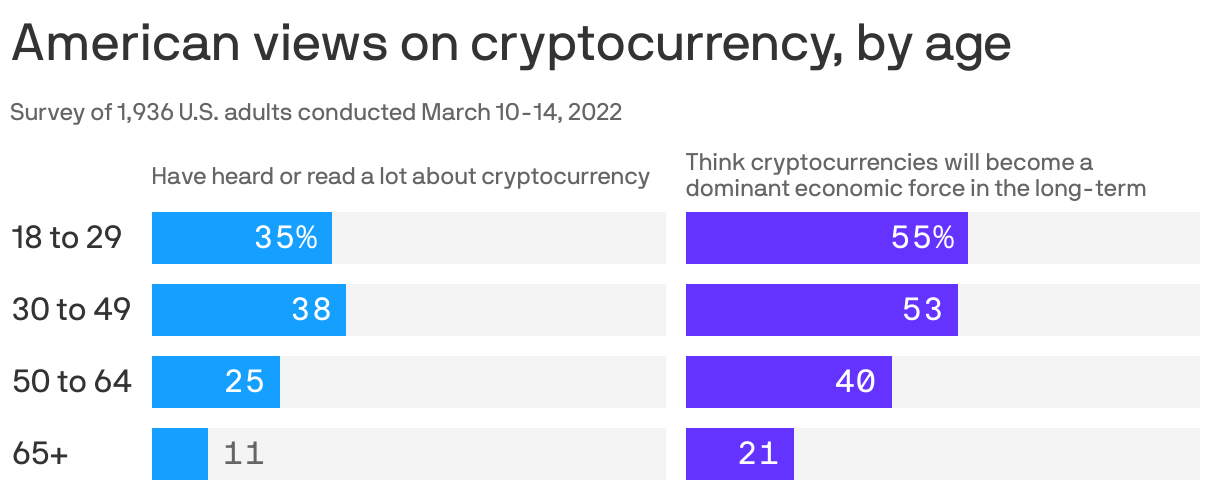
Americans under 50 are bullish on the future of cryptocurrencies, according to a Quinnipiac University poll released Thursday.
Driving the news: "That signals the marketing is working as crypto companies target sports advertising in a push to go mainstream," Quinnipiac finance professor Osman Kilic said.
By the numbers: Fewer than 1 in 5 (16%) of the 1,936 polled (margin of error: ±2.2 points) say they currently own cryptocurrency.
- 74% say they have never bought it, and 8% say they owned it in the past, but no longer do.
Go deeper: White House issues executive order on regulating cryptocurrencies
4. FCC adds Kaspersky to banned list
The Federal Communications Commission added Russian security software company Kaspersky Lab to a list of companies deemed to pose a national security threat.
Why it matters: Companies that receive funds from the FCC's $8 billion annual Universal Service Fund can't use that money to buy or maintain the products of listed firms, per Reuters.
Details: The FCC said Friday it was adding Kaspersky, along with China Mobile International and China Telecom (Americas), to the so-called "covered list."
What they're saying: "Last year, for the first time, the FCC published a list of communications equipment and services that pose an unacceptable risk to national security, and we have been working closely with our national security partners to review and update this list," said Rosenworcel.
- "This decision is not based on any technical assessment of Kaspersky products — that the company continuously advocates for — but instead is being made on political grounds," Kaspersky said in a statement.
5. Take Note
On Tap
- Y Combinator holds one of its twice-yearly Demo Days this Tuesday and Wednesday.
Trading Places
- Longtime Amazon executive Mike Frazzini is stepping down as head of the Seattle company's gaming studio, as Bloomberg first reported.
ICYMI
- Researchers at Stanford have uncovered the latest trend in LinkedIn marketing: AI generated faces on fake profiles. (NPR)
- Spotify announced Friday that it is suspending its services in Russia after the Kremlin passed a law cracking down on free press and speech. (Axios)
- A group of Google Fiber contract workers in Missouri voted to unionize. (The Verge)
- Apple TV+ makes history as the first streamer to win a Best Picture Oscar. (Axios)
6. After you Login
Check out the come-from-behind victory in this baby race held by the NBA's New Orleans Pelicans.