Axios Login

March 18, 2021

Yesterday I asked you where else you want to see that swooping bowling alley drone deployed. The best reply I got was from reader Daniel Cooper: "A rain forest; a steel mill; John Malkovich's head."
Today's newsletter is 1,346 words, a 5-minute read.
1 big thing: Facebook sees computing's future on your wrist
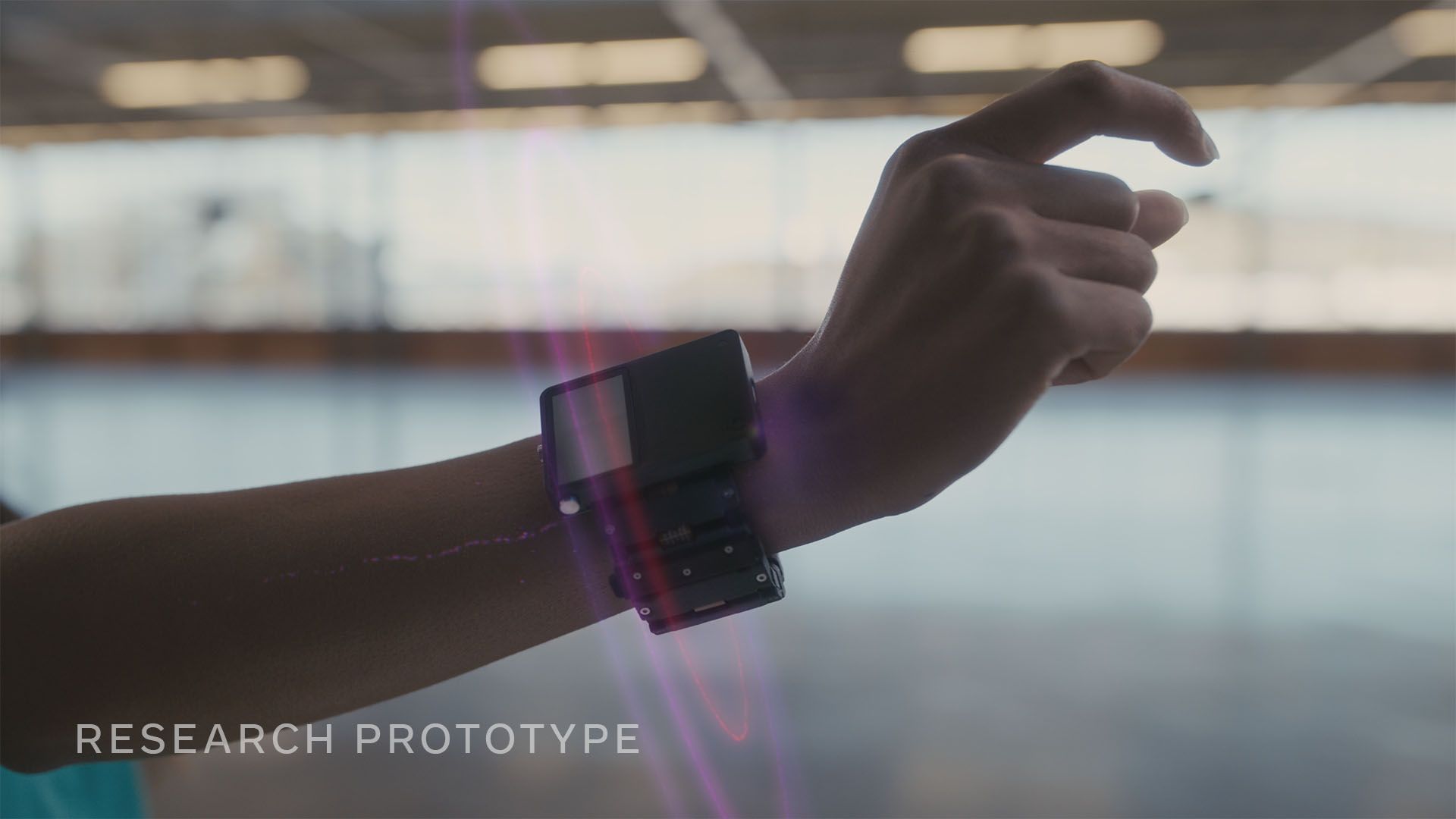
Photo: Facebook
Facebook researchers are rapidly learning how to replace mouse clicks and screen taps with finger twitches. They're doing it by putting a band on your wrist that reads nerve impulses sent by your brain to your hand.
The big picture: Tech insiders widely expect the next generation of computing after the smartphone will be built around some combination of glasses, headphones and other worn devices. The challenge is figuring out how users navigate information and make choices in such a world.
What's new: By picking up brain signals, Facebook's futuristic wristband can interpret small finger-motions as, for instance, typing on an invisible keyboard or clicking on a button that isn't there.
- This "intelligent click" will be paired with images you'll likely see via augmented-reality glasses — so that the menu items you're selecting, for instance, might appear to be hanging in the air around you.
- The whole system is stage-managed by predictive AI programs that work to understand where you are and what you might need. When you step into the kitchen, for instance, you might see a recipe.
- The goal is to give users "exactly the right interaction at the right time," says Tanya Jonker — one of a crew of Facebook Reality Labs researchers who demoed the new technology for reporters this week.
The science behind Facebook's new vision for the human-computer interface — electromyography, or EMG — can read nerve signals in muscles anywhere in the body. But Facebook researchers said the wrist is the ideal spot to apply it.
- The brain devotes lots of neurons to fine control of hand motion, providing plenty of information for the devices to read.
- Also, people are already used to wearing stuff on their wrists.
"Brain-computer interfaces" is a field Facebook has been talking about and investing in for years now, but the company is emphasizing that we won't get our hands on this technology for some time.
- Sean Keller, Facebook Reality Labs director of research, said Facebook was unveiling details of this work early because it knows there are pitfalls and hopes to steer around them with input from outside the company.
- "We want to open up an important discussion with the public about how to build this technology responsibly," he said.
Likely trouble spots:
- The more "context" your device knows, the more data it has on you, and Facebook has a long record of playing fast and loose with user information.
- Researchers say they know they've entered a potential minefield. "Building a new platform allows us to build security, privacy and safety in from the very start," said Facebook CTO Mike Schroepfer.
- Facebook is all about connecting people. But the examples the researchers discussed, where lone users are cooking a recipe or choosing music to play, are far simpler than interactions between people using these tools, where the potential for privacy problems multiply.
- Facebook makes money by selling ads, and the "all around you" interface it's building could easily become overloaded with commercial come-ons.
Of note: The Facebook team nodded to the scope of their ambition by showing a still from Douglas Engelbart's celebrated 1968 "mother of all demos."
- That event introduced the mouse and many other foundations of the graphical computer interfaces we use today.
- Facebook wants to invent the pieces for what comes after that.
2. Facebook stops recommending political groups
Illustration: Sarah Grillo/Axios
Facebook is getting out of the business of recommending "civic and political groups" to users around the world, the company announced Wednesday. It already imposed temporary limits on recommending such groups in the U.S. in January.
Why it matters: Critics — including some inside the company — argue that Facebook's group recommendations can lead users toward extremism and conspiracy theories. Once you join one group, the "if you liked this, you'll love that" algorithm can point you deeper down a rabbit-hole.
- Facebook's own research showed that groups played an important role in the escalating promotion of false claims of fraud and calls for violence in the wake of President Biden's election victory last fall, the Wall Street Journal has reported.
- Researchers inside Facebook have also found that a relatively small number of users and a handful of groups, many associated with the QAnon conspiracy theory, are responsible for promoting COVID vaccine hesitancy, according to the Washington Post.
Other steps Facebook announced to "keep Facebook groups safe" include:
- Penalizing groups that start to break Facebook rules by not recommending them as often.
- Notifying users when they're about to join a group that violates Facebook's standards, and requiring such groups to have moderators approve all posts before they become visible to members.
The big picture: In 2019, Facebook redesigned its flagship app in an attempt to make groups the central focus of the service, as CEO Mark Zuckerberg outlined.
3. How Clubhouse became Silicon Valley's party line
When the founders of Clubhouse first decided to go into business together, a new profile in Wired reports, they reached an understanding of what they didn't want to do.
"They didn't know what it would be," writes Wired's Steven Levy, "but they agreed on what to avoid — the roller coaster of a social app. Whatever they did, it would not be a consumer product."
The big picture: Clubhouse, their startup, went on to become the pandemic era's highest-profile new social app for consumers.
- The invite-only social audio service, born into beta just as COVID-19 began spreading a year ago, found its first fans among the venture-capital crowd.
- Investors pumped in $12 million a year ago and $100 million more in January, at a $1 billion valuation.
How it works: Clubhouse charmed early adopters with the opportunity to begin in "the audience" (listening in silence) and get called onto "the stage" (joining the conversation). It launched at a moment when audio, in the form of podcasts, was already riding a wave of popularity.
What they're saying: Co-founder Paul Davison tells Levy that Clubhouse is figuring out how to "scale intimacy."
- "Audio is potentially the most intimate medium ... You have all the intonation and fidelity, but you don't have the anxiety of video. It allows people to be very real and authentic."
Yes, but: Clubhouse's growth has triggered all the social-network moderation problems — including harassment, hate speech and indecent behavior — that have bedeviled much larger companies.
- Levy writes: "Davison and Seth have walked straight into the hardest question in tech. They have to encourage healthy conversation in real time, with huge numbers of chattering voices, across communities and social groups that don’t all share the same rules of engagement."
4. Exclusive: Study questions online political ad disclosures
Disclosure notices on political ads largely go unnoticed by users who see them online, according to new research from Rutgers University and the University of Amsterdam shared exclusively with Axios' Ashley Gold.
The big picture: Tech platforms have required political advertisements to disclose who funded them to stave off criticism that it's too hard to tell which politicians and groups are paying to amplify their messages online.
- Tech companies have changed the way they approach political advertising. Twitter eliminated political ads completely in 2019, and Google and Facebook paused political ads after January's attack on the U.S. Capitol.
- Platforms have also introduced ad transparency libraries so people can look up who sponsored an ad.
How it works: Researchers showed a political ad on YouTube, sponsored by a trade group, and put 2,500 people into three groups: one where the disclosure was shown, one where a text disclosure was shown and one where a graphical disclosure resembling a stoplight was shown.
- Most did not notice the text disclosures, and if they did, it didn't change their view of the ad.
- Participants noticed the graphical disclosure; if a red or orange light was used, they found the ad less credible.
What they're saying: "Policy makers must understand that good design is critical," said Ellen Goodman of the Rutgers Institute for Information Policy and Law and a senior fellow at the German Marshall Fund.
5. Take note
On Tap
- The House Judiciary antitrust subcommittee will hold a hearing on strengthening antitrust laws.
Trading Places
- Robinhood hired Google veteran Aparna Chennapragada as its chief product officer. (CNBC)
ICYMI
- Google will spend $7B on new offices and data centers in the U.S. this year. (Wall Street Journal)
- Amazon touts its pay for workers at the Alabama warehouse that's the focus of a union drive, but other local employers pay more, according to a New York Times report. (New York Times)
- A New York police department report found that conspiracy theorists and white supremacists are targeting 5G cell towers. (The Intercept)
- The FBI says businesses reported more than $4B in losses to cybercrimes in 2020, 20% more than in 2019. (CyberScoop)
- How online education and tutoring could fight COVID learning loss among students. (Axios)
- TikTok will ramp up ad targeting next month, whether you like it or not. (Recode)
6. After you Login
You can't resist a map of the U.S. featuring each state's most oddly named town. Foul Rift, New Jersey, anyone?
Sign up for Axios Login

Taking you inside the AI revolution, and delivering scoops and insights on the technologies reshaping our lives.