Axios Login

June 15, 2023
Hi, it's Ryan.
Situational awareness: Twitter faces a new $250 million lawsuit by music publishers charging it with copyright infringement.
Today's Login is 1,277 words, a 5-minute read.
1 big thing: GLAAD says social media firms enable real world violence
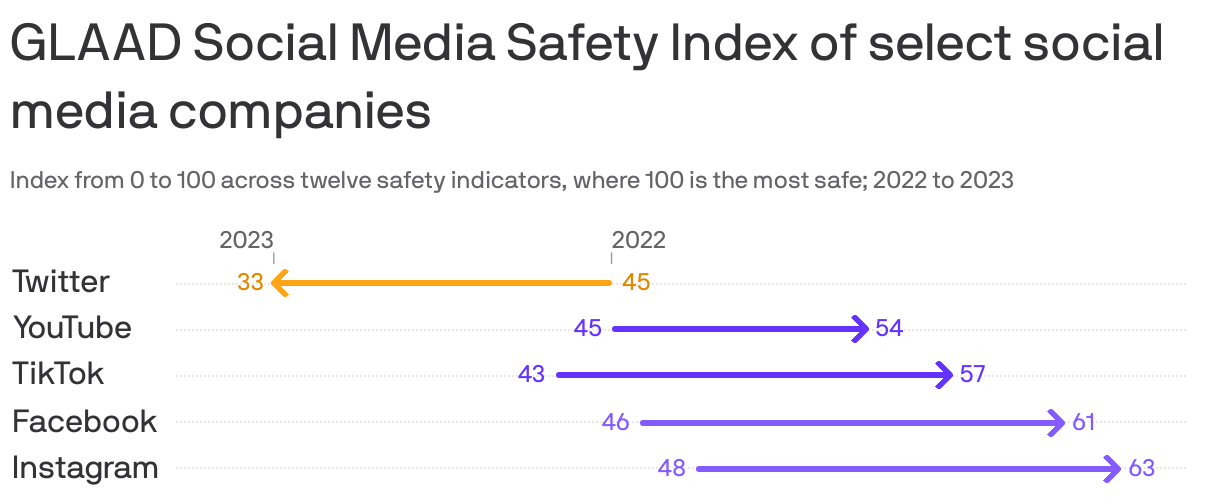
By continuing to allow harassment and hate on their platforms, Facebook, Instagram, TikTok, YouTube and Twitter are fostering an environment that has led to a wave of threats and violence against the LGBTQ community, according to a new report from GLAAD, Axios' Ina Fried reports.
- The social media companies "are directly responsible for the uptick in hate and violence on the LGBTQ community," GLAAD CEO Sarah Kate Ellis told Axios, pointing to more than 160 documented acts or threats of violence at LGBTQ events so far in 2023.
Ellis said that rather than fostering a healthy dialogue, social media companies are profiting off of "enragement — that equals engagement and profits."
- "I just want to shake these media companies and wake them up," Ellis said. "They've chosen to turn their backs on the LGBTQ community. This is a choice they make on a daily basis."
Driving the news: GLAAD's annual Social Media Safety Index gave failing grades to all the major social media companies for the second year in a row, in part for failing to enforce their own policies against anti-LGBTQ harassment.
- All the major companies, with the exception of Twitter, saw their scores rise modestly from last year.
- The report noted that, at least anecdotally, TikTok often appears to have less tolerance for overt anti-LGBTQ hate, and as a result, some far-right figures post less extreme content there than on other platforms.
Yes, but: Twitter's scores plummeted under new owner Elon Musk, who personally posts anti-transgender memes and often engages with far-right accounts, including LibsofTikTok.
- "When the head of the company is one of the biggest creators of this toxic environment, these companies who are advertising on it really need to take a look at why [they are advertising] and who they are appealing to," Ellis said.
- As we've reported, a number of tech companies continue to be large advertisers on Twitter, including Apple and Amazon.
Between the lines: In crafting their policies, social media platforms have to balance preventing hate and harassment while allowing a variety of viewpoints.
- However, in many cases, GLAAD says, the largest companies are allowing content to remain even when it violates those policies.
- Ellis said GLAAD and other groups have expended a huge amount of energy to achieve only small gains. "Even when we partner with them, they are not moving fast enough or doing enough," she said.
- As for the argument that the platforms are simply allowing free speech, Ellis said the companies are failing to act against a significant amount of content that crosses the line into harassment or hate speech. "If you took this offline, you would call the police on these people," she said.
The big picture: Content moderation has become a lower priority for many tech platforms during the current financial downturn, and many have reduced the size of their teams that work to enforce content rules.
What they're saying:
- YouTube: "Our policies prohibit content that promotes violence or hatred against members of the LGBTQ+ community," spokesman Jack Malon said in a statement to Axios. "Over the last few years, we’ve made significant progress in our ability to quickly remove this content from our platform... We remain committed to this important work."
- Meta: "We want our products and platforms to be safe for everyone," the company said in a statement. "We engage with civil society organizations around the world in our work to design policies and create tools that foster a safe online environment. This approach is always evolving, and input from LGBTQ+ safety and advocacy organizations is critical to informing and continually improving Meta’s technologies and programs."
- TikTok: "At TikTok, we're focused on building a safe and supportive platform where the LGBTQ+ community can keep inspiring and thriving," a spokesperson said in a statement to Axios. "We're proud to have strong policies aimed at protecting LGBTQ+ individuals from harassment and hate speech, including misgendering and deadnaming."
- A Twitter spokesman did not respond to a request for comment.
2. Europe, everywhere all at once
Illustration: Aïda Amer/Axios
European leaders have spent the week doing what they do best: regulating, and promising to poke around in other people's tech.
Driving the news: The EU's legislative reconciliation process is underway to finalize the bloc's AI Act. While officials met until nearly midnight — after a supermajority of legislators approved the text Wednesday — the process will likely take months, with the law not taking force until 2025.
- The EU's antitrust regulator on Wednesday issued new charges against Google's ad business, with the goal of forcing Google to break the business up.
- Google Tuesday was forced to delay the launch of its Bard chatbot in the EU, as the Irish data regulator demanded proof of EU General Data Protection Regulation compliance.
- U.K. Prime Minister Rishi Sunak opened London Tech Week with the claim that he'd secured "early or priority access" to the models of OpenAI, Anthropic and DeepMind for the British government.
Between the lines: European parliamentarians have a strong interest in quickly finalizing the AI Act. EU elections take place May 2024, and AI guardrails are a popular measure, which handily demonstrate the EU's global influence.
- "Quality is just as important as speed," the Parliament's lead negotiator Eva Maydell told Axios from inside the negotiating room.
- EU digital enforcer Margrethe Vestager needs a win before her term ends in 2024, after a series of crushing court losses on major antitrust and digital tax cases.
- The U.K. government meanwhile is desperate to brand its post-Brexit economy as more innovation-friendly than the EU.
What's happening: The EU's AI Act lays out the first democratically negotiated rules for foundation models, and would require AI use cases to be categorized according risk, with some high-risk cases banned.
- Prohibited uses of AI could include emotion recognition systems, biometric databases built by scraping photos on the internet (such as Clearview AI), and real-time facial recognition — though diplomats are expected to insist on exemptions for national security systems in the final text.
- The British government is working to sell London both as HQ for global AI regulation, and as an AI innovation hub.
Be smart: The EU's two-year effort to craft AI regulation — which had to be patched at the last minute to account for generative AI uses — offers lessons for the U.S. and U.K., giving both the possibility of second-mover advantages.
Yes, but: While EU officials rail against facial recognition, U.S. Homeland Security agents have proved its use this month, identifying and arresting a man living in Tennessee on war crimes charges dating back to the 1990s Bosnian War.
Flashback: French, Italian and Spanish data protection agencies have all announced investigations into ChatGPT, and the EU's privacy watchdog announced a task force on the company's practices in in April.
3. Take note
On Tap
- Amazon is officially opening its HQ2 in Arlington, Virginia, today.
- Elon Musk is headed to Paris, officially to address Europe's largest trade tech fair, and amid speculation he'll build another gigafactory, this time in France.
Trading Places
- HPE appointed Bethany Mayer, former CEO of Ixia, to its board.
- AccuWeather announced Steven Smith as its new CEO.
ICYMI
- IBM claims quantum breakthrough, in a Nature paper. (New York Times)
- Reddit CEO caught belittling protests — prompting blackout extensions. (The Verge, Gizmodo)
- The Insider strike is over — at 13 days, the longest ever at a digital media outlet — with reporters winning a $65,000 minimum wage. (Washington Post)
- FCC chairwoman Jessica Rosenworcel announced the agency will launch a privacy and data protection task force. (Cyberscoop)
4. After you Login
TikTok users are taking inspiration from the new "Spider-Man: Across the Spider-Verse" and sharing their "canon events" — the unavoidable, unchangeable or embarrassing experiences that made them who they are today. What's yours?
Thanks to Scott Rosenberg for editing and Bryan McBournie for copy editing this newsletter.
Sign up for Axios Login

Taking you inside the AI revolution, and delivering scoops and insights on the technologies reshaping our lives.
