Axios Login

April 26, 2022

Today's Login offers a deeper look at the implications of Elon Musk's takeover of Twitter.
Today's newsletter is 1,176 words, a 4-minute read.
1 big thing: Here's what Musk is getting for $44 billion
Illustration: Aïda Amer/Axios
Twitter's most precious asset isn't its technology, its business, its data, or even its employees. What makes Twitter unique is the attention it has won from the media profession — and that is what Elon Musk bought for $44 billion Monday, Axios' Scott Rosenberg writes.
Catch up quick: Journalists fell in love with Twitter because it's a fast, open medium for sharing news. Then their presence on the platform transformed what was once just a buzzy, ephemeral social network into a conduit for world leaders, public institutions and social debates.
In announcing that his offer to buy the company had been accepted, Musk called Twitter "the digital town square where matters vital to the future of humanity are debated."
Yes, but: Town squares are generally run by town governments. When private companies own them, we call them "malls."
By the numbers: In the Big Tech wars, Twitter is only a bit player.
- It has a little over 200 million daily average users globally and brings in $5 billion in annual revenue.
- Compare that to Facebook's 3 billion users and $117 billion annual revenue.
Musk's purchase of Twitter, then, is less a big move in the tech industry's platform wars than the latest instance of a digital billionaire buying up a media institution.
- There's one key difference, though: The journalists on Twitter aren't Musk's employees — they're just voluntary users. They're free to leave at any time.
- Sometimes, their actual bosses tell them tweeting is part of their job, but just as often, their editors exhort them to "get off Twitter."
- If journalists tomorrow stopped using Twitter as a combination water cooler, source bank, news wire and jobs board, its power and prominence would begin to dissipate — eroding its appeal to presidents and plutocrats.
Reality check: So far, the record shows that story-chasing reporters, take-happy pundits and spotlight-thirsty public figures have all had a devil of a time quitting Twitter.
- Over the years, tons of journalists have made big shows of departing in a huff — only to return.
- To win them over, any alternative is going to need to similarly hook them with speed and scale.
Our thought bubble: Musk can hang on to Twitter's journalistic sway by improving the integrity and civility of its conversations.
- To the extent that his drive for his version of free-speech principles opens it up to new waves of misinformation and harassment, the service's influence could dwindle.
2. Who is cheering, jeering Musk's Twitter deal
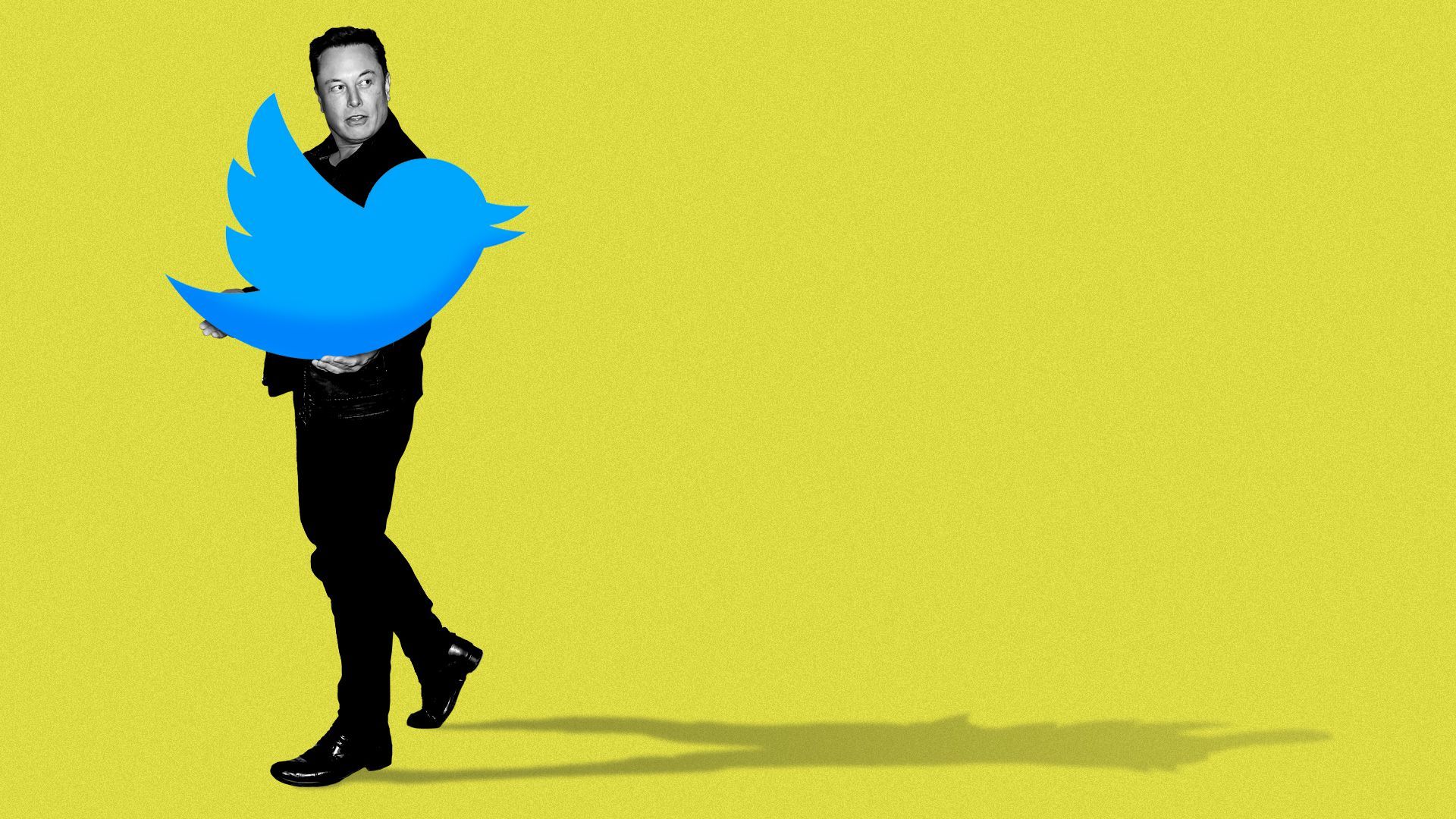
Photo illustration: Sarah Grillo/Axios. Photo: Britta Pedersen-Pool/Getty Images
Right-wing politicians were among those most excited by Elon Musk's purchase of Twitter, while those expressing the most worry were groups representing women, people of color and the LGBTQ+ community.
Why it matters: While it is far too early to know how Elon Musk's ownership will end up changing Twitter, it's worth noting who is most excited and who's most fearful of the shift.
Inside Twitter, vocal skeptics of the deal included people working on everything from the core technology to those responsible for building equitable AI systems. Notably, it's also top of mind for both those doing the hiring and the people Twitter is recruiting.
- "If you're wondering what Twitter employees think, I can only speak for myself: It's a time of genuine discomfort & uncertainty," Twitter's Edward Perez wrote.
- Twitter co-founder Jack Dorsey said he doesn't think any person or company should own Twitter, but praised the sale to Elon Musk as the best strategy: "Taking it back from Wall Street is the correct first step."
Outside the company's walls, many focused on the pros and cons of Musk's promise to promote free speech above all, while others worried about the impact of any one man being in charge of such a key forum.
- Still others questioned how Musk's own business interests, including those in China, could impact Twitter policy. That group included Amazon's Jeff Bezos, who quipped: "Did the Chinese government just gain a bit of leverage over the town square?"
What they're saying:
- American Civil Liberties Union: "While Elon Musk is a card-carrying member and one of our most significant supporters, there's a lot of danger having so much power in the hands of any one individual."
- Electronic Frontier Foundation: "Elon Musk's purchase of Twitter highlights the risks to human rights and personal safety when any single person has complete control over policies affecting almost 400 million users."
- GLAAD: "Twitter should hold to its principles and the industry standard of prohibiting speech that endangers people, spreads misinformation, and incites harassment and abuse," CEO Sarah Kate Ellis said.
Be smart: Some of the biggest changes may come not via policy dictates, but rather through employee turnover.
3. Everything Musk wants to change about Twitter
An edit button
- At the TED2022 conference in April 2022, Musk said he wants Twitter to have an "edit" button.
Worth noting: Twitter confirmed it is working on an edit button, adding, "No, we didn't get the idea from a poll."
Long-form tweets
- Musk commented on a long Twitter thread in April 2022: "My most immediate takeaway from this novella of a thread is that Twitter is *way* overdue for long form tweets!"
Where it stands: Twitter has a 280 character limit. The company increased from a 140 characters in 2017.
Spam bots and authentication
Musk once called spam bots "the single most annoying problem" on Twitter. He tweeted in April 2022: "If our twitter bid succeeds, we will defeat the spam bots or die trying!"
- He wrote in a reply to that tweet that Twitter would "authenticate all real humans" under his ownership.
Open-source algorithm
Musk has said he's concerned about bias being inherent to Twitter's algorithm — which he said he'd solve with an open-source algorithm.
- In late March 2022, he tweeted, "I'm worried about de facto bias in 'the Twitter algorithm' having a major effect on public discourse. How do we know what's really happening?"
Be smart: An open-source algorithm would also make it easier to manipulate Twitter.
Content moderation
Musk has outlined his free speech-first vision for Twitter: He thinks Twitter should not regulate content beyond what is required by the laws of the countries it operates in.
Our thought bubble: It's easier to advocate broad policy change from the outside of a company like Twitter than to enact it from within. It's also worth remembering that Musk has been a mercurial tweeter, and his plans could easily change.
4. Take note
On Tap
- Microsoft and Google report earnings.
Trading Places
- LastPass named Karim Toubba its first CEO as it becomes a standalone company, with LastPass board member Mike Kohlsdorf continuing to lead GoTo (formerly LogMeIn). Toubba is the former CEO of Kenna Security, which was acquired by Cisco in July of 2021.
- Code.org is adding YouTube CEO Susan Wojcicki, Microsoft CTO Kevin Scott and Amazon senior vice president David Treadwell to its board of directors.
- Lyft executive Craig Martell is heading to a Pentagon job leading its AI work, as Breaking Defense first reported.
ICYMI
- OpenSea is buying Gem, an NFT aggregation site, for an undisclosed price. (The Block)
5. After you Login
Who wants to see a dachshund and a turtle playing soccer? Or should I just say, who doesn't want to see that?