Axios Login

August 24, 2018

This will have to last you until Monday, so read slowly.
1 big thing: Platforms fight against a sea of hacks
Illustration: Lazaro Gamio/Axios
Facebook, Twitter and Google all announced that major disinformation campaigns had been thwarted on their services this week. The threats were discovered neither by the companies themselves nor by government agencies, but by an outside firm — and that highlights the complicated nature of this new field of conflict.
The details:
- FireEye, a well regarded security company, tipped off Facebook and Google to attacks traced back to Iranian state media. (See story below.)
- Facebook said Tuesday that it had removed hundreds of pages and accounts linked to both the attack uncovered by FireEye as well as a separate campaign from Russia.
- Later that day Twitter said it, too, had removed hundreds of accounts, including many that appeared to be from Iran.
- Google said Thursday that it had also traced a coordinated campaign on its sites to Iranian state media.
- Microsoft said that last week it had uncovered a new round of phishing attacks that it had traced back to Russia.
The bottom line: The successful defense of a system as complex as the modern internet needs big companies to have sound, well-executed policies (which have been lacking). But it also requires an ecosystem that includes governments that set and enforce laws, nimble small companies that can observe new behavior and act fast to flag it, and an educated user base that can grow smarter over time.
Yes, but: None of this takes the tech giants off the hook. It just means they can’t manage on their own. Wired explored some of the power dynamics in this piece.
What's next: As first reported by BuzzFeed, tech giants including Facebook and Twitter are set to meet Friday in San Francisco to discuss strategy related to the midterm elections and potential interference. (Google, Microsoft and Snapchat were among the other companies invited, though I'm hearing Microsoft won't be represented at the meeting.)
There's also a congressional hearing set for Sept. 5 with top execs from Facebook and Twitter testifying. (As my colleague David McCabe scooped Thursday, Twitter CEO Jack Dorsey has until Friday to decide whether to appear.)
Our thought bubble: Imagine someone had come to you a couple years back and told you that in August 2018 there will be a secret meeting among the top tech platforms to prepare a midterm election strategy — you would have thought they were crazy. And yet, that's our world.
As the responsibilities of tech platforms and political institutions blur together, both find themselves under increasingly sophisticated attacks from abroad that combine the tactics of hackers with the resources of state actors — and it will take a coordinated response to overcome them.
2. Hero of the day — FireEye
As mentioned above, FireEye, a California-based cybersecurity firm, has been credited twice just this week with helping two of the biggest tech companies uncover midterm election threats — and got a stock bump as a result.
Why it matters: While companies like Google and Facebook have the in-house expertise to uncover some malicious activity, third-parties like FireEye are sometimes better equipped to spot malicious activity through their own monitoring.
FireEye has invested more heavily than others in “multi-disciplinary threat intelligence,” said Steve Weber, director for the Berkeley Center for Long Term Cybersecurity. "It includes capabilities that are more like what you'd find in a national intelligence agency — country expertise, language skills, geopolitical savvy."
Go deeper: Read the in-depth look by Axios' Shannon Vavra and Sara Fischer.
3. Business leaders speak out on immigration
Top U.S. CEOs, including the heads of Apple, Cisco, IBM, Pepsico and AT&T, sent a letter to Homeland Security this week expressing their "serious concern about changes in immigration policy."
The letter, which was provided to Axios, argues that the changes are "unfair and discourage talented and highly skilled individuals from pursuing career opportunities in the United States."
The big picture: The Trump administration has imposed several new policies and released memos that have made it much more difficult for highly skilled foreign workers to obtain H-1B visas — and much easier for immigration officials to deport foreign workers who become ineligible.
- Many tech companies in particular rely on these foreign workers to fill the labor and skills gap in the U.S.
Go deeper: Stef Kight has more here.
4. What's inside Magic Leap One's headset
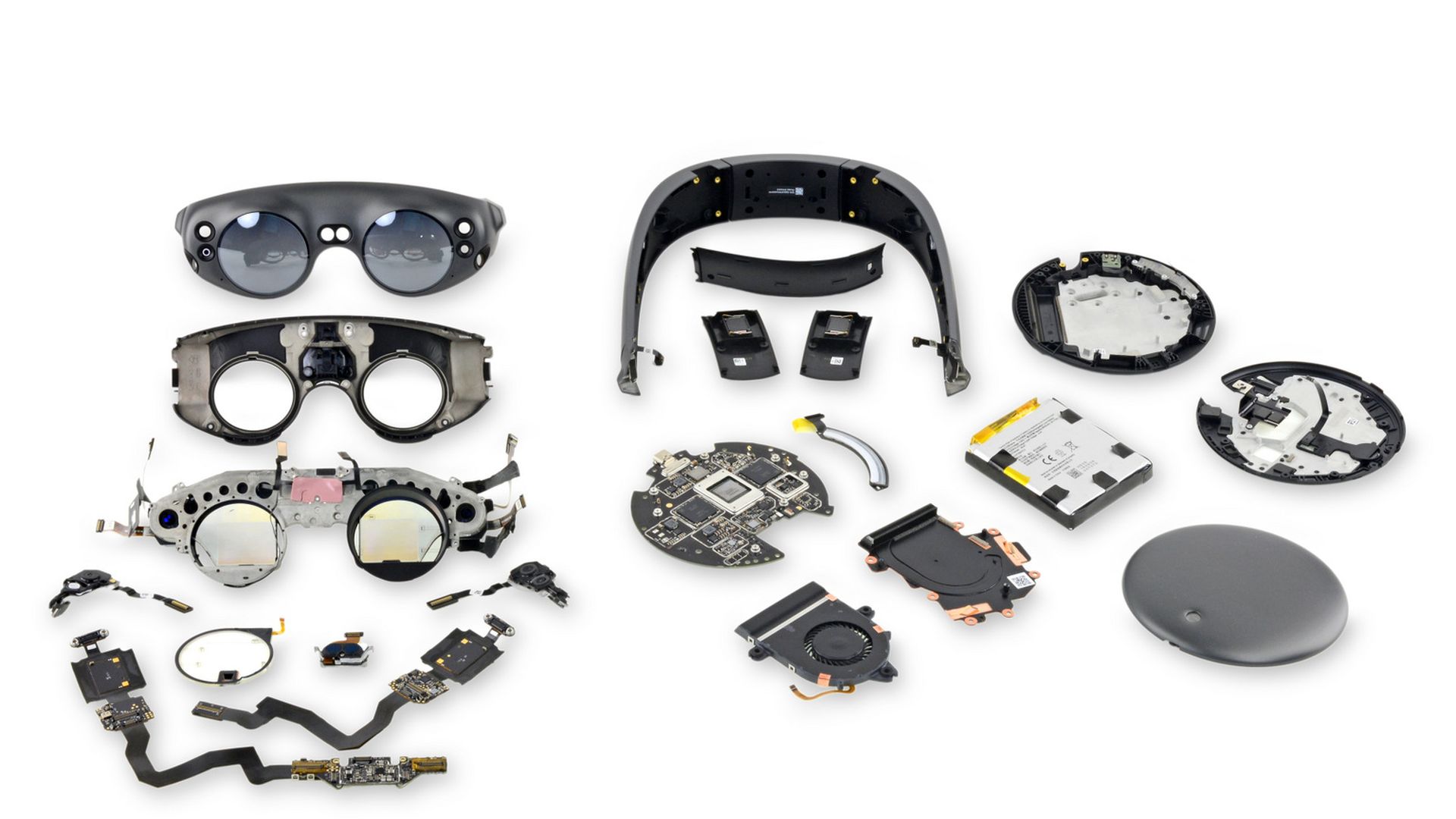
Photo: Ifixit
While it's always interesting to see what's inside the latest iPhone, it's even more fun on an all-new piece of hardware. Which is why you should check out Ifixit's teardown of the Magic Leap One augmented reality headset.
A peek inside: There are lots of pretty pictures and nerdy details on their site, but here are a few of the highlights.
- Nvidia's Tegra X2 is the processor in the computer part, along with memory chips from Samsung and Toshiba.
- The glasses feature a processor from Intel's Movidius unit.
- The battery is about the same size as one found in a tablet.
- And the best nugget: Oculus founder Palmer Luckey offered up access to his device for the analysis.
5. Take Note
On Tap
- It's Friday. No, really.
Trading Places
- Airbnb added former Pixar CFO Ann Mather to its board of directors.
- Facebook hired HP marketing head Antonio Lucio as its new chief marketing officer.
ICYMI
- Iranian hackers appear to keep targeting schools despite indictment, according to Secureworks. (Axios)
- Eventbrite filed for a $200 million IPO. (Axios)
- DJI introduced new versions of its foldable Mavic drone featuring improved cameras, among other upgrades. (TechCrunch)
- 23andMe is shutting down a tool that gave developers access to customers' DNA. (CNBC)
- Filter bubbles can be quite beautiful, at least in a data visualization. (MIT Tech Review)
6. After you Login
Once upon a time, a bunch of colleges set up virtual campuses inside Second Life. Here's what they look like a decade later.