Axios Login

November 08, 2021

Wondering what the healthiest kinds of cheese are? Now you know. (This intro is courtesy of my cousin Madelyn.)
Today's newsletter is 1,123 words, a 4-minute read.
1 big thing: Apple-Facebook fight moves to metaverse
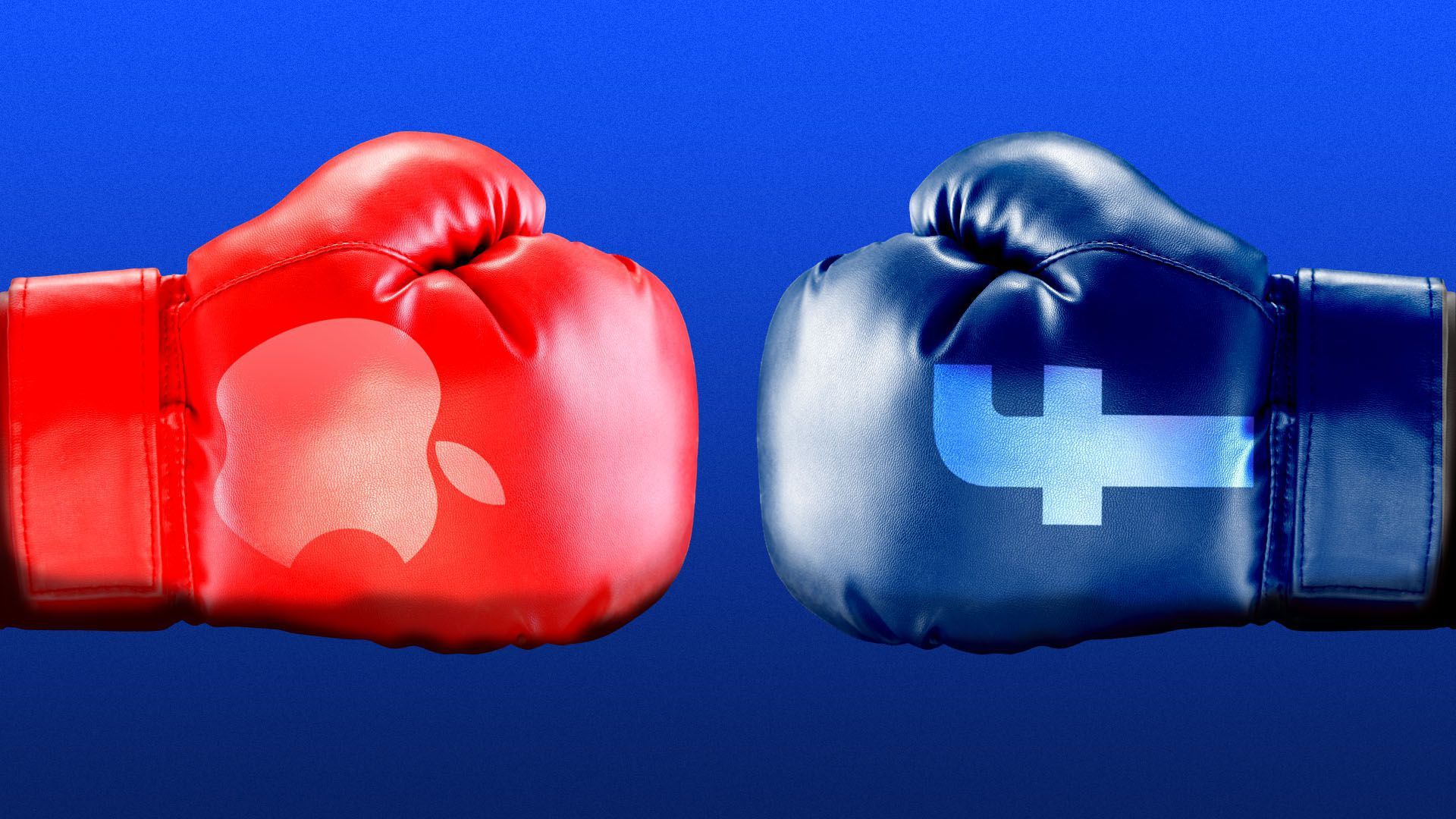
Illustration: Sarah Grillo/Axios
Facebook's pivot to the metaverse is also a move to check Apple in the tech industry's long-term game of "what's next," Axios' Scott Rosenberg reports.
The big picture: Tech's leaders view their story as a series of shifts from one dominant platform to another. Each transition is a moment of peril to incumbents and opportunity for newcomers.
Between the lines: Beltway insiders and Facebook critics like to position Facebook's name change and metaverse push as a hand-waving effort to distract the public from the firm's antitrust perils and from leak-driven stories about Facebook's responsibility for real-world harms.
- To industry leaders, those headlines are the distraction, and the struggle to control the next platform is the fight that matters.
Today, Mark Zuckerberg is leading the metaverse charge because he wants to make sure that Apple doesn't own whatever comes after the smartphone — which Silicon Valley assumes will be some mix of headsets and goggles, mixed-reality applications and remote presence.
Meta, formerly known as Facebook, is now investing heavily in all kinds of hardware — VR, AR, smart home devices and more — to try to make sure Apple doesn't own the next generation of devices. But first movers don't always win platform wars.
- Apple's pattern is to let other companies rush to market with half-baked products, and then swoop in to seize the public imagination and win a market’s profitable high ground.
- That's how it defined the smartphone era with the iPhone's 2007 release.
Facebook and Apple have long been at odds over privacy, ad rules and other concerns. The companies' conflict stretches back to when the mobile-device explosion the iPhone kicked off nearly boxed Facebook out of the future.
- Back then, Facebook resisted building its own iPhone app at first, and ultimately had to resign itself to tenancy on operating system platforms controlled by other companies.
Facebook prospered, but the era left deep scars, as Zuckerberg admitted in his presentation ushering in Facebook's rebranding as Meta:
- "This period has also been humbling because as big of a company as we are, we've also learned what it is like to build for other platforms, and living under their rules has profoundly shaped my views on the tech industry."
- Flashback: Apple's move in 2019 to lock out Facebook's employees from their own applications was a particularly humiliating moment for Zuckerberg and his team.
Yes, but: Even when today's tech giants are colliding, they're bound together as well.
- Facebook owns three of the top-10 iPhone apps. Apple sells more devices because people want to use those apps. These companies may not like each other, but they will continue to cooperate whenever they can profit together.
Of note: Microsoft and Google also have major investments in AR and VR. Amazon is betting big on voice assistants and smart home gadgets.
Be smart: Sometimes the future unfolds the way the industry expects, and sometimes — as in the mid-1990s web explosion — the future takes everyone by surprise.
2. Infrastructure bill's broadband billions

Illustration: Shoshana Gordon/Axios
The infrastructure bill heading to President Biden's desk includes $65 billion to improve high-speed internet access and affordability, Axios' Margaret Harding McGill reports.
Why it matters: The pandemic proved the necessity of connectivity to participate in daily American life, and Biden's administration acknowledged that by including this funding in the infrastructure package.
By the numbers: The funding is aimed towards building high-speed internet networks, helping low-income families pay for service and digital equity programs.
- $42.45 billion in grants to states for broadband projects, which can range from network deployment to data collection to help determine areas that lack service.
- $14.2 billion to provide $30 per month to low-income Americans for internet service. It will replace a $50-a-month Emergency Broadband Benefit program, offering less money monthly, but increasing the number of those eligible.
- $2.75 billion for digital inclusion and equity projects, such as improving digital literacy or online skills for seniors.
- $4 billion for rural broadband construction programs.
- $1 billion to build "middle mile" infrastructure to connect local providers to larger internet access points.
- $600 million for private activity bonds to finance broadband deployment projects in rural areas.
Between the lines: Early fears from cable and telecom companies that Biden's broadband plan would lead to government-backed competitors in their service footprints or price regulation went unrealized.
The intrigue: The power player on broadband funding will be the Commerce Department, because its telecom division has a key oversight role in how the $42.45 billion in state funding will be spent.
3. New Senate bill could block Big Tech mergers
Sens. Amy Klobuchar and Tom Cotton arrive at the Capitol for the impeachment trial of President Trump on Jan. 21, 2020. Photo: Tom Williams/Getty Images
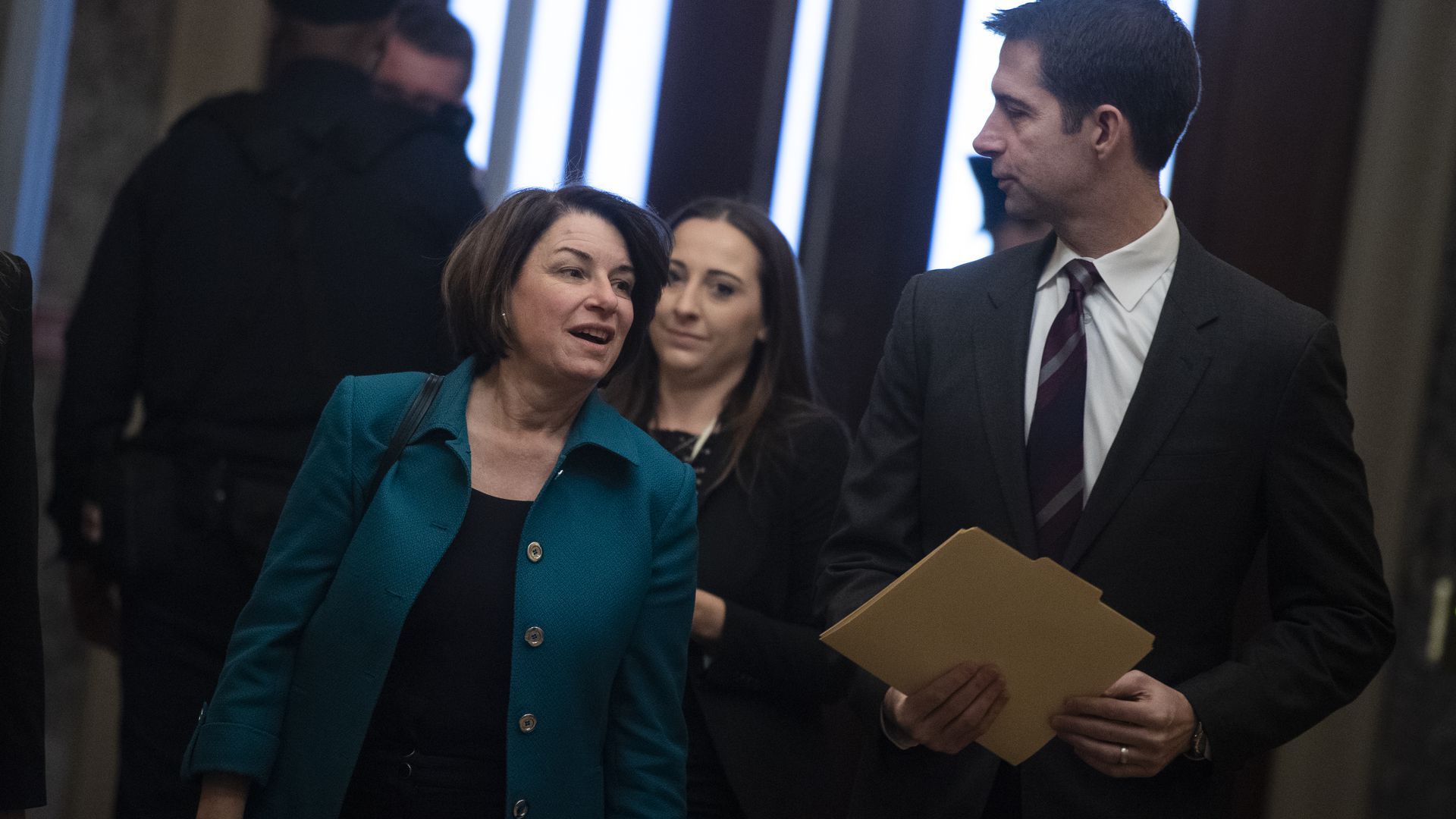
Sens. Amy Klobuchar (D-Minn.) and Tom Cotton (R-Ark.) introduced a bill Friday that would make it more difficult for Big Tech to acquire rival companies, Axios' Ashley Gold reports.
Driving the news: The Platform Competition and Opportunity Act is a Senate companion bill to a similar House bill of the same name. It's motivated by a belief that acquisitions like Facebook's parent company Meta buying WhatsApp and Instagram have harmed consumer choice and competition.
What they're saying: "Big Tech firms have bought up rivals to crush their competition, expand their monopolistic market share and to harm working Americans," Cotton said. "That's bad for America."
- The bill would give enforcers, like the Justice Department, more authority to stop acquisitions by "dominant platforms" of competitors, or acquisitions that would expand a firm's market position.
- It would also shift the burden of proof to a company that wishes to buy or merge with another to show it's not anticompetitive.
4. Mayor-elect defends bitcoin paycheck plan
Eric Adams, the newly elected mayor of New York City, told CNN's "State of the Union" Sunday that his plan to receive his first several paychecks in bitcoin is intended to encourage New York to become a "center of innovation," Axios' Ivana Saric reports.
The big picture: Adams later told reporters that exploring the option of bitcoin payments could lead to giving New Yorkers a "a choice of how they want to receive their paychecks," according to Bloomberg.
- He added that some in the blockchain community see the city as overly bureaucratic, but that he wants to make it a hub for new technologies, per Bloomberg.
5. Take note
On Tap
- Fortune holds its Brainstorm AI conference in Boston, while Nvidia hosts its GPU Technology Conference online.
- Earnings reports today include PayPal and Roblox.
Trading Places
- Matt Huang, co-founder and managing partner at Paradigm, is joining Stripe's board of directors.
ICYMI
- Viasat, a large U.S. satellite communications provider, announced the $7.3 billion acquisition of British rival Inmarsat. (Financial Times)
- One of the hobbies that enjoyed a resurgence amid the pandemic has been taking care of Neopets, 2000s-era digital pets. (New York Times)
6. After you Login

Image: Lego Education
The first Lego minifigures are going to space. Kate and Kyle are set to blast off aboard the upcoming, otherwise unmanned Artemis 1 mission. It's part of a broader collaboration between Lego's education unit and NASA.