Axios Login

November 01, 2021
Don't worry. We gave out most of the candy, but saved a few treats for you.
Today's newsletter is 1,148 words, a 4-minute read.
1 big thing: Metaverse's awkward truth

Illustration: Annelise Capossela/Axios
The cavalcade of wonders in Mark Zuckerberg's metaverse show last week left out one crucial screenshot: what your body actually looks like while your mind has gone meta.
The catch: The real you is just sitting in a chair wearing goggles, Axios' Scott Rosenberg writes.
The video mock-ups of the metaverse Zuckerberg unveiled showed us what remote-presence wizardry might look like from within the 3D dimension. But they omitted the prosaic reality of most current VR.
- Today's headsets mostly block out the "real world" — and sometimes induce wooziness, headaches and even nausea.
Why it matters: If you fear screen time atrophies your flesh and cramps your soul, or find Zoom drains your energy, wait till you experience metaverse overload.
The big picture: Facebook's metaverse project aims to move more of our lives to a 3D game world.
- The vision is to liberate our digital existence from the confines of the screen, restore our freedom of movement on a more "embodied" internet and enable deeper interpersonal connections in a social environment where we can see and interact with other people.
Yes, but: Right now, the metaverse isn't "embodied" at all. It's an out-of-body experience where your senses take you somewhere else and leave your body behind on a chair or couch or standing like a blindfolded prisoner.
Mixed reality and augmented reality tech and techniques promise to heal that rift and make 3D work and play a more mobile physical experience.
- There are fledgling efforts in this direction — like some fitness apps, the "Beat Saber" game Zuckerberg praised in his talk and the experimental pass-through video features, mixing real and digital fields of vision, that Oculus introduced last summer.
Of note: Safety will always be a concern. Remember those videos of Wii users smashing their TVs? That's just a preview of what can go wrong when our bodies are moving around real objects while our minds are in virtual space.
What's next: AR glasses of the future could help deliver a more seamless blending of real world and metaverse. But lightweight, affordable glasses with all-day battery life are years off.
In the meantime, observers expect a metaverse that's delivered to the public piecemeal.
- Aspects of it will turn up first in gaming worlds like Roblox and Fornite and crypto-based products like NFTs rather than 3D virtual offices and parties.
The bottom line: It's possible to imagine an "at-best" scenario in which VR — powered by more fluid tech, innovative fitness applications and passthrough features that mix real and digital fields of vision — becomes truly embodied.
- But the business realities of the social internet and the likelihood of slow incremental improvements in today's hardware make the worst case look like a much better bet.
Go deeper: What the author who coined the term "metaverse" thinks about Facebook's plans
2. Big Tech finally reckons with climate denialism

Illustration: Annelise Capossela/Axios
Tech companies are cracking down on climate misinformation ahead of this year's UN COP26 climate summit, in an effort to get ahead of an expected surge in climate misinformation during the global conference, Axios' Sara Fischer reports.
Why it matters: Internet platforms have let climate denialism run rampant for years. Their new efforts to curb climate misinformation come in the wake of a more serious global conversation around the crisis.
- Ahead of the conference, which began Sunday, experts warned that misinformation could undermine the event.
Driving the news: Twitter on Monday rolled out a new program designed to "pre-bunk" climate misinformation, or get ahead of false narratives about climate by exposing people to more accurate information about the crisis on its platform.
- Last month, Google and its subsidiary YouTube took a much more drastic step, announcing a new policy that prohibits climate deniers from being able to monetize their content.
- In September, Facebook introduced new measures intended to counter misinformation about climate change after expanding an online portal meant to counter such misinformation in February.
Yes, but: Most of the recent actions taken around climate misinformation aren't as aggressive as other efforts tech firms have taken to ban other types of misinformation.
The big picture: Long before anti-vaccination content and election denialism became society's biggest misinformation headaches, false claims that scientists were divided over climate science findings spread widely online with little intervention from Big Tech platforms.
- Most major tech firms have announced climate pledges, alongside the majority of corporate America.
3. Roblox suffers three-day outage
Roblox was back online Sunday night following an outage that stretched over three days.
Why it matters: By virtue of Roblox's success, an outage on its service not only affects the virtual world startup but all of the creators who have come to depend on the company, too.
Yes, but: Roblox has said it "will implement a policy to make our creator community economically whole as a result of this outage," with more details to come soon. Roblox also said it doesn't believe any user data was lost.
What they're saying: CEO David Baszucki apologized for the length of the outage on Sunday.
- "A core system in our infrastructure became overwhelmed, prompted by a subtle bug in our backend service communications while under heavy load," Baszucki said.
4. Charted: The Facebook attention gap
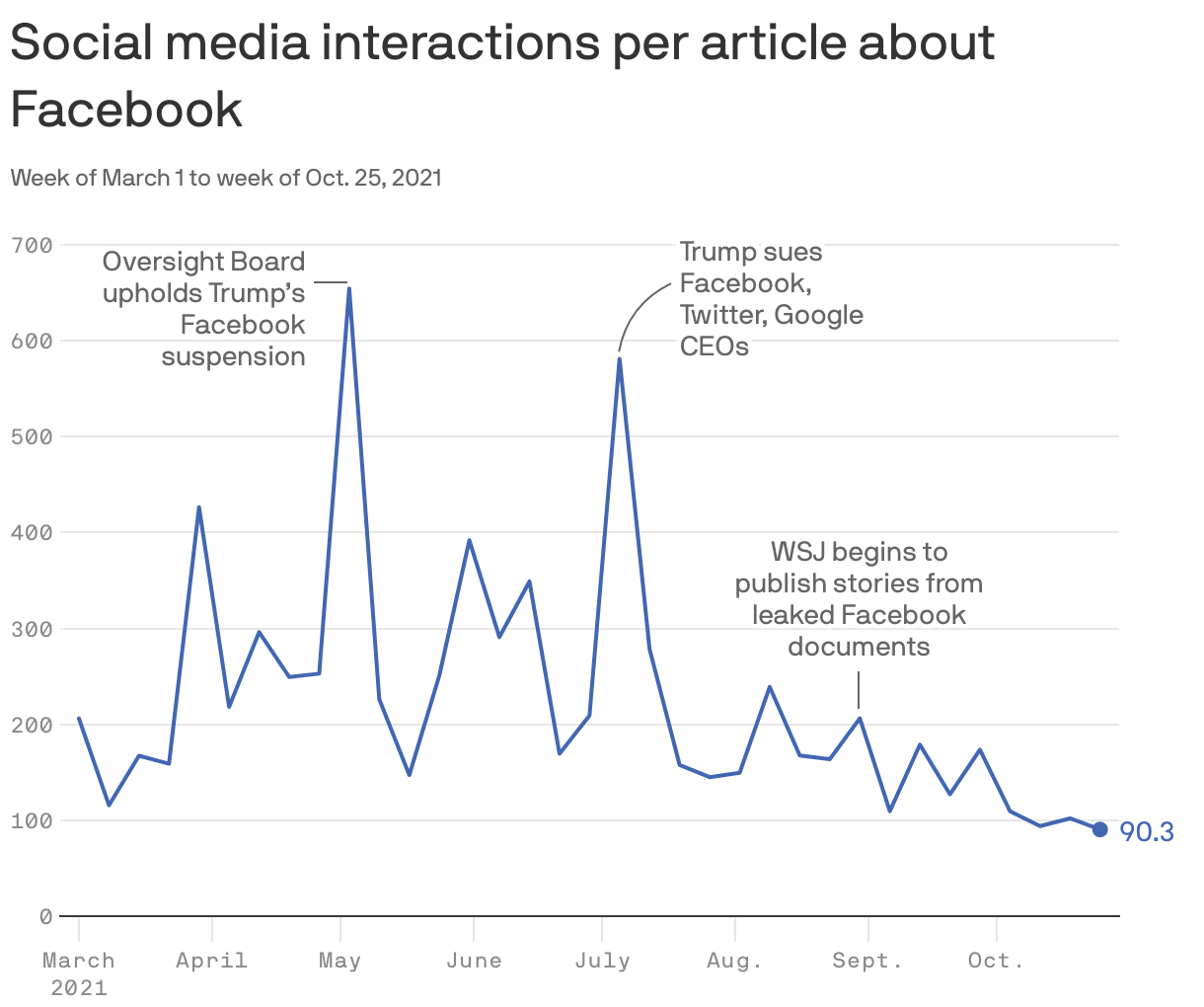
The Facebook Papers based on whistleblower documents were a public relations nightmare for Facebook, but so far, the company's core stakeholders — advertisers, users and investors — seem unfazed, Axios' Sara Fischer and Neal Rothschild report.
The big picture: For now, this controversy is mainly of interest to the media and lawmakers, at least if reader engagement is an indicator.
By the numbers: Interest in Facebook — measured by social media interactions per published article about the company — has declined over the course of the year, according to exclusive data from NewsWhip.
- The biggest jumps in engagement on stories about Facebook have come from stories about former President Trump.
- Google Trends data show a similar decline in Google searches for Facebook over the past year.
- WSJ's most-engaged story from its Facebook investigations ranked 48th in social media interactions among all of the publication's stories since March, according to NewsWhip data.
5. Take note
On Tap
- Web Summit takes place this week in Lisbon.
Trading Places
- TripAdvisor marketing director Luke Tarbi is joining event space marketplace Peerspace as its first chief marketing officer.
ICYMI
- A Financial Times analysis estimates that Apple's ad-tracking changes cost Snapchat, Facebook, YouTube and Twitter nearly $10 billion for the second half of this year. (Financial Times)
- Facebook parent company Meta said Friday it is acquiring Within, maker of the VR fitness service Supernatural. (The Verge)
- Two transgender Netflix employees (one current, one former) have filed charges against the company with the NLRB, alleging unlawful retaliation over protected activities. (The Verge)
6. After you Login

I warned Harvey if he played so much Nintendo Switch that he would turn into one. It finally happened.
Here's my review of the "new console" pictured above:
- Pros: Big screen, seemingly endless battery life.
- Cons: Hard to control and noisy. Haven't been able to find an off button.
Sign up for Axios Login

Taking you inside the AI revolution, and delivering scoops and insights on the technologies reshaping our lives.